Agile Wasn't Built for AI. AfterAgile™ Is.
Z Experience Collective unveils a six step AI product development method that prioritizes smarter decisions and customer needs.
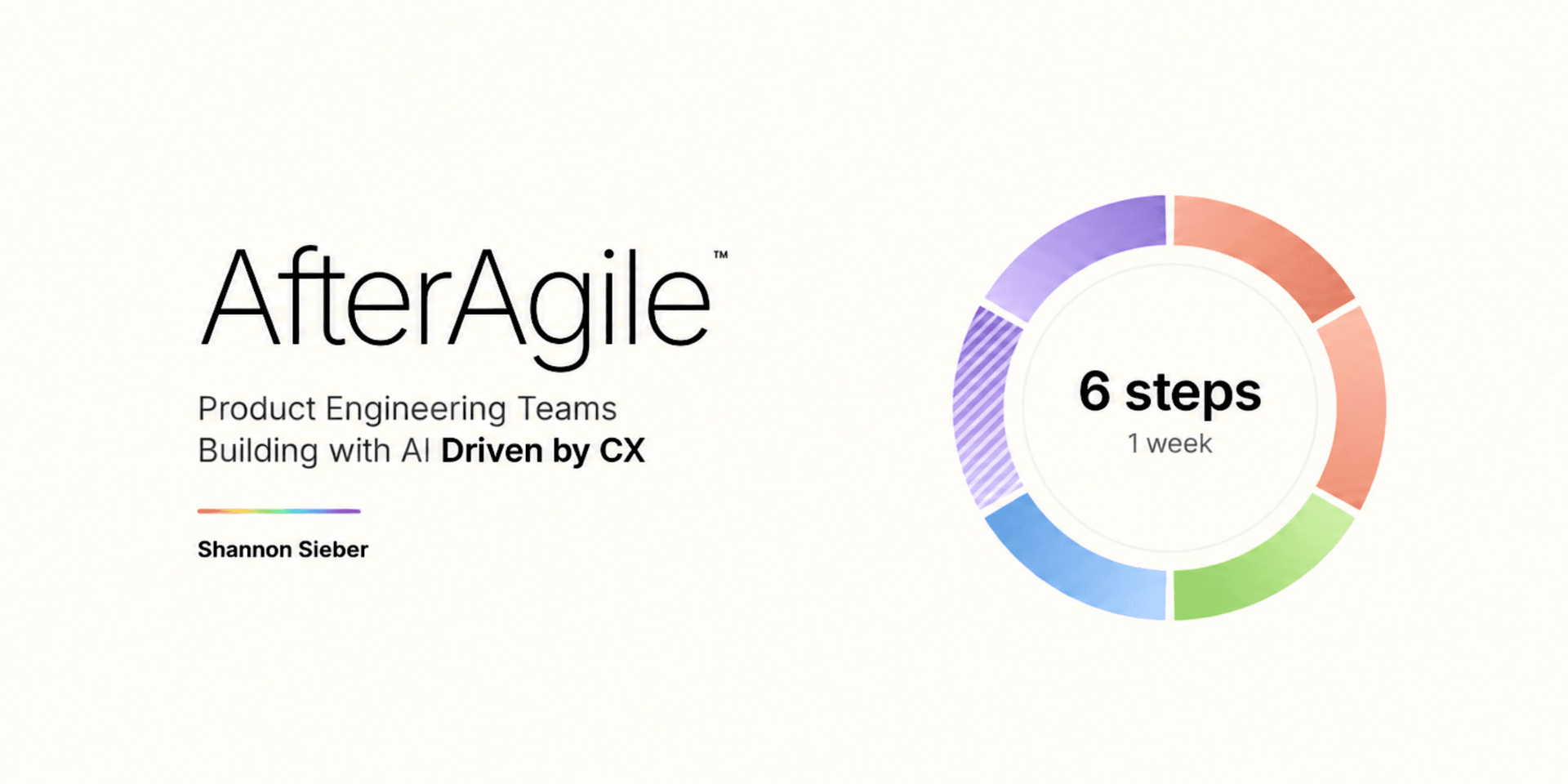
AI has collapsed the cost of building software. A feature that once filled a two-week sprint can now ship in an afternoon. What hasn’t changed is how long it takes to decide what’s worth building — and to know whether it worked. Z Experience Collective is addressing that gap with AfterAgile™, a product development method that puts the customer back at the center of every decision, every week.
The company has released its complete 84 page AfterAgile™ playbook free of charge, giving organizations a practical framework for adapting their product engineering development processes to an AI enabled environment.
When Building Becomes Faster Than Deciding
For years, Agile provided product teams with a structured rhythm built around sprints, standups, reviews, and retrospectives. These practices helped teams coordinate work and deliver improvements in manageable stages. However, AI is changing the pace of software development. Tasks that once required extended development cycles can now be completed much faster, creating a growing gap between the speed of execution and the time needed to establish priorities.
According to Shannon Sieber, CEO of Z Experience Collective and creator of AfterAgile™, this shift calls for an entire revamp of how our product/engineering teams approach product development.
“We removed the friction that forced us to think,” Sieber said. “The handoffs and sprint reviews were slow, but that’s where someone asked, ‘Should we build this at all?’ Now teams can build faster than they can decide. AfterAgile™ puts the thinking back where it belongs, and puts the customer first.”
The method responds to a central question for modern product organizations: how can teams take advantage of AI assisted development without allowing speed to replace judgment? AfterAgile™ aims to answer that question by organizing work around customer intent, shared responsibility, and a weekly feedback loop.
A Six Step Method Built Around the Customer
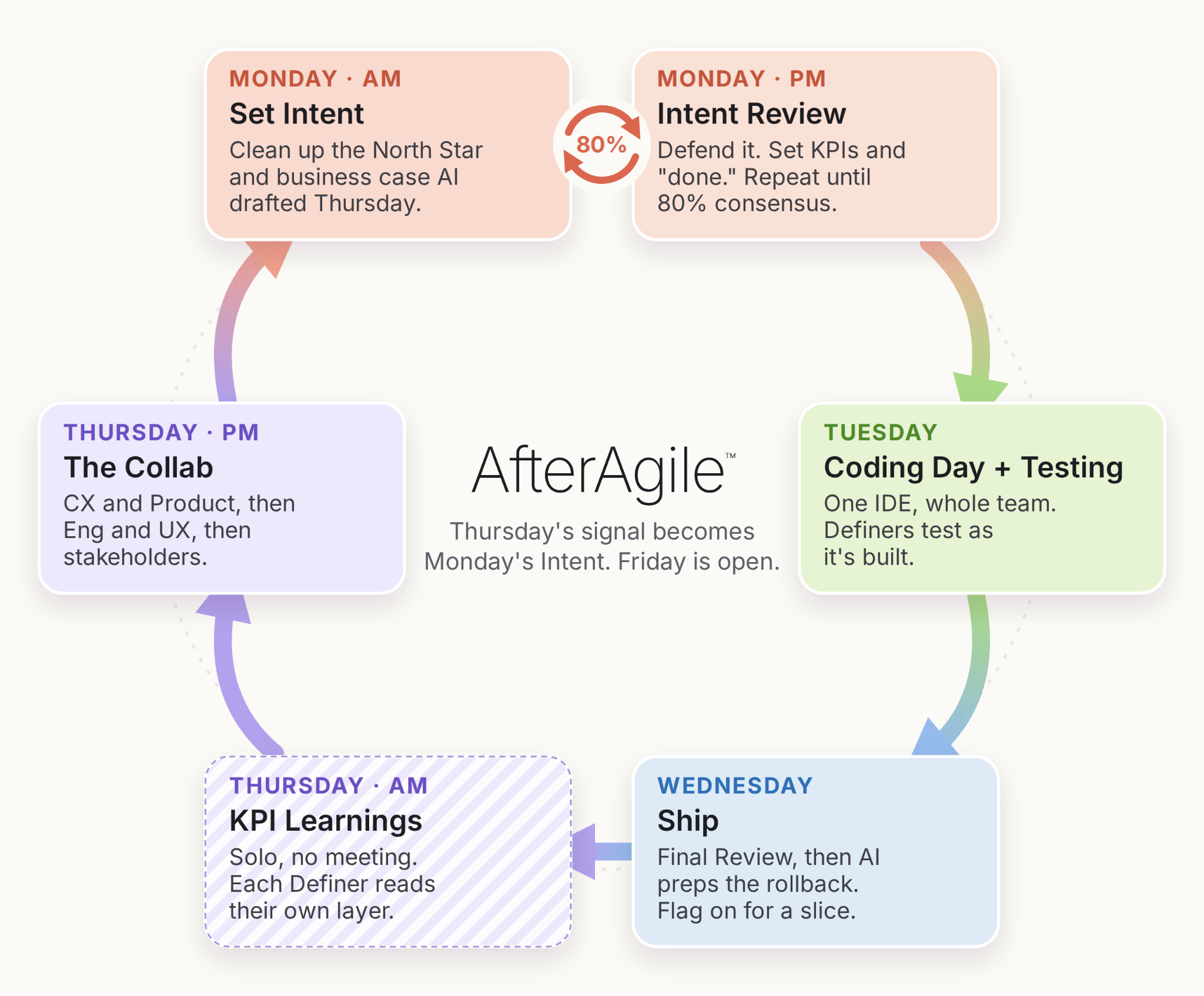
Rather than organizing the process primarily around ceremonies and time blocks, AfterAgile™ establishes a repeatable system that connects planning, development, release, and learning. Its core practice follows six steps across Monday through Thursday, leaving Friday open for other priorities.
- On Monday, AI helps draft the week's Intent using customer signals. Customer Experience (CX) and Product refine the proposed direction, while Product presents and defends it with stakeholders until the group reaches 80 percent consensus. The purpose is to establish a shared understanding of what deserves to be built before development begins.
- Tuesday is dedicated to coding and testing. CX, Product, User Experience (UX), and Engineering work together in a shared AI native workspace. Testing takes place throughout development, allowing the team to evaluate its work as it progresses rather than waiting for a separate testing stage.
- Wednesday focuses on shipping. Following a Final Review in the morning, the team releases the change to a portion of customers behind a feature flag. A tested rollback plan provides a way to reverse the change if necessary.
- Thursday completes the cycle through KPI Learnings and The Collab. Each owner reviews results within their area of responsibility. An AI moderated afternoon session then brings the team together to interpret actual customer behavior and use those insights to shape the following Monday's Intent.
- Friday is open on purpose. It is not a fifth workday to fill. AfterAgile™ protects it as unstructured time — space for teams to think, explore, or simply step back. The value isn’t in what gets done on Friday; it’s in what Monday through Thursday can accomplish when people know they have room to breathe.
Together, the six steps create a continuous process in which customer needs inform decisions, teams build and test collaboratively, and real world results influence what happens next.
Redefining Responsibility Across Product Teams
The principle at the heart of AfterAgile™ is simple: whoever defines it, tests it. The people who decide what "right" means are the people who check whether the result got there. There is no separate QA handoff, no backlog of tickets waiting for someone else to review, and no end-of-sprint retrospective — the week closes its own loop every Thursday.
- CX defines the customer's needs.
- Product establishes the business case and success measures.
- UX is responsible for the brand, interface, and workflow.
- Engineering maintains the guardrails that keep development safe.
Instead of passing work between teams and waiting weeks to discuss what happened, every role stays accountable from intent to outcome within the same seven days.
“Agile told engineering how to work,” Sieber said. “It never told the 4 groups how to agree on what to build, or how to know, in the same week, whether it worked. That’s the problem AfterAgile™ solves.”
The distinction is important as AI makes it easier to produce software quickly. Faster development can increase output, but output alone does not establish whether a product improvement is useful. By connecting customer intent to measurable results, AfterAgile™ seeks to make decision quality an integral part of the development process.
A Free Playbook for Organizations Ready to Adapt
Z Experience Collective has made the complete AfterAgile™ playbook available at no cost, allowing teams to examine the method and consider how it might fit their existing operations.
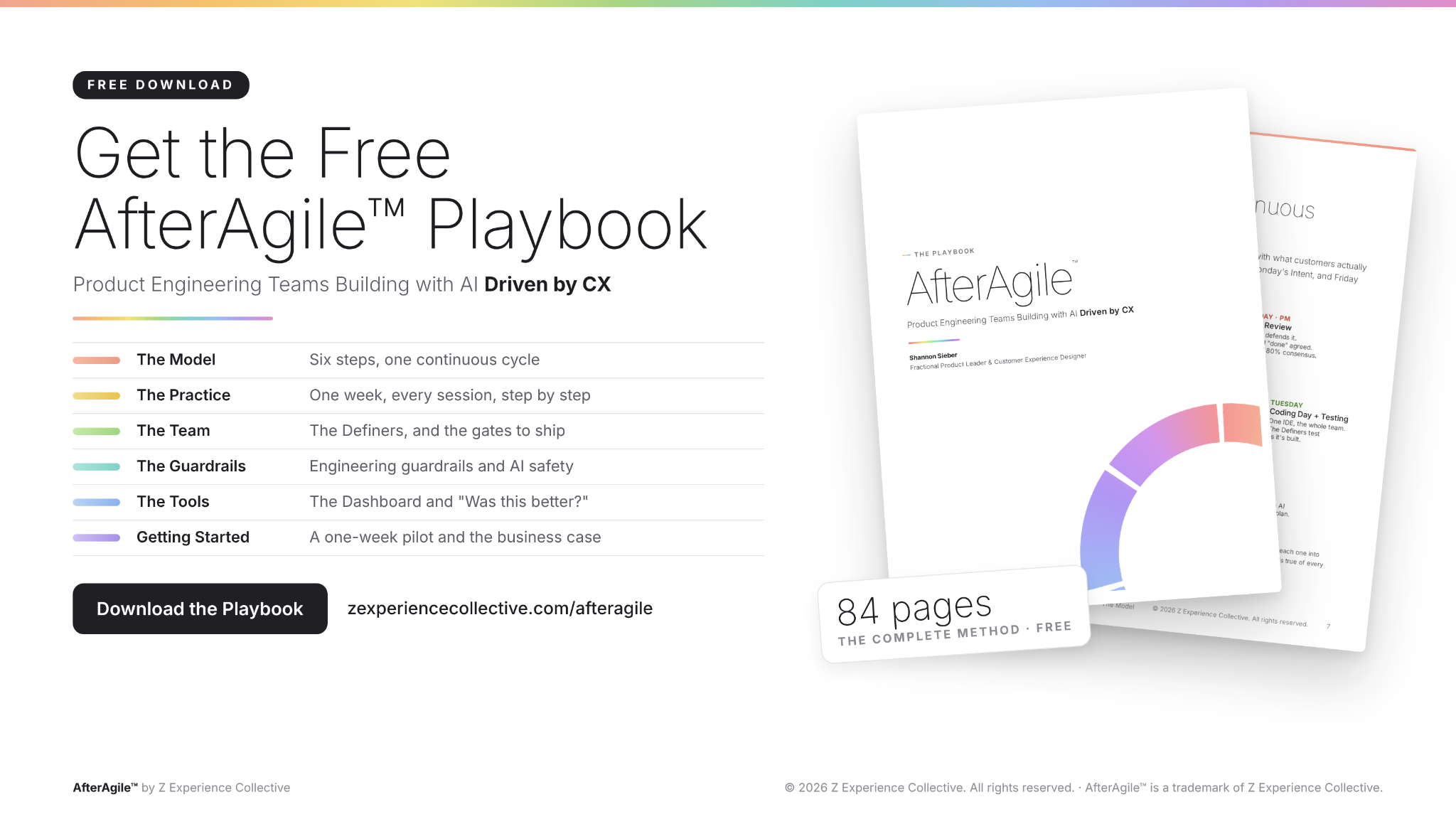
The 84 page resource covers the underlying model, weekly practices, team roles, engineering guardrails, AI safety, a one week pilot plan, and a business case. Organizations can use the framework independently or work with Z Experience Collective, from an initial one week pilot to a broader transition for an existing product.
The company is also preparing two additional offerings. The Dashboard is a planned SaaS model, launching Q1 '27. It will provide a single live view where aggregate inputs are displayed and AI source is captured, replacing the traditional backlog board and ticket queue. AfterAgile™ Certification is planned for later this year. It is for practitioners working in CX, Product, UX, and Engineering.
The playbook's free availability gives organizations an opportunity to understand the approach before deciding whether to adopt it. It also reflects the company's emphasis on making the methodology publicly accessible to teams exploring how AI changes their development practices.
Putting AI Speed to Better Use
AfterAgile™ arrives at a time when businesses are reconsidering how their teams organize work, evaluate ideas, and measure progress. AI can accelerate development, but the decisions surrounding a product still require context, collaboration, and an understanding of customer needs.
For Z Experience Collective, the answer is not simply to add more automation to an existing process. It is to create a working system in which teams can make decisions, deliver changes, and learn from customer behavior within a consistent cycle.
The method offers a structured alternative for organizations seeking to connect AI assisted development with customer-centered product decisions. Its emphasis on shared responsibility and measurable outcomes provides a framework for considering not only how quickly teams build, but also whether they build the right things.
Those interested in working directly with Z Experience Collective can learn more at zexperiencecollective.com, email hello@zexperiencecollective.com to schedule a call. Or call +1 619 374 6555 to discuss a pilot or a broader transition.
About Z Experience Collective
Z Experience Collective is a San Diego based customer-centered consultancy co-founded by Shannon Sieber, CEO, and Michael ZeMans, President. Its offerings, AfterAgile™ and
Holistic CX™.
Sieber brings 20 years of experience in product, UX, and customer experience across healthtech, fintech, e-commerce, and telecommunications, and holds six health tech patents. ZeMans, a 2005 Webby Award winner, brings expertise in digital transformation, UX and CX with a specialization in digital transformation (DX).
AfterAgile™ and Holistic CX™ are trademarks of Z Experience Collective.