
AI Built by Marketers vs. AI Built for Marketers: What’s the Difference?
Learn how AI built by marketers differs from AI built for marketers, and why marketing expertise matters when choosing the right AI technology.

AI tools for marketers are everywhere. They all promise to score leads, analyze customers, build content, and automate marketing workflows. Yet many marketing teams still face the same dilemma.
When the AI tool generates hundreds of ideas and data points and delivers impressive output in seconds, many marketers still struggle to decide what to do next. The tool was supposed to remove assumptions and ease decision-making, but it often does the opposite.
This is where it becomes important to make a clear distinction:
There is a difference between AI built for marketers and AI built by people who understand marketing problems from the inside. That difference lies in how they develop the technology and what they prioritize.
Why Does the Origin of an AI Tool Matter?
Many AI marketing tools start with a technology-first approach. They ask, “What can AI do?” and then try to apply it across several niches; marketing just happens to be one.
By contrast, an AI tool built by marketers takes a problem-first approach. Because of their experience, they focus on the problems marketing teams face and use AI to build solutions.
That single difference in approach shapes everything that follows.
It influences what gets built, what gets measured, what the interface prioritizes, and whether the product helps a marketing team achieve its intended outcomes.
An AI tool built for marketers may claim to “automate content creation.” One built by marketers will focus on automating the kind of content most likely to move targeted buyers.
Both approaches would create useful products, but the results would differ.
This problem-first approach is illustrated by Anthony Skinner, founder of Pressfit.ai, whose firsthand experience in using AI to solve marketing problems led to the company.
Why PressFit Took a Problem-First Approach
The story behind PressFit started with a problem that had nothing to do with building a marketing software company.
Anthony Skinner was building a cybersecurity business, Vectra, and needed outbound messaging that would drive real buyer responses. He decided to shun the usual approach of spending on marketing agencies or guessing what would work.
Instead, he built AI agents.
The system tested thousands of message variations against actual buyer behaviour. What he discovered challenged a basic assumption in the cybersecurity industry.
As Skinner describes it:
“Every cybersecurity company in the world leads with the same message: your data is at risk. We tested that assumption with AI. It was wrong.”
The messages that performed better focused on something very different: operational disruption, internal accountability, and the personal consequences of being the person who failed to act.
Skinner says that approach helped Vectra grow from being a side project into a thriving business in under eight months.
Importantly, Skinner’s marketing success showed why many AI tools built for marketers fail to deliver. Most are based on assumptions that do not reflect current realities. PressFit grew out of his problem-first approach and firsthand experience testing what actually works.
The PressFit team brings practical marketing experience to developing AI technology designed to help businesses improve visibility, identify opportunities, and make better decisions.
The goal is not to be another AI tool, but to replace assumptions with evidence and use technology and marketing expertise to solve real problems.
Why Marketing Experience Shapes Better AI Decisions
Many AI marketing tools focus on what the software can deliver: more content, deeper analysis, or better campaign automation. The problem, however, is that marketers don’t get paid for simply producing more output. They get paid for making better decisions that lead to better business outcomes.
That means an AI tool’s value depends heavily on the questions it helps answer. This is where real marketing experience changes the game.
Marketing professionals understand the relationship between strategy, implementation, and evaluation for growth. They also know what takes time, which metrics matter, and what insights drive decisions.
Instead of focusing only on what technology can do, AI built by experienced marketers often focuses on what users need to accomplish. This creates products that align more naturally with real-world workflows and better support decision-making.
Marketing experience influences:
- Feature priorities
- Workflow design
- Reporting requirements
- Campaign optimization
- Customer understanding
- Performance measurement
- Strategic planning
This brings about a solution that is more intuitive and useful for users. As a result, marketing teams don’t need to waste time figuring out how the technology works; instead, they focus on getting value from it.
How AI Built by Marketers Solves Different Problems
Unlike typical AI developed for marketers, AI built by marketers often does not simply aim at task automation. It focuses on key business issues, such as identifying opportunities and useful actions.
Platforms developed by marketers can detect content gaps, visibility issues, audience trends, and competitive opportunities, providing valuable information rather than a mass of data.
“Built by marketers” should not simply mean the founding team has worked in marketing. A more useful question is whether the product reflects how marketers think about problems.
The value is therefore not necessarily in the AI alone, but in the feedback loop it creates.
AI created for marketers often doesn’t lack capabilities. It falls short in translating those capabilities into marketing results.
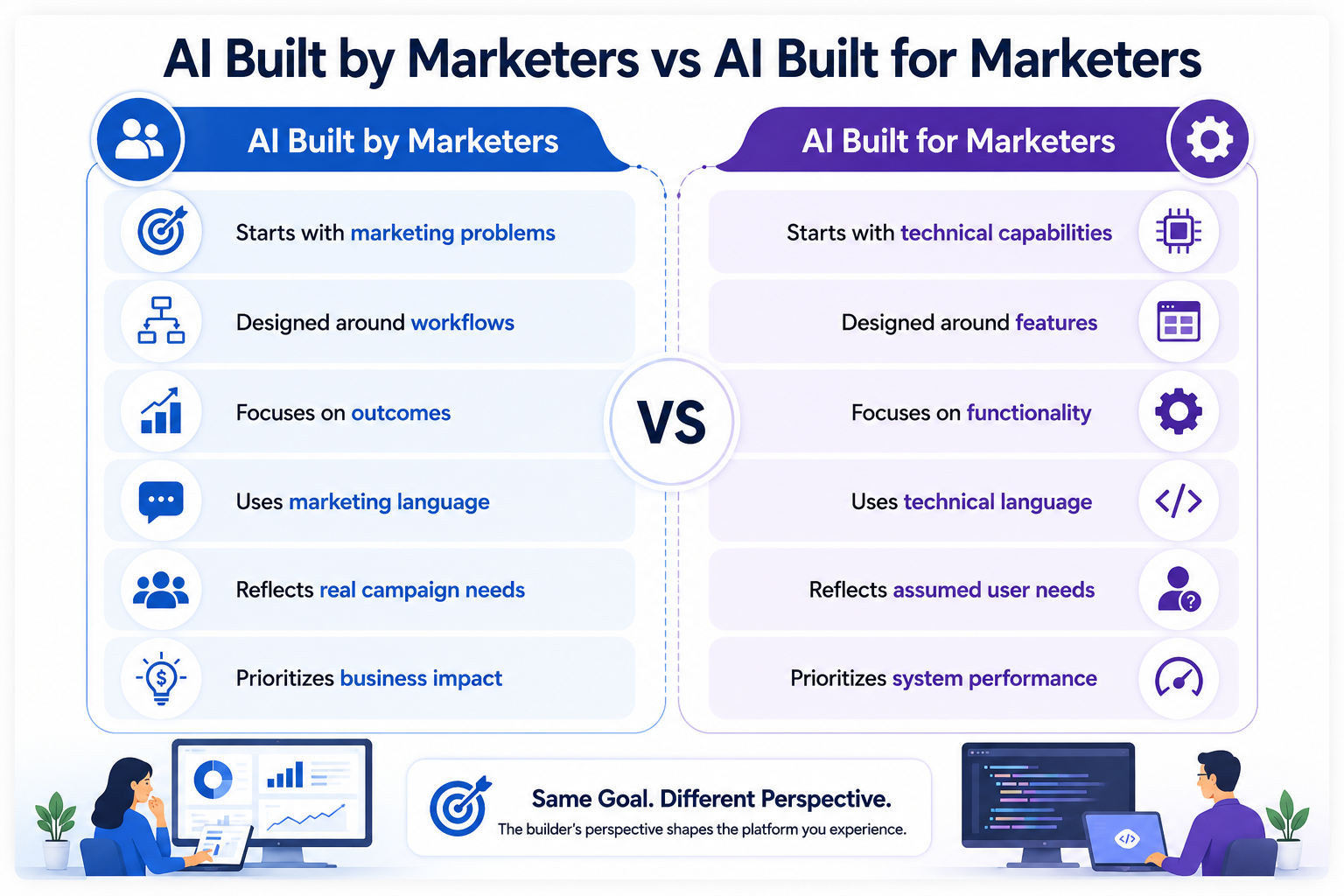
So the distinction between AI built for marketers and AI built by marketers isn’t about superiority. It’s about how the development philosophy shapes usability and the success of the teams that use it.
What Businesses Should Look for When Evaluating AI Marketing Platforms
Choosing the right AI marketing platform should go beyond comparing features. Businesses should focus on whether the platform delivers actionable insights, fits existing workflows, and supports measurable marketing results.
Here are five important questions to ask:
1. What decision does this help my team make?
If the answer is unclear, the platform may be generating information, not intelligence. Look for AI that identifies specific opportunities, performance issues, and practical next steps, not just data.
2. What evidence supports the recommendation?
Marketers should understand where an insight came from and why it deserves attention. Recommendations should reflect the company’s industry, audience, and goals. Generic advice offers limited strategic value.
3. Does this fit the way my team already works?
The best tool in the world is not useful if the team avoids opening it. The platform should work smoothly with analytics, CRM, content management, and advertising tools to reduce manual work and provide a complete view of marketing performance.
4. What happens after the insight?
Marketers should understand how insights are generated, what data is used, and why specific recommendations are made. A recommendation should lead to direct actions that produce better results.
5. Can we measure what happened next?
The ultimate test is not how impressive the AI looks. It is whether the decision it influenced produced a better result. The right platform should contribute to meaningful outcomes, such as better visibility, stronger campaign performance, new growth opportunities, greater efficiency, or improved ROI.
As marketing AI platforms continue to grow, businesses should prioritize solutions that fit their workflows, simplify decision-making, and deliver measurable value.
How PressFit Combines AI Technology With Marketing Expertise
PressFit was created with the idea that marketers need more than AI automation tools; they need insights that give them a clear competitive edge.
The company grew out of BlueWave Cyber Defense, where the team spent years working with behavioral machine learning to identify patterns in noisy data. That philosophy now drives the company’s approach to start with the problem and build around evidence of what works.
The goal isn’t just to add an AI feature to a traditional marketing stack but to deliver an AI-native system that meets the peculiarities of today’s problems.
AI built for marketers may give you capability, but AI built by operators with deep marketing experience gives capability with context, helping teams understand buyers, choose priorities, and build a healthy pipeline.
Today, when AI companies can easily access the same underlying AI models, that context can be the hardest to replicate.
By combining AI technology with marketing expertise, PressFit helps companies cut the noise and focus on tangible marketing results.
See for yourself how it works. Follow PressFit on LinkedIn and Instagram, and Anthony Skinner on X/Twitter and Instagram.