
When Help is 30 Minutes Away
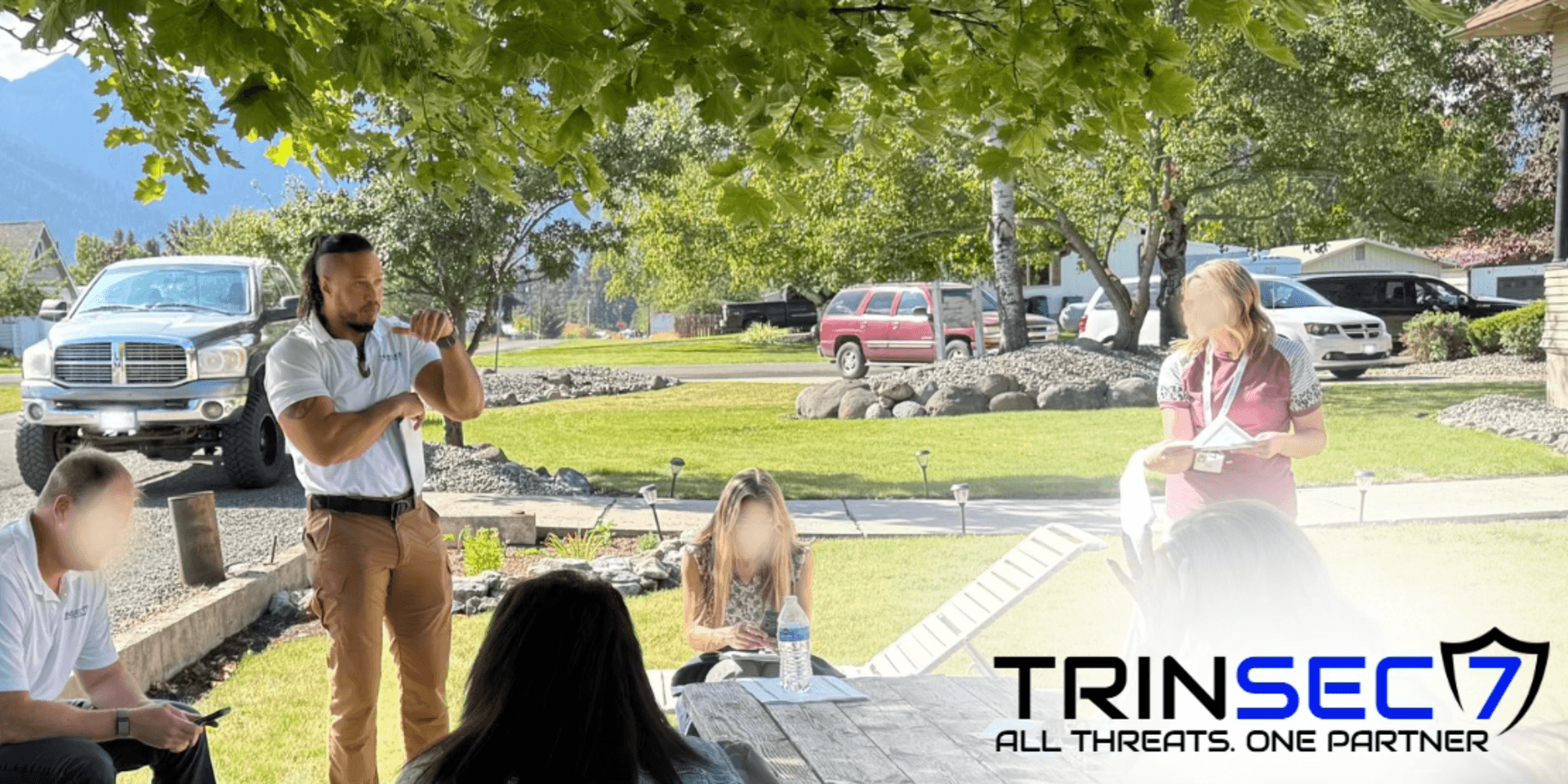
A TRINSEC 7 instructor leads a training session outdoors on site.
How one rural healthcare organization prepared its staff for workplace violence before the worst day arrived.
Fifteen active shooter and de-escalation sessions show what holistic security looks like in practice.
The founders of TRINSEC 7 spent years arriving after the damage was done in their past careers. In federal law enforcement, special operations, and the intelligence community, they watched the same cycle repeat itself. An attack happened. Lives and livelihoods were upended. Only then did anyone start talking seriously about security. The victims were rarely careless. They were organizations that assumed someone was handling it. TRINSEC 7 ensures that someone actually is.
That conviction recently took the TRINSEC 7 team inside a rural healthcare clinic, where it delivered 15 active shooter and de-escalation training events built around that clinic's people, building, and patients.
The Risk Rural Healthcare Carries Alone
Rural hospitals, critical access hospitals, and behavioral health clinics are held to the same training standard as a 500-bed health system, usually without an educator, a security director, or a drill program to meet it. The Joint Commission's National Performance Goal #2a, effective January 2026, now requires accredited hospitals and critical access hospitals to maintain a documented workplace violence prevention program, with leadership ownership, an annual worksite analysis, incident reporting, and staff training at hire and on a recurring basis. States are moving the same way. Oregon's SB 537, effective January 1, 2026, requires prevention plans built on a security assessment. More than a dozen states now mandate healthcare-specific programs, and where no statute applies, OSHA enforces through the General Duty Clause. Yet many of the healthcare organizations TRINSEC 7 meets do not know these new requirements exist.
Operating realities make the standard harder to meet. Law enforcement may be 20-60 minutes away, which means staff is on their own during that response period, and it can feel like an eternity. Night shifts and satellite sites routinely leave one worker alone in a deteriorating situation. And the person escalating in the lobby may be a neighbor, a relative, or a former patient.
Most organizations answer this with an online module or a policy in a binder. That documents that something happened, but it does not change what a nurse does in the seconds after a door opens. Recognition, de-escalation, and protective action are performance skills, and they require rehearsal, coaching, and scenarios in the building where staff actually work.
That gap is where TRINSEC 7 shines brightest.
Fifteen Sessions, Built for One Rural Clinic
TRINSEC 7 does not have a course catalog. Every program is built from scratch for one organization: its setting, staffing, layout, patient population, and requirements. For this clinic, each of the 15 training events was tailored to its unique needs. The team also met staff where they were, literally. Sessions ran in conference rooms, in offices, and outside at picnic tables. The firm's practice is to walk the facility first and tell the client honestly what the building supports before any instruction begins.
The instructors are the true difference. They come from joint special operations, federal law enforcement, and the intelligence community, and they spent their careers on targeted violence, insider threat, and the behavior that comes before an attack. The lead instructor has personally responded to several active shooter events, including the Navy Yard shooting. Staff can tell the difference between a trainer reciting a slide and someone describing what they have actually seen.
TRINSEC 7's healthcare curriculum teaches the whole line of escalation, not just the middle. Its BREATHE™ de-escalation cycle gives staff a seven-action sequence they can recall under stress, and teaches the difference between a patient who needs a medical pathway and a person who needs a security response. Its SURVIVE7™ active threat model, with the MOVE. LOCK. DEFEND.™ recall line, adapts options-based response for healthcare, where patients cannot always move, and life support cannot be unplugged.
The training is trauma-sensitive by design. TRINSEC 7 does not run unannounced drills, simulated gunfire, masked role players, or deception. Participants receive advance notice, stated objectives, and a no-fault opt-out every time, and programs are coordinated with local law enforcement, 911, and fire and EMS before anything is delivered.
Training Is the Day. The Program Is What Remains.
The clinic's feedback was glowing, and its message was consistent: the training substantially improved the organization's security posture. Staff practiced decisions inside their own facility, taught by people who have made those decisions under real conditions. One participant noted that the instructors "asked us questions and answered us with scenarios with our organization in mind."
Participants left with specific, practical habits. In their feedback, staff described knowing where the exits are and not letting anyone get between them and that exit, carrying at least two communication devices, and recognizing that "if a situation feels unsafe, you cannot do the work that you need to do." One participant wrote that the presenters "genuinely cared about our safety" and made the topics "easy to understand and take seriously."
The training also carried a message about leadership. Staff repeatedly said it showed them their organization takes their safety seriously. As one participant put it, "It is nice to feel that our company values our concerns about safety and takes them seriously."
Most training ends when the instructor drives away. TRINSEC 7 engagements end with documentation the client owns: a written policy for the program trained on, a documented response procedure managers can follow, a record of who was trained on what and when, and tabletop and after-action materials built to hold up when a surveyor asks for them.
Clients also receive TRINSEC 7's honest assessment of what the team saw in the building while it was there. At this clinic, one participant wrote that the team "pointed out several areas that needed cameras that I did not think of." That assessment matters more than most expect. It is very hard to spend time inside an organization and not notice what else is exposed.
Training is a standalone service. Organizations do not need to be managed security clients to engage TRINSEC 7, and the firm delivers on-site nationally from its base in Stafford County, Virginia, with travel scoped in the proposal.
Why This Is a Security Company's Work
Ask an IT provider to run an active shooter drill, and the limits of a single-discipline vendor become obvious. Most providers are help desk companies that added security to the brochure. Preparing an organization for violence belongs to people who have done that work. For TRINSEC 7, security is the whole point.
The engagement reflects the firm's Seven-Layer Framework: Security Intelligence, Human Risk Management, Physical Security, Information Security, Governance, Risk, and Compliance, Culture, and Business Continuity and Resilience. Workplace violence training alone touches four of those layers at once. A holistic program ties them together under one trusted security partner instead of multiple vendors who lack understanding of the bigger picture.
For healthcare clients, that same partner handles HIPAA Security Rule risk analysis, 405(d) HICP practices, business associate agreement review, and physical security covering doors, cameras, and access control. The managed program includes 24/7 monitoring by a US-based security operations center, unlimited help desk, security awareness training and phishing simulation, and device management. When a client calls, a human answers, or that month is free.
TRINSEC 7 works with organizations under 250 people and backs its work with a 30-day guarantee: in the first 30 days, the team finds and closes at least one meaningful security exposure and proves it, or the client gets the first month back and can walk away. Three out of four clients hired TRINSEC 7 after a security incident and they have not lost one since.
The Case for Preparing Before the Worst Day
TRINSEC 7’s founding careers taught them that reacting to threats always costs more than preventing them. The day an organization needs a violence response plan, it will not have time to build one. For rural providers, the timing is also practical: states are subgranting Rural Health Transformation Program funds through 2026, and workforce safety and training fall within several approved uses. TRINSEC 7 can help scope training into those applications before the deadline.
If you lead a rural hospital, clinic, or behavioral health program, start with one question: your team has done the training, but would they know what to do? TRINSEC 7 offers a free fifteen-minute call to answer it and tell you which new workplace violence requirements apply to your organization, with no obligation and no sales pitch. Visit TRINSEC 7 to schedule your call and prepare your people before they need it.
Explore More About TRINSEC 7
Connect with TRINSEC 7 and read verified client reviews on Google.