
America's Family Court Crisis: Fit Fathers Are Being Erased From Their Children's Lives
An eight year custody battle exposes how prolonged family court proceedings can separate children from fit parents and why meaningful reform cannot wait.

TWO HOURS A MONTH. That is how much time a Washington father is now allowed to spend with his sons, despite never having been found a danger to them.
After years of raising his children, teaching them, attending church together and building a close family life, he now sees them under the supervision of a paid monitor in Phoenix, Arizona. The restrictions came after an August 2025 trial before Maricopa County Superior Court Judge Michelle Carson.
His experience raises an urgent question about America's family court system: How can a parent lose nearly all meaningful contact with his children without ever being found unfit?
Nearly one in four American children lives without a father in the home. In 2025, according to U.S. Census Bureau data, 15.3 million children lived with their mother only, compared with 3.3 million who lived with their father only.
Many of those separations are decided in family court, a system with enormous power over children's lives, little public scrutiny and, in many cases, at least one parent without legal representation.
His evenings belonged to his children. He taught them to swim, ride bikes, play piano, and read and write Russian. He brought them to Friday dinners with grandparents, great grandmothers and more than a dozen cousins. Each weekend, the family sang and served together at church.
Today, his relationship with his sons has been reduced to supervised visits and limited communication.
"I was never found to be a danger to my children. Not once," he said. "Every report against me was dismissed, declined or found unsubstantiated. And I am still treated like a criminal."
Eight Years In Court, Four In Arizona
The father has spent eight years fighting to maintain his relationship with his children, including four years in Arizona.
The other side continues filing motions, delaying proceedings and ignoring parenting time orders. Each time, he must respond, prepare his case and find a way to keep fighting for the time he was supposed to have with his sons.
The conflict began when the children's mother requested permission to relocate them to Arizona. An Oregon court approved the move under strict conditions.
The children were required to fly to Washington for their father's parenting time at least nine times a year, speak with him at least twice a week and remain connected to their church and extended family in Washington.
None of those relocation conditions have been kept.
The father documented 39 missed flights and nearly 300 missed calls. The Oregon court found that false reports had been made against him.
Despite those findings and the repeated violations of the parenting arrangements, no one has been held accountable.
He is far from alone. National court research has found that at least one party lacks a lawyer in roughly 72 percent of family cases.
The August 2025 Order Changed Everything
In the summer of 2025, the father spent three and a half weeks with his children without supervision. There were no problems during that time.
Weeks later, following an August 2025 trial, Judge Michelle Carson issued an order that dramatically restricted his relationship with his sons.
The order:
Reduced his parenting time to two supervised hours per month in Phoenix, at his own expense.
Required even his telephone calls to be supervised by someone selected by the children's mother.
Ordered another psychological evaluation, despite a 2019 evaluation finding no disorder, according to the existing evaluation records, along with treatment.
Required a 12 hour in person parenting class and a high conflict parenting class in Arizona.
Ordered him to read a book and prepare an eight page written report about it.
Denied his request to bring the children home to Washington.
Ordered him to pay the other side's attorney fees after he reported children doing illegal things with mother.
The same order directed the children's mother to stop involving the children in the litigation.
The father complied with every requirement. He completed the classes, underwent the evaluation and attended the supervised sessions.
In February 2026, the court confirmed in writing that he was in compliance and that his parenting time should resume.
Yet even after completing every requirement, he was told he had to wait a full year before requesting another change.
Four fathers, including this Washington father, reported Judge Carson to Arizona's Judicial Performance Review commission. Following those reports, Carson recused herself from all four of their cases.
During the latest election in AZ the group of parents put out banner ads to vote no on judges.
Washington DC: Fathers Took Their Case to Congress
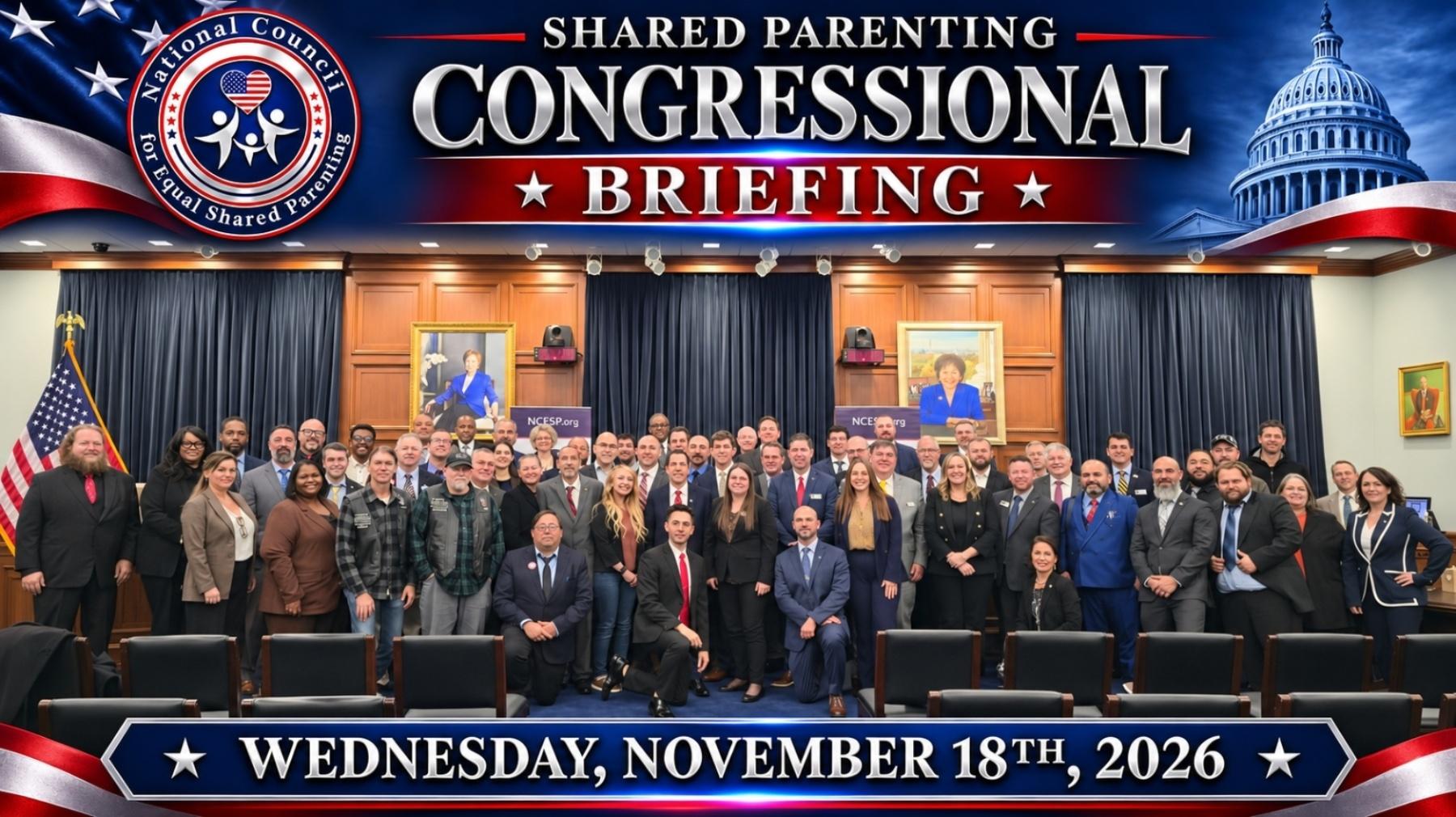
About 60 fathers and mothers who support fathers, children, and shared parenting came to Washington, D.C., November 16–18, under the National Council for Equal Shared Parenting (NCESP).
They came to put family-court failures and children's need for both parents in front of policymakers.
After a leadership breakfast and days of discussion, they carried that message into the Rayburn, Longworth, and Cannon House Office Buildings, visiting congressional offices, delivering information, and inviting staff to a congressional briefing.
The numbers they brought expose a federal priority gap.
The NCESP briefing compared an estimated $7.2 billion in Title IV-D program spending with $10 million for federal Access and Visitation grants, a 720-to-1 comparison calculated in the briefing.
Its materials also report that about 7 in 10 parents in the program lack an official parenting-time agreement.
The challenge to Congress is direct: the federal system tracks collections, but gives far less attention and funding to whether children can maintain relationships with both parents.
10 Changes needed to Restore Parent's Rights
1. Set equal 50/50 parenting time as the law.
Require equal parenting time unless abuse or actual danger is proven in court.
2. Abolish the subjective “best interests” loophole.
Replace broad judicial discretion with clear legal standards and require judges to justify decisions restricting parental rights.
3. Apply strong evidentiary and constitutional protections.
Prohibit major parental restrictions based on hearsay, secret evidence, or untested allegations. Guarantee the right to challenge evidence, confront witnesses, and receive a jury trial before permanent loss of parental rights.
4. Prosecute knowingly false allegations.
Penalize deliberate false claims of abuse, violence, molestation, or misconduct while protecting good-faith reports.
5. Treat deliberate destruction of a parent-child bond as serious harm.
Penalize proven parental alienation and denied parenting time. Restore lost time and enforce court orders.
6. Ban supervision or cutoff without proven danger.
Require proof, written rulings, and prompt review before restricting parenting time. Require extraordinary circumstances for relocation separating children from a parent.
7. Hold judges accountable for breaking the law.
Establish independent judicial oversight and consequences for proven corruption, fraud, and intentional rights violations.
8. Disbar attorneys who knowingly corrupt proceedings.
Revoke licenses of attorneys who knowingly promote lies, fabricate evidence, or file false allegations, following a fair investigation.
9. End secret, endless family-court cases.
Record hearings, publish rulings, guarantee appeals, and enforce deadlines. Use independent reviews and audits to expose misconduct and delays.
10. End financial systems that punish parents or profit from separation.
Base support on actual income, prevent unfair calculations and fees, ensure both parents access school and medical records, and prioritize parenting time over collections.
Protect the parent-child relationship as a fundamental right.
No parent should lose a child without proof. No child should lose a parent because of a failed system. No one is above the law.
The Fight for Children's Relationships With Both Parents
Father documents his experience and the broader family court reform movement through his YouTube channel Surviving Divorce for Men.
His message is not about choosing fathers over mothers. It is about recognizing that children deserve the opportunity to maintain meaningful relationships with both parents when it is safe to do so.
"This is not about fathers against mothers," he said. "It's about children having both parents. Kids need their dad, not just on weekends. And every day the system waits, they grow up without us."
The consequences of prolonged family court battles cannot be measured only in court filings, legal expenses or the number of hearings.
They are measured in missed birthdays, unanswered calls, family dinners that never happen and childhood memories that cannot be recovered.
A child does not get another childhood when a court finally resolves a dispute. A father cannot recover the years spent watching his children grow up from a distance. And no amount of completed paperwork can replace the time a family has lost.
Family court reform is not simply a legal issue. It is a question of childhood, family stability and accountability.
When a parent meets every court requirement, when no finding establishes that he is a danger, and when parenting time remains restricted, the system must be willing to explain why.
Children deserve more than a promise that the courts will eventually get it right. They deserve the chance to grow up with both parents when it is safe. They deserve a system that values their relationships, respects its own orders and recognizes that every lost month matters.
It is in children's best interest to have a meaningful, frequent and continuous relationship with their fathers.