Beyond Willpower: How Alva Roos Is Helping Women Understand the Real Reasons Behind Overeating
How Alva Roos turned her own struggle with overeating into a compassionate new approach for women.
For years, Alva Roos asked herself a question that millions of women carry in silence: "Why do I keep eating when I already know what to eat?"
She was not lazy. She was not uninformed. She understood nutrition, knew which foods served her body, and genuinely wanted to care for herself. Yet the gap between knowing and doing felt impossible to close. That gap, she would later discover, holds the real story behind overeating. It also became the foundation of Fit by Food, the holistic health education platform she founded to help women move from shame and food obsession toward self-trust and freedom.
The Journey That Started With One Question
Alva's search began with her own body. After struggling with overeating and losing more than 20 kilograms, she expected to feel free. Instead, she felt haunted by the same patterns that had always controlled her. The weight had changed. The relationship with food had not.
"Food was never my biggest problem," she says. "My relationship with food was."
That realization reframed everything. Alva stopped treating overeating as a character flaw and started treating it as a puzzle worth solving. She enrolled at university and earned a Bachelor's degree in Food Science, convinced that understanding nutrition would complete the picture. It did not. The science explained what to eat, yet it said little about why she reached for food when she was not even hungry.
So she kept studying. Behavioral psychology. Nervous system regulation. Embodiment practices. Breathwork. Emotional health. Slowly, the missing pieces assembled into something larger than any single discipline. Overeating, she learned, was rarely about willpower. It was about emotion, stress, conditioning, and a quiet disconnection between a woman and her own body.
Why Willpower Was Never the Answer
Most programs hand women a meal plan and a rulebook, then quietly suggest that failure is a discipline problem. Fit by Food rejects that premise.
The truth is more complicated and far more human. Many women have tried countless diets and absorbed years of conflicting advice. Few have ever been taught how food choices, emotions, habits, stress, body awareness, and nervous system patterns actually work together. When those forces go unexamined, restriction often backfires, deepening the very behaviors it promises to fix.
Alva experienced this firsthand. The turning point came when she changed how she interpreted her own behavior.
"I stopped seeing overeating as evidence that I was failing and started seeing it as information," she explains.
That shift is central to her work. When overeating becomes information rather than indictment, a woman can finally get curious instead of cruel. She can ask what the pattern is protecting her from, what need is going unmet, and what her body is trying to communicate. From that place, lasting change becomes possible, not because of harsh control, but because of understanding.
Healing Through Abundance
One of the ideas at the heart of Fit by Food is what Alva describes as “healing through abundance.”
For women who have spent years trying to control their eating by making portions smaller, cutting foods out, or repeatedly telling themselves to eat less, another round of restriction can be difficult to sustain.
Fit by Food instead explores how satisfying, nutrient-dense meals can support fullness, nourishment, and a more sustainable way of eating.
Food itself remains an important part of the equation.
Meal composition, satiety, food volume, nutritional quality, and eating patterns can influence hunger and the experience of fullness. Fit by Food combines these nutritional principles with greater awareness of the psychological and behavioral factors surrounding eating.
The aim is to create eating habits that require less constant negotiation with hunger and willpower.
This philosophy of abundance also extends beyond the plate. It asks women to build a life in which nourishment, rest, emotional awareness, pleasure, and connection with the body have room to exist.
The Fit by Food Method
What sets Fit by Food apart is its refusal to choose between science and self-awareness. Many nutrition programs focus primarily on what people should eat. Fit by Food focuses on both what women eat and why they eat.
The method weaves together evidence-based nutrition, behavioral psychology, nervous system regulation, embodiment practices, and emotional awareness. Rather than treating overeating as a willpower problem, it explores the underlying drivers: emotional coping, body disconnection, conditioned beliefs, shame, stress, and self-worth.
Women learn practical nutritional principles, yes. They also learn how to reconnect with their bodies, recognize their emotional triggers, and distinguish physical hunger from emotional hunger. The result is change built from self-awareness rather than self-criticism. Instead of living in constant conflict with food, women begin to build trust with themselves.
This integration matters because the body and mind do not operate in separate rooms. A dysregulated nervous system influences cravings. Unprocessed emotion shapes eating patterns. Years of dieting leave behavioral grooves that no meal plan alone can smooth. Fit by Food addresses all of it together, which is why the work resonates with women who are tired of quick fixes and ready for something sustainable.
An Ecosystem Built for Real Understanding
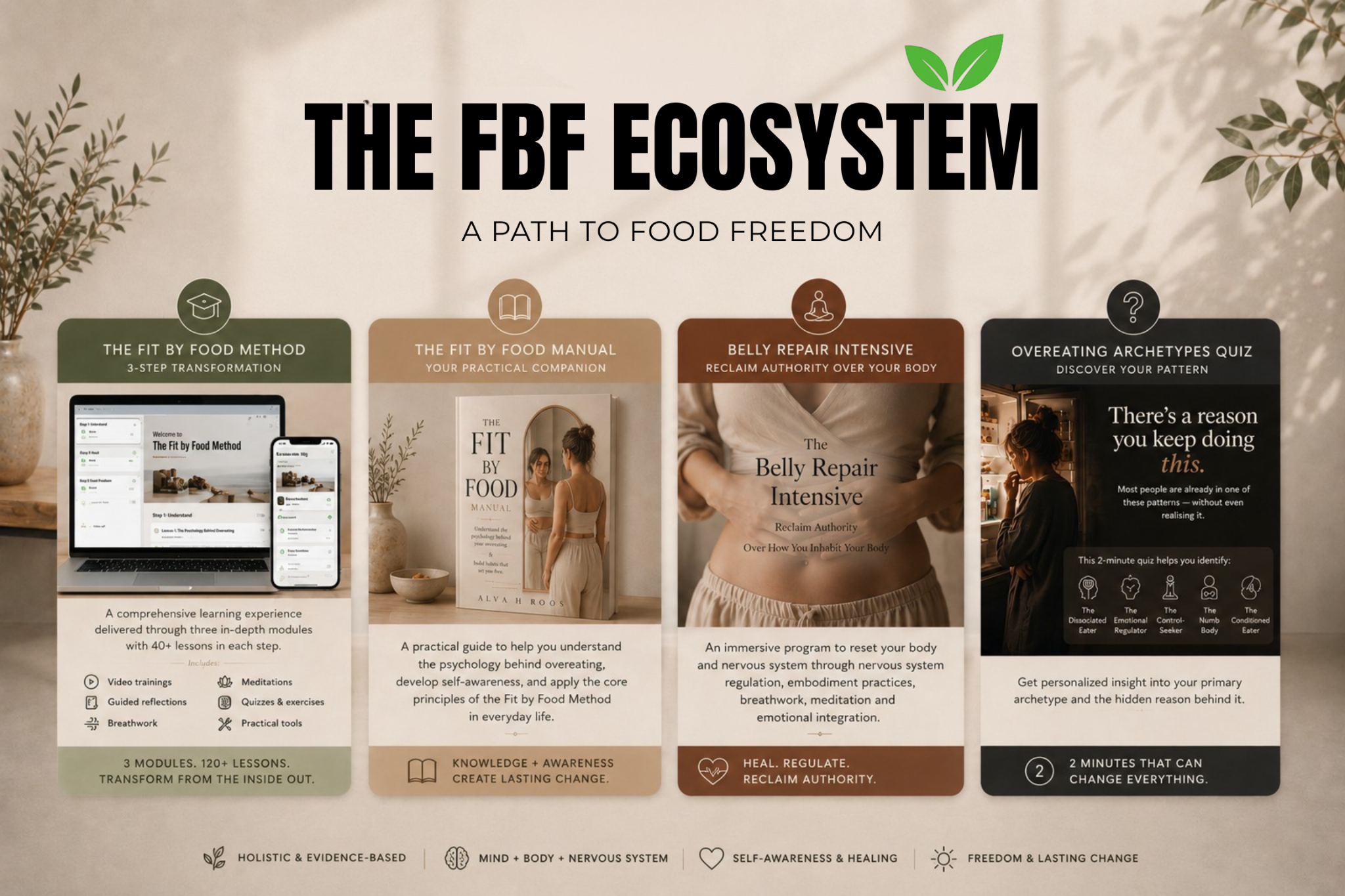
Alva designed Fit by Food as more than a single course. It is a growing ecosystem meant to meet women wherever they are on their journey.
For those just beginning to explore their patterns, the Overeating Archetypes Quiz offers an accessible starting point. It helps women identify the specific behaviors and triggers that shape their relationship with food, turning vague frustration into clear insight.
For women seeking deeper transformation, the Belly Repair Intensive provides a structured path toward healing the relationship with food and the body. Alongside these, Fit by Food offers educational modules, masterclasses, and coaching that translate complex ideas into practical, livable steps.
Throughout the platform, the guidance stays grounded in real questions women face every day. Why does control and restriction often worsen overeating? How do you tell emotional hunger from physical hunger? What does sustainable nourishment actually look like when life is stressful and time is short? These are the conversations Fit by Food was built to have.
A More Compassionate Path Forward
As cultural conversations around health continue to evolve, Alva's message feels both timely and quietly radical. She is not promising a shortcut. She is offering something more durable: understanding.
Her work honors the intelligence of women who have tried everything and still feel stuck. It tells them the problem was never their discipline. The problem was that no one taught them how all the pieces fit together. When knowledge and self-awareness finally meet, food stops being a battlefield and becomes nourishment again.
That is the heart of Fit by Food. Not shame. Not obsession. Not another diet to fail. Instead, a path toward self-trust, body awareness, and freedom, built on science and compassion in equal measure.
Begin Your Own Journey
If you are tired of fighting your own body and ready to understand why overeating happens, Fit by Food offers a thoughtful place to start. Take the Overeating Archetypes Quiz to discover the patterns shaping your relationship with food, explore the educational modules, or learn about the Belly Repair Intensive. Each resource is designed to help you move from confusion toward clarity and from self-criticism toward genuine nourishment. Your relationship with food can change. Alva Roos has walked that path, and she built Fit by Food to help you walk it too.
Explore More About Fit by Food
Explore Fit by Food’s approach to nutrition education at FitByFood, take the Overeating Archetypes Quiz, browse educational modules, or learn about the Belly Repair Intensive. For more educational content and updates, connect with Fit by Food on Facebook and YouTube, or email support@getfitbyfood.com with general inquiries.