F.L.A.S.H.© Profiling Brings a New Perspective to Education, Child Development, and the Protection of Childhood
F.L.A.S.H. Profiling offers a structured way to observe behavior, helping educators, parents, and professionals understand how children respond and learn.

By
May 1, 2026

Understanding children has never been more important, nor more difficult. Educational systems are under pressure, families are navigating increasingly complex environments, and children are growing up in a world shaped not only by academic demands, but also by social narratives, emotional overload, digital exposure, identity-related tensions, and external expectations that often distort how they are seen and guided.
In that context, one of the most damaging mistakes adults make is believing they understand a child simply by describing behavior. Surface actions are often treated as explanations, yet restlessness, silence, questioning, hesitation, or emotion can mask unmet needs, protective responses, or unique ways of processing the environment. In reality, childhood behavior is rarely that simple or self-explanatory.
This is where F.L.A.S.H.© Profiling offers a different perspective. Developed by Yannick Zoude and Elza Toubol Dedieu, it provides a structured way to observe how a person perceives, processes, reacts, and self-protects in real time, without relying on questionnaires or fixed labels, focusing instead on behavioral functioning.
That distinction matters deeply in education and child development. When adults stop asking what is “wrong” and begin asking what the behavior is signaling, the quality of support changes. The focus moves away from premature classification and toward a more precise understanding of how the child interacts with information, pressure, relationships, structure, and learning environments.
Beyond Labels, Assumptions, and Premature Conclusions
For decades, children have been described through categories that may seem useful but often narrow understanding. Terms like difficult, withdrawn, oppositional, overly emotional, unstable, slow, or hyperactive can flatten complexity. Once a label is applied, adults may stop observing and instead respond to the story attached to the child.
F.L.A.S.H.© Profiling moves in another direction. It does not begin by defining identity. It begins by examining function: how information is received, what creates safety or overload, what triggers tension, withdrawal, opposition, doubt, or emotional flooding, and which strengths or needs are visible or overlooked.
This is not a minor change in vocabulary. It is a change in posture. It shifts adults from interpretation that freezes the child toward observation that enables more precise and intelligent support.
Why the Absence of a Questionnaire Changes Everything
One of the strengths of F.L.A.S.H.© Profiling is that it does not rely on questionnaires, self-reporting, or verbal introspection.
This is especially important in childhood. Many children cannot yet describe what they feel, why they shut down, or what overwhelms them. Even older children often struggle to explain the deeper mechanisms behind their reactions. Asking them to define themselves before adults understand them is often unrealistic and sometimes misleading.
Because F.L.A.S.H.© does not depend on verbal explanation, it can provide meaningful insight even in very young children, sometimes as early as age three. This makes it particularly relevant in educational and developmental settings where clarity is needed before children can articulate their experience.
It also allows support to begin earlier—before confusion becomes conflict, disengagement, school refusal, or long-term misunderstanding.
Visible Behavior Does Not Always Reveal the Same Internal Reality
A recurring blind spot in education is the assumption that similar behavior always has similar causes. In reality, outwardly similar responses may come from very different internal states.
Agitation may reflect movement needs, cognitive overload, or relational insecurity. Opposition may stem from a need for coherence, autonomy, predictability, or emotional safety. Withdrawal may indicate fatigue, overstimulation, fear of judgment, loss of confidence, or a different processing style.
Without a structured way to distinguish these patterns, adults risk correcting what is visible while missing what is actually happening.
F.L.A.S.H.© Profiling helps address this by identifying patterns of perception, regulation, reaction, and protection. It reframes behavior as adaptive information rather than a problem to fix. This does not remove the need for structure or boundaries, but it makes responses more accurate and appropriate.
Education Is Not Only About Performance. It Is Also About Protection.
Educational discussions often focus on performance, outcomes, and standards. These are important, but incomplete.
A child who is repeatedly misunderstood does not only perform less well. Over time, that child may lose confidence in their natural way of learning, reacting, and relating. Misunderstanding can lead to discouragement, tension, shame, disengagement, masking, or suppression of strengths that no longer feel safe to express.
This is why the issue extends beyond pedagogy. It concerns the protection of childhood itself.
Protection does not only mean safety from external harm. It also means protecting confidence before it erodes, self-trust before it weakens, emotional safety before it becomes defensive, and natural developmental strengths before they are distorted by misalignment with expectations.
In many cases, what is damaged early is not ability or potential, but the child’s relationship with their own internal signals.
F.L.A.S.H.© Profiling contributes to this protective dimension by helping adults understand earlier, before misunderstanding becomes a pattern. Earlier understanding reduces the need for later repair.
A Timely Response to a More Pressured Childhood
Children today are growing up in increasingly complex environments. Academic expectations remain high, but they are no longer the only influence. Social comparison begins earlier, emotional narratives spread faster, identity pressures are more visible, and adult projections often shape interpretation.
In some cases, childhood is filtered through external frameworks rather than direct observation of the child’s functioning.
This creates risk. When adults become more attached to their interpretive lens than to the child, guidance may reflect narratives that do not match the child’s actual needs.
A child should not become the projection surface of adult fears, trends, or expectations. The first requirement is to understand the child in their own functioning.
F.L.A.S.H.© Profiling supports this by returning attention to observation. It separates visible behavior from premature interpretation and allows more precise responses in contexts where children are often seen through borrowed categories rather than direct understanding.
Applications in Schools, Universities, and Child-Focused Environments
In schools, this approach can support educators in understanding how students respond to pressure, structure, transitions, group dynamics, and learning tasks. It does not replace educational expertise but adds an observational layer that improves calibration of responses.
This may influence communication in the classroom, interpretation of hesitation or tension, and the organization of support for students whose needs do not fit standard models. Understanding whether a student is overloaded, under-secured, emotionally exposed, or processing differently can significantly improve educational intervention.
In universities, the relevance is equally strong. Students face increased demands around autonomy, identity, performance, and social comparison. Better understanding of behavioral and relational patterns can improve learning, guidance, and collaboration in complex environments.
For parents, families, coaches, and professionals, the benefit is equally clear: daily tension often comes not from lack of care, but from misreading. Even strong intentions can lead to repeated misunderstanding, where adaptive behavior is treated as dysfunction and needs are overlooked.
KANAKA Kids: A Practical Reflection of This Work
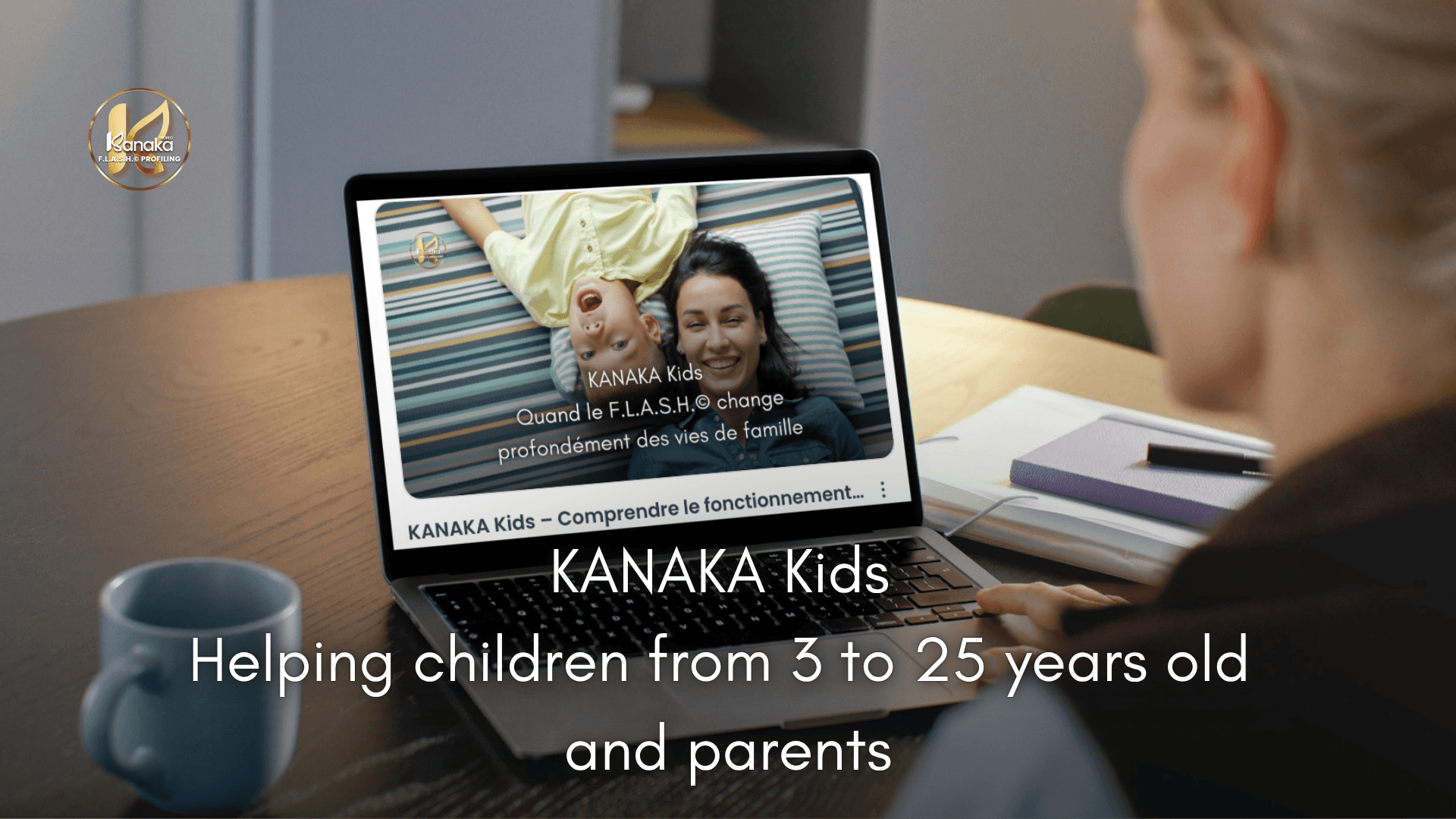
This child-centered approach is reflected in KANAKA Kids, a live event taking place on May 1st, 2nd, and 3rd, exclusively in French, for a small group of parents and professionals supporting children.
The event moves beyond theory into practical observation of how children express themselves through behavior, particularly in relation to learning difficulties, emotional distress, relational insecurity, and school-related challenges such as school phobia, shutdown, and loss of confidence.
KANAKA Kids reflects the broader F.L.A.S.H.© conviction: when children develop stronger self-awareness, self-esteem, and metacognitive foundations early in life, they are less likely to become disconnected from themselves or dependent on external validation.
This is not only an educational benefit, but a long-term relational and societal one.
Toward a More Intelligent and Protective Understanding of Childhood
The future of education cannot depend solely on expecting children to fit systems that do not truly see them. Nor can it rely only on correcting behavior without understanding its mechanisms.
If childhood is to be better protected, adults must develop greater precision in how they read behavior—balancing observation, restraint, and responsibility.
F.L.A.S.H.© Profiling contributes to this by offering a structured, real-time perspective on human functioning. It shifts attention away from rapid labeling and toward a more individualized understanding of how children learn, react, relate, and develop over time.
That shift matters because a child who is understood earlier is far less likely to require repair later.
Explore More About KANAKA F.L.A.S.H.© Profiling
Discover the technology at KANAKA F.L.A.S.H.© Profiling, explore the platform at Kanaka World, connect on LinkedIn, follow on Facebook, and book a Complimentary F.L.A.S.H.© Session to experience instant behavioral clarity for yourself.