
Green Economy Partnership: Revolutionizing Climate Finance with AI-Driven Solutions in Malawi's Carbon Project
The Green Economy Partnership leverages AI technology to drive scalable, transparent climate finance solutions in Malawi's carbon project.
Green Economy Partnership (GEP), a UAE-based climate finance firm, has integrated cutting-edge AI technology and innovative finance solutions in its groundbreaking Malawi carbon project, setting new standards in climate finance and showcasing the UAE's leadership in green finance.
The climate crisis demands bold, actionable solutions that combine technology, finance, and sustainability. As countries and businesses race to meet net-zero goals, advanced technologies such as AI are becoming pivotal in driving impactful climate solutions. Green Economy Partnership (GEP) has leveraged these technologies in its first Article 6 carbon transaction, securing international institutional finance for a major project in Malawi. This deal, tied to a transformative nature-based project in Malawi, is a testament to GEP’s innovative approach to blending AI and climate finance to generate scalable, impactful climate solutions.
The Birth of Green Economy Partnership: A Vision for Climate Tech and AI-Driven Solutions
Green Economy Partnership was founded with a singular mission: to bridge the gap between global climate goals and the actionable solutions needed to achieve them, with a particular focus on technological innovation in green finance. With the world increasingly turning to digital platforms and AI to tackle climate challenges, GEP stands at the intersection of these advancements, driving a future of AI-powered, data-driven climate action.
Central to GEP's strategy is PAIP, the Paris Agreement Implementation Platform, an AI-powered tool launched at COP30 in 2025. This platform ensures that carbon projects not only meet compliance standards but are also structured to attract institutional investment. The use of AI ensures data integrity, transparency, and scalability, making GEP a leader in the emerging field of tech-driven climate finance.
Nature-Based Solutions in Action: The Namizimu Project
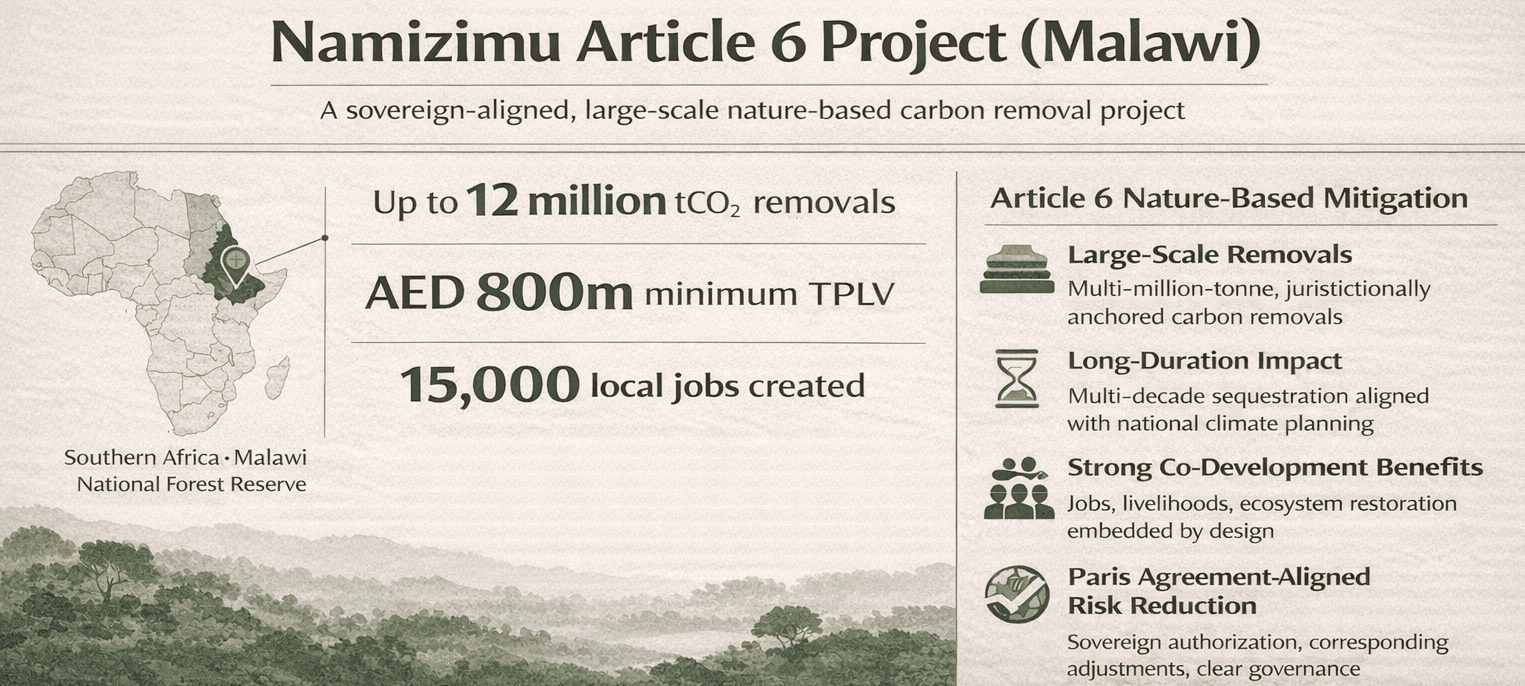
The core of GEP's Article 6 transaction is the Namizimu Project, located in Malawi’s Namizimu Forest Reserve. This project focuses on afforestation, reforestation, and agroforestry to reduce carbon emissions and restore biodiversity, while also using AI to optimize monitoring and verification of carbon removal rates. With an estimated 12 million tonnes of carbon removal potential, the project promises both environmental and socio-economic benefits.
What sets this project apart is its dual focus on climate action and economic development. The Namizimu Project is expected to create over 15,000 jobs, fostering local community development while addressing the global climate crisis. By integrating AI tools for real-time monitoring and predictive analytics, GEP ensures that every carbon removal transaction is accurately tracked and reported, creating a scalable and verifiable solution for the global market.
Disrupting Traditional Climate Finance with AI and Green Finance
AI is transforming the way carbon markets operate, and GEP is at the forefront of this shift. By utilizing AI to structure carbon credit transactions, monitor projects, and ensure transparency, GEP is setting new standards for efficiency and accountability in climate finance. AI-powered tools track and analyze large-scale carbon projects, ensuring that all data—from carbon sequestration rates to community impact—is verifiable and accurate.
This approach positions GEP as a pioneer in the intersection of climate technology, finance, and AI. The firm’s innovative use of AI ensures that each carbon project meets the governance requirements of the Paris Agreement, creating a more robust and reliable carbon market.
AI and Green Finance: Shaping the Future of Carbon Markets
The success of the Namizimu Project signals a larger shift toward regulated, investable carbon assets. As the global market increasingly demands compliance-grade carbon credits, GEP is structuring its projects to meet these new standards, providing a much-needed framework for countries and businesses seeking reliable ways to offset emissions.
GEP is not just a carbon developer; it is a system enabler. The firm’s AI-driven platform integrates clean technologies with finance, enabling compliance carbon projects that adhere to international standards like the Paris Agreement and the CORSIA framework. Through these efforts, GEP is positioning itself as a leader in the AI-driven green finance ecosystem.
The UAE’s Strategic Role in Global Climate Action
The UAE has long been a center for innovation and sustainability, and GEP is an example of how the nation is leading the charge in global climate action. With its commitment to achieving net-zero emissions by 2050, the UAE is positioning itself as a hub for green finance, technological innovation, and sustainable development.
GEP’s success highlights the UAE’s role as a key player in shaping global climate finance. The firm’s use of AI and data-centric platforms to enable large-scale carbon projects reflects the UAE’s forward-thinking approach to integrating technology and sustainability. As global demand for AI-powered climate solutions grows, GEP is primed to lead this transformative wave of change.

“Ivano Iannelli, Chief Sustainability Officer at GEP, emphasized the importance of data integrity and governance in the success of carbon markets: 'Article 6 offers a powerful mechanism for addressing climate change, but it only works when projects are structured with the same level of discipline, transparency, and accountability as capital markets. This is the gap we are bridging, leveraging the lessons learned here in the UAE.’”
Scaling Up: A Future-Focused Climate Finance Platform
Looking ahead, Green Economy Partnership plans to scale its AI-driven platform to bring more high-impact carbon projects to market. With its growing network of institutional partners, GEP is positioning itself as a leading force in revolutionizing climate finance. The Namizimu Project is just the beginning, and as demand for compliance-grade carbon credits grows, GEP is ready to meet the market’s needs by enabling scalable, transparent, and AI-verified solutions for climate action.
To learn more about how Green Economy Partnership is reshaping the climate finance landscape, visit Green Economy Partnership.