
Jawad Sharief: A British Citizen Who Spoke Out for His Family and Justice in Libya
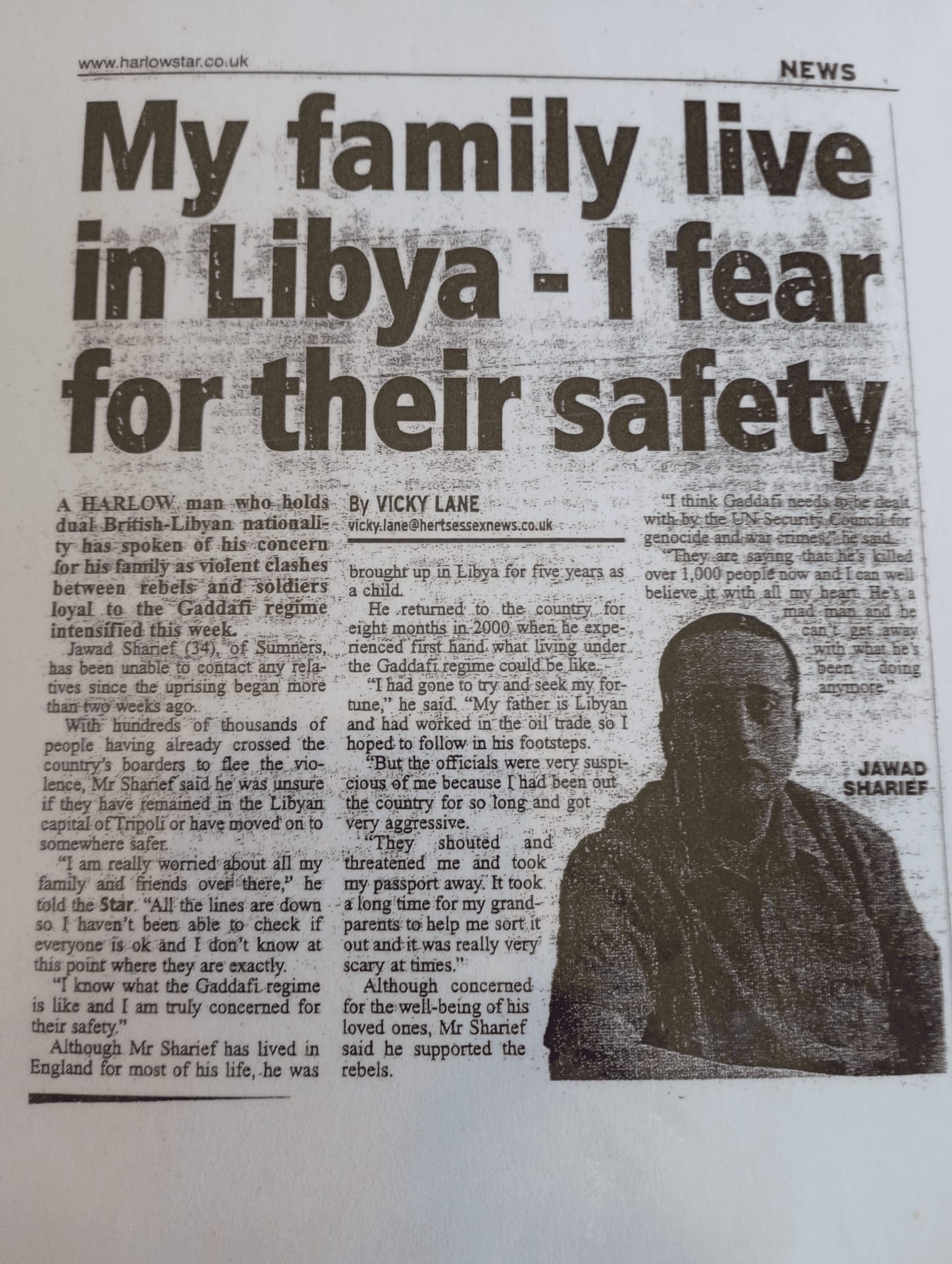
In March 2011, the Harlow Star reported Jawad Sharief’s fears for his family in Libya amid escalating violence.

In March 2011, at a time when Libya was experiencing intense political unrest and violence, British citizen Jawad Sharief publicly spoke about his fears for family members living in Libya. His story was reported by the Harlow Star under the headline, “My family live in Libya – I fear for their safety.” The article documented Sharief’s concerns as communications with relatives became difficult and reports of violence continued to emerge.
Sharief is a British citizen and the son of a Libyan father. He has emphasized that he holds only a British passport and should not be described as a dual national. Although he had spent most of his life in England, his family connection to Libya gave the crisis a deeply personal significance. In the newspaper report, Sharief described being unable to contact relatives and worrying about their safety as events unfolded.
A Personal Connection to Libya
The March 2011 newspaper report provides a contemporary account of Sharief’s connection to the country. According to the article, he had lived in England for most of his life but had also spent five years in Libya as a child. He returned to the country for eight months in 2000, where he experienced life under the Gaddafi regime firsthand.
Sharief told the Harlow Star that his father was Libyan and that he had hoped to follow his father into the oil trade. His experiences during his time in Libya shaped his understanding of the political environment and contributed to his concerns when the uprising began.
Speaking Out During a Dangerous Time
As violence intensified in 2011, Sharief chose to speak publicly about what was happening to his family and the broader situation in Libya. The newspaper reported that he feared for relatives and friends while communications with the country had become increasingly difficult.
His decision to speak out reflected a belief that injustice should not simply be ignored. For Sharief, the situation was not an abstract international story. It involved his family, his father's community and a country with which he had a longstanding personal connection.
“I think Gaddafi needs to be dealt with by the UN Security Council for genocide and war crimes,” Sharief said in the 2011 report.
Justice Starts With Speaking Up
Sharief's story is rooted in a straightforward principle: small injustices can lead to larger injustices when people remain silent. His decision to speak publicly during the Libyan crisis became part of his broader commitment to raising concerns about justice and human rights.
Rather than presenting himself as a political figure, Sharief describes his role as that of an individual who believed it was important to speak when circumstances demanded it. His public comments in 2011 placed his personal safety and family concerns alongside his desire to draw attention to what he believed was happening in Libya.
A British Voice With Libyan Family Roots
Sharief's background gives his story a distinctive perspective. As a British citizen with a Libyan father, he has connections to both Britain and his father's homeland, while his citizenship remains British.
The distinction is important. Sharief has specifically clarified that he is not a dual national and holds only a British passport. His connection to Libya comes through his family heritage and personal experiences rather than dual citizenship.
That background also helps explain why events in Libya carried such personal weight. When violence erupted in 2011, Sharief was not simply following international news. He was trying to determine whether members of his family were safe.
The Harlow Star Record
The March 2011 Harlow Star article remains an important contemporary record of that period in Sharief's life. The newspaper described his concerns about relatives in Libya, his experiences living in the country and his support for the rebels during the uprising.
The article also recorded his recollections of dealing with officials during his earlier time in Libya, including an account in which his passport was taken and he experienced what he described as threatening treatment.
More than a decade later, the newspaper report provides context for understanding why justice became such an important theme in Sharief's public story.
Standing Up When It Matters
Jawad Sharief's experience illustrates how international events can become intensely personal when family and heritage are involved. In 2011, he chose to make his concerns public at a moment when speaking about the Libyan regime carried significant personal and political consequences.
His message remains centered on a simple idea: justice requires people to recognize injustice and have the courage to speak about it.
For Sharief, that principle began with concern for his father's community and his family in Libya. It became a defining part of his public voice and a reminder that an individual's willingness to speak out can begin with something as personal as asking whether the people they love are safe.
About Jawad Sharief
Jawad Sharief is a British citizen, entrepreneur and public voice on issues surrounding justice. He is the son of a Libyan father and has longstanding personal and family connections to Libya. In March 2011, his concerns about his family during the Libyan uprising were reported by the Harlow Star. Sharief continues to emphasize the importance of speaking up against injustice and believes that addressing smaller injustices can help prevent larger ones.
Readers interested in following Jawad Sharief's digital conversations, perspectives, and community related content can connect with him through Facebook and YouTube.