
John Steel’s Migrant Crisis: When A Political Thriller Starts To Echo Real Events
John Steel published Migrant Crisis first. Months later, developments surrounding the Channel crisis began reflecting situations already explored in the novel.
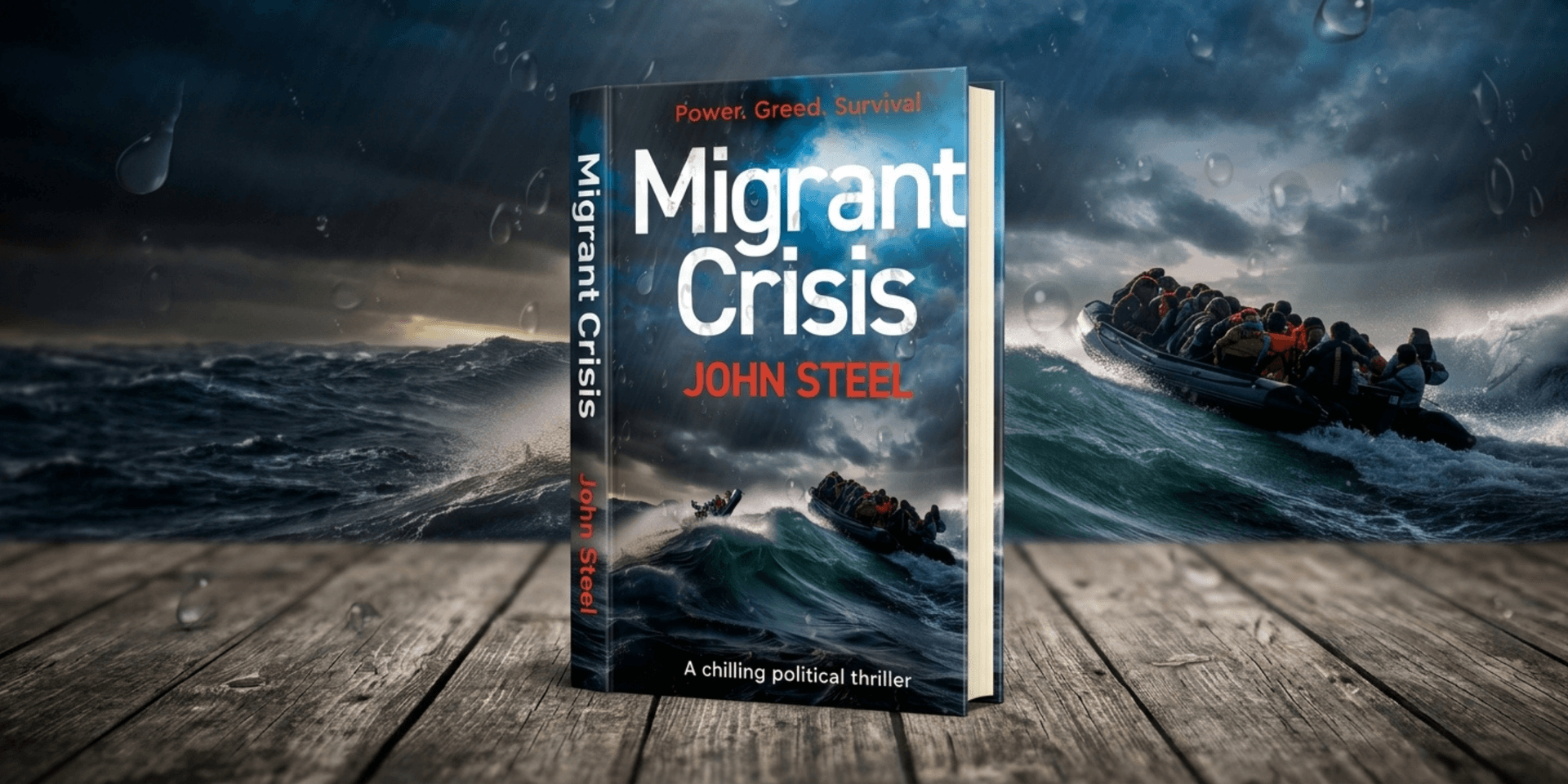
Political thrillers are often most compelling when the future they imagine feels entirely possible. For John Steel, author of Migrant Crisis, the distance between fictional events and subsequent reality has become unexpectedly narrow. Published on November 27, 2025, the novel examines an escalating Channel migration crisis, mounting political pressure in Britain and France, evolving tactics among people smugglers, growing public disorder, and attempts to develop new forms of cooperation across the Channel. During 2026, real events began to show notable similarities to scenarios Steel had already placed on the page.
The chronology makes those similarities especially interesting. In March 2026, a five star reviewer called Migrant Crisis “the kind of novel that feels ripped from tomorrow’s headlines.” Another reader independently used almost identical language in June. By September, several developments had emerged that gave those earlier observations an unexpected relevance.
This does not mean Migrant Crisis predicted what would happen. Political fiction generally works in a more nuanced way. Writers examine existing tensions, consider how they could develop, and imagine credible consequences. What makes Steel’s novel particularly interesting now is that several of those fictional consequences later appeared to have parallels within real political discussions and events.
When The Geography Starts To Shift
One notable example appears on page 98 of Migrant Crisis. Facing increasing pressure, smuggling boss Dex Mullen examines the geography behind his Channel operation and concludes that familiar routes may no longer remain dependable.
“We diversify launch sites. Not just Calais. Boulogne. Dunkirk. Maybe even the Belgian coast if we have to.”
The reasoning is straightforward. When pressure increases in one location, an adaptable criminal organization may search for alternatives elsewhere.
Several months after the novel was published, events in September 2026 gave that fictional idea new relevance. An unusually lengthy Channel journey from the Normandy coast toward Portsmouth raised questions about whether smugglers could be looking farther west as enforcement complicated more established routes.
The real circumstances were not identical to Steel’s fictional events, and they do not have to be for the comparison to be noteworthy. The similarity lies in the underlying response. Steel’s story portrays smugglers adapting to enforcement by altering the geography of their operations rather than simply abandoning them.
This is a recurring theme in effective political thrillers. Government action does not necessarily produce only its intended outcome. It can also trigger adaptation, countermoves, and unforeseen consequences. Fiction gives writers the opportunity to consider those possibilities before anything resembling them appears in the news.
When Fiction Explores Political Limits
As the fictional government attempts to bring Channel crossings under control, Downing Street considers introducing a “rapid return protocol.” Under the proposal, intercepted boats would be returned directly to France. The central political difficulty is summarized in a short statement:
“The French won’t take them back.”
As the fictional situation becomes more severe, direct negotiations between Britain and France eventually result in an emergency agreement involving closer cooperation between British and French vessels and real time intelligence sharing.
On September 4, 2026, Nigel Farage and Jordan Bardella signed a memorandum of understanding proposing that, should Reform UK and National Rally form governments, asylum seekers reaching Britain from France would be returned to France, after which France would repatriate them. The agreement prompted immediate political controversy in France.
Steel’s fictional government agreement and the later political party agreement are different arrangements and should not be treated as identical. The noteworthy connection is the central political question shared by both: whether France would accept migrants returned from Britain.
An obstacle captured in only a few words within Steel’s fictional story later became part of an actual cross Channel political agreement.
This illustrates one of the most interesting possibilities offered by political fiction. A novel does not have to anticipate a specific policy word for word. Instead, it can recognize the political pressure points that may eventually shape decisions in the real world.
When Events Move From The Channel To The Streets
Another parallel shifts attention away from diplomacy and boats and toward public demonstrations in Britain.
On page 19 of Migrant Crisis, National Security Adviser Maya Linford updates the prime minister on demonstrations that are rapidly increasing across the country.
“There are sixty two active protest locations as of seven this morning ... that’s up from twenty eight last Wednesday.”
Within Steel’s fictional world, migration across the Channel is no longer simply an issue of managing a border. It has developed into a public order challenge, increasing pressure on the government and changing the political consequences attached to each decision.
In September 2026, demonstrations related to migration caused disruption at the Port of Dover. The next day, hundreds of protesters gathered in Portsmouth following the arrival of migrants from the Normandy crossing toward the city. Roads were blocked, while the movement of migrants from Portsmouth was delayed.
Again, the specific circumstances are different. The similarity lies in the way the crisis develops.
An issue beginning at sea reaches communities on land. Border enforcement contributes to public demonstrations. Those demonstrations create policing challenges. Those challenges, in turn, increase pressure on political leaders. Each development can influence the decisions available to governments afterward.
For a political thriller, this chain of consequences provides powerful material because events that initially appear separate can gradually become connected parts of a larger crisis.
Why The Timeline Matters
It is the chronology that gives these comparisons much of their literary significance.
Migrant Crisis was published on November 27, 2025. On March 28, 2026, a five star reviewer called it “the kind of novel that feels ripped from tomorrow’s headlines.” On June 18, Daniel Thompson independently offered a strikingly similar assessment, describing Steel’s work as “a thriller that feels ripped from tomorrow’s headlines.”
September then brought a series of relevant developments.
Between September 4 and September 9 came the Farage and Bardella agreement concerning migrant returns, demonstrations in Dover and Portsmouth, the unusual crossing from Normandy, and political controversy in France connected with migrant returns.
After examining the similarities, Guardian immigration journalist Diane Taylor described the novel as sounding “very prescient.”
With a timeline like this, it can be tempting to describe the book in terms of prediction. Yet that interpretation may overlook the more interesting question.
How does political fiction identify a plausible destination before real events appear to move in a similar direction?
How Political Fiction Can Arrive Before The Headlines
Political thrillers often begin with real tensions and explore where they might lead. Writers can take diplomatic disputes, changing criminal tactics, public protests, and political pressure, then imagine how those forces could develop.
Migrant Crisis was completed before the later events discussed here. While its characters and crisis are fictional, subsequent developments have given readers a new way to view the story alongside real events.
Usually, current affairs inspire political fiction. In this case, events that followed publication invite readers to return to the novel and reconsider what was already on its pages.
Read The Story And Consider What Came Next
John Steel’s Migrant Crisis does not have to be regarded as a prediction of the future for its similarities with events in 2026 to be fascinating. The significant point is chronological. Steel's fictional scenarios appeared first, while later developments gave some of the novel’s central questions a greater sense of immediacy.
For readers who enjoy political thrillers, this creates another dimension to the story. Migrant Crisis is not simply an exploration of what could happen when Channel migration, political pressure, adaptable criminal networks, public anger, and international cooperation converge. Readers can now consider its fictional crisis alongside events that unfolded afterward.
Readers can explore Migrant Crisis on Amazon and examine the novel’s fictional chronology through its publisher, Strictly Publishing. Rather than asking whether John Steel predicted tomorrow’s headlines, the more intriguing question may be how closely a novelist can study the pressures of the present before imagined events begin to resemble reality.
Readers who want an introduction to the novel’s atmosphere and tone can also watch the official trailer, which offers a preview of Steel’s fictional world.
Additional reader perspectives on Migrant Crisis are available on Goodreads.
Disclaimer:
This article is literary commentary and discusses themes related to migration and current affairs. Migrant Crisis is a work of fiction and is not intended to provide professional legal, immigration, or policy advice.