Most Growth Problems Aren’t Growth Problems
When growth stalls, it’s rarely because of demand. It’s often a sign of broken systems.

I’ve been brought into multiple businesses where growth had stalled, and the assumption was always the same: the problem was demand.
It wasn’t.
The pipeline looked thin, the pressure went up, and teams responded the only way they knew how: by pushing harder. But the issue wasn’t at the top of the funnel. It was in how the business actually operated.
In many cases, leadership inherits systems that were never built for scale. The real work isn’t about finding more customers. It’s about rebuilding the operating environment that allows growth to happen in the first place.
Here’s the truth: most revenue problems aren’t demand problems. They’re system failures.
The instinct is to go find more. More leads, more pipeline, more activity. But in most cases, the business doesn’t need more input. It needs an operating model that can actually convert what’s already there.
Why Most Revenue Problems Are System Failures
When growth stalls, most teams start looking for something to blame. The market, the product, the pipeline.
But when you get inside the business, the pattern is usually the same.
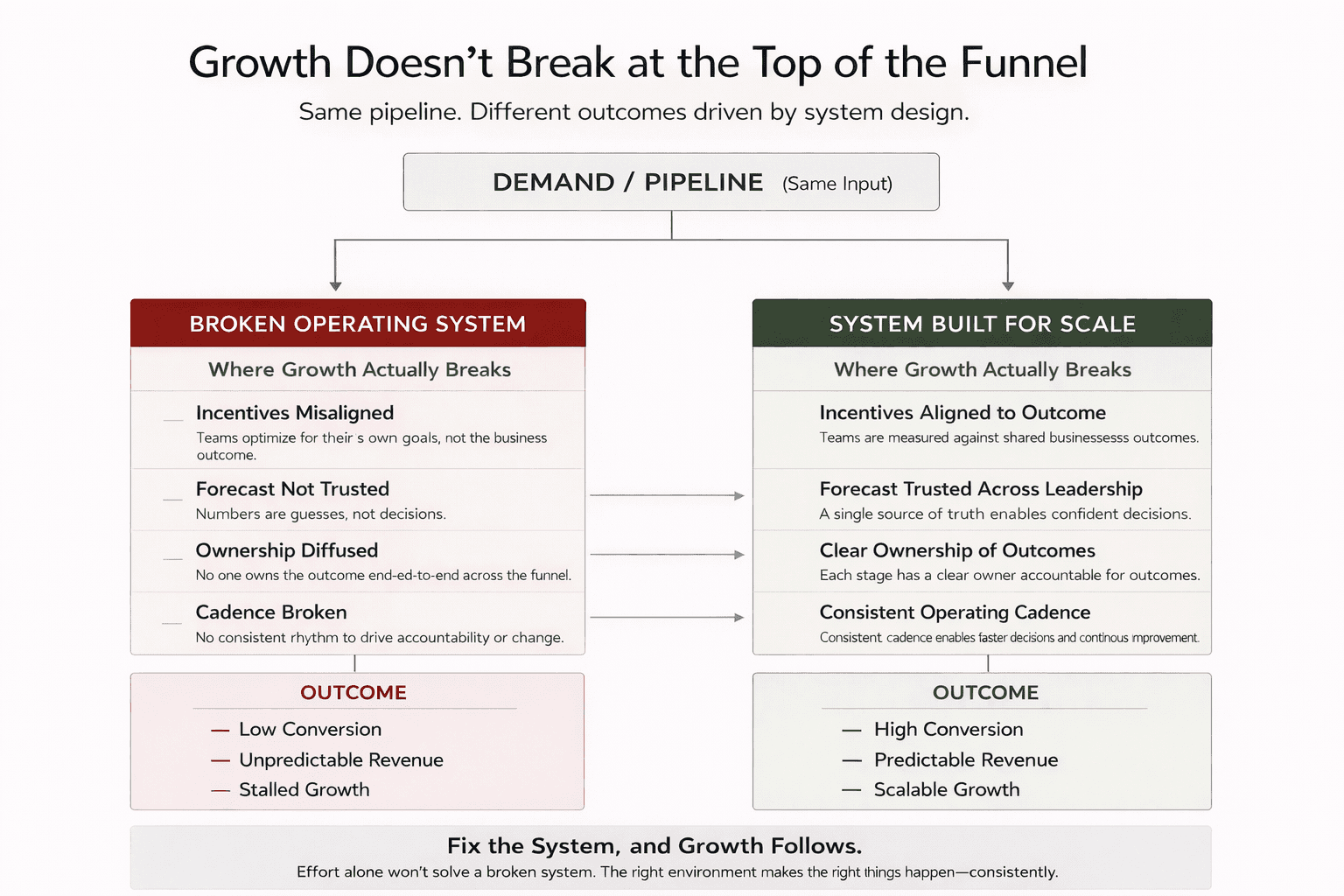
Leaders are often brought in to “drive growth,”and quickly find that while the people are capable and the opportunity exists, the system itself can’t support consistent execution. When incentives are misaligned, forecasting is poor, ownership is unclear, and the operating cadence is weak, it’s impossible to build a foundation for sustainable growth.
A company might have the right people, the right products, and the right market, but if the systems that support those elements aren’t aligned, those assets will never be able to achieve their full potential. This is the issue most leaders face when they walk into an underperforming business: systems that are either outdated or fundamentally flawed, setting them up to struggle before they even begin.
Common System Breakdowns That Hinder Growth
1. Misaligned Incentives:
In nearly every underperforming business I’ve stepped into, incentives are pulling in different directions. Sales is chasing volume, marketing is optimizing for leads, and operations is trying to keep up. Everyone is working hard, but not toward the same outcome.
2. Poor Forecasting:
Forecasting is often treated as a reporting exercise instead of an operating discipline. Numbers get rolled up, but no one trusts them. Leaders end up making decisions without a clear picture of what’s actually happening.
3. Unclear Ownership:
Ownership tends to break down at the seams. Sales hands off to customer success, customer success points to product, and accountability gets diluted. Work is happening, but no one truly owns the outcome.
4. Weak Operating Cadence:
Most teams don’t have a true operating rhythm. Meetings happen, but they don’t drive decisions. Metrics are tracked, but they don’t change behavior. Without a consistent cadence, execution drifts.
These issues show up differently on the surface, but they all point to the same underlying problem: the system isn’t built to support consistent growth. They are common across businesses of all sizes. The result is underperformance, despite having strong people, real market opportunity, and the right ambitions.
What Strong Operators Do Differently
When strong operators step into a new environment, they don’t start by pushing for more. They start by understanding how the business actually runs. Here’s what the best operators do first:
1. Assess the Systems:
Before trying to fix anything, strong operators focus on understanding the systems that are already in place. How is the sales pipeline managed? What does the handoff between sales and customer success look like? How does the team collaborate? By identifying where the system breaks down, they can pinpoint the real issues.
2. Align the Team Around a Common Goal:
Once they understand where the systems are broken, the next step is getting the team aligned. This means aligning everyone, from sales to marketing to operations, on the same vision and the same objectives. Misalignment is a killer for growth, and strong operators know that they need to get buy-in from all departments to move the company forward.
3. Rebuild the Operating Rhythm:
Great operators don’t just set a vision and walk away. They establish an operating cadence that everyone follows. This could mean weekly check-ins with leadership, daily updates on key metrics, or setting up a new process for decision-making. By creating that rhythm, the company can move with purpose and speed.
Managing Performance vs. Rebuilding Systems
Most leadership teams default to managing performance. They push harder, add incentives, and increase activity. It works for a while, but it’s a band-aid.
The real work is rebuilding the system that produces the outcome. Making sure incentives align, ownership is clear, and execution follows a consistent rhythm.
The difference between managing performance and rebuilding systems is the difference between treating symptoms and curing the disease.
Rebuilding for Long-Term Growth
Growth doesn’t come from pushing harder. It comes from building an environment where the right things happen consistently.
When that environment is in place, growth follows. When it isn’t, no amount of effort will fix it.
That’s the difference between a business that scales and one that keeps trying to.
As a leader, you may inherit a broken system. But the good news is that fixing it is possible. By starting with a deep understanding of how the business operates and rebuilding the systems that enable growth, you can set the organization on a path to sustained success.
When you fix the systems, growth follows.
Chad Angle is an operator responsible for leading go-to-market, sales, and operations within a Fortune 250 business unit. He is often brought into situations where growth has stalled to diagnose and rebuild the systems required for scale. He shares additional insights on LinkedIn and on X.