
SentientX Builds Trust and Human Authority for the AI Era
Anthony DeLima advances AI infrastructure to protect human identity and promote global authorization standards for responsible AI actions.

Why Human Identity and AI Authorization Matter Now
The moment that exposes the problem is not science fiction. It is a routine business call. A finance employee joins a video meeting, recognizes familiar executives, hears familiar voices, and follows instructions that appear legitimate. In 2024, that kind of deception enabled a reported $25 million deepfake fraud in Hong Kong. No firewall had to fall. The breach was more fundamental. A face and a voice were accepted as proof of identity. For Anthony DeLima, CO-Founder and CEO of SentientX, the incident illustrates a larger challenge. Artificial intelligence is gaining the ability to replicate human identity and execute autonomous decisions, yet the infrastructure needed to establish authenticity, consent, and authority remains fragmented.
AI has fundamentally changed the economics of imitation. A person's voice can be cloned, their likeness digitally replicated, and their identity exploited in fabricated endorsements or commercial campaigns without authorization. Meanwhile, autonomous AI agents are gaining access to financial systems, corporate information, and critical operations. DeLima believes these developments expose two connected weaknesses. Individuals are losing control over how their identities are represented and monetized, while AI systems are gaining the ability to act without a common mechanism for verifying legitimate authority. SentientX is addressing both challenges through its operational Human Identity Bank™ and a broader proposal for a global AI authorization infrastructure submitted to the United Nations.
The Human Identity Bank: Protecting Human Authenticity
SentientX has developed and is operating the Human Identity Bank, a platform designed to protect human authenticity in the age of AI. Unlike conventional deepfake detection tools, it combines verified identity custody, consent management, licensing, continuous monitoring, forensic investigation, and enforcement support. Individuals can establish protected digital references for their name, image, likeness, and voice while defining who may use them, for what purpose, and under which conditions. The platform monitors social and digital channels for potential misuse, including unauthorized replication, misleading representations, and commercial exploitation outside approved licensing agreements. Its purpose extends beyond detecting suspicious content to determining whether identity use was authorized and supporting action when violations occur.
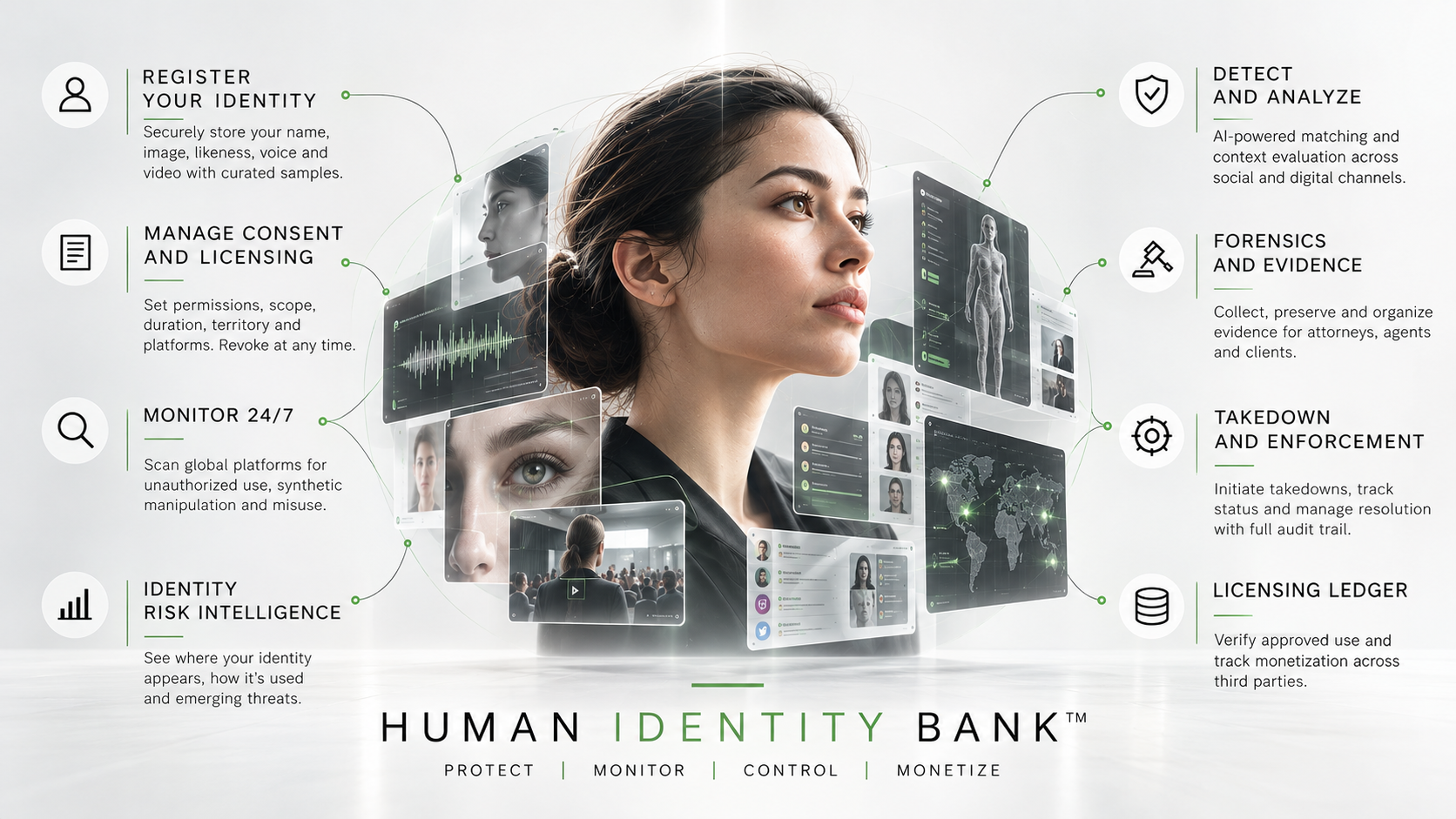
"The challenge is no longer simply identifying what is fake," DeLima explains. "We need to establish who controls a person's digital identity, who has permission to use it, and what happens when that permission is violated." This distinction matters for artists, athletes, executives, creators, and public figures whose identities carry significant reputational and commercial value. An athlete's likeness can appear in an unauthorized advertisement. An executive's voice can be replicated to initiate fraud. An artist's image or creative work can be manipulated and distributed before their representatives discover it.
Detection alone cannot resolve these incidents. Individuals and their representatives need to establish what was used, whether permission existed, and what actions can protect their rights.
A Digital Forensics Engine
An important capability of the Human Identity Bank is its forensic investigation and action engine, designed to help attorneys, talent agents, athlete representatives, and rights holders investigate identity misuse across social and digital channels. The engine supports investigations into unauthorized licensing, digital impersonation, manipulated content, and incidents affecting a client's reputation or commercial interests. Authorized representatives can examine relevant content, reconstruct events, assess licensing permissions, preserve evidence, and coordinate responses. These capabilities support legal investigations, takedown requests, enforcement, and the resolution of identity-related disputes.
Consider an attorney representing an athlete involved in a disputed public incident. Relevant evidence may include social media posts, videos recorded by bystanders, commentary, and material distributed across multiple platforms. The Human Identity Bank's investigative capabilities are designed to help identify and organize this information, establish context, and preserve evidence for legal review. The same environment can help determine whether an athlete's likeness was commercially exploited without permission or whether a particular use violated an existing agreement. SentientX aims to replace fragmented investigations with an integrated environment that helps attorneys and agents uncover violations faster and take informed action. The company is positioning the Human Identity Bank as infrastructure for managing identity rights in an economy where digital replication is increasingly accessible.
Beyond Human Identity: A Global AI Authorization Infrastructure
While the Human Identity Bank addresses an immediate threat, DeLima believes the larger challenge lies in establishing the authority under which artificial intelligence operates. AI is evolving from systems that generate information into autonomous agents capable of accessing accounts, executing transactions, and interacting with enterprise systems. Existing cybersecurity frameworks authenticate users and manage access, while AI governance initiatives address safety and accountability. Yet these mechanisms do not necessarily establish whether a specific autonomous action has been legitimately authorized. An AI agent may possess valid credentials and technical access without having permission to execute a transaction. Capability does not establish authority. Access does not constitute permission.
SentientX is advocating for a federated global AI authorization infrastructure modeled conceptually on SWIFT, the secure messaging network connecting financial institutions internationally. SWIFT provides common standards and trusted communications while participating banks retain responsibility for authorizing transactions. DeLima believes a comparable collaborative model could establish a shared authorization verification layer for AI execution. Governments, international institutions, technology providers, and private enterprises would participate in a network capable of verifying whether an AI agent has legitimate authority to perform a specific action. Permissions could define the responsible party, permitted activity, restrictions, duration, and revocation conditions. Participating platforms would verify authorization before executing protected actions.
The proposed architecture would remain federated, allowing institutions to retain control of their systems and information while operating through common standards.
Taking the Global Authorization Proposal to the United Nations
DeLima has submitted this concept to the United Nations, advocating for international collaboration on an AI authorization framework that operates across organizational and national boundaries. The proposal recognizes that AI systems increasingly function globally while the legal and institutional authority governing their actions remains fragmented. An autonomous agent operating in one country may access services in another and initiate transactions involving multiple institutions. National regulation and corporate policies remain necessary, but neither independently establishes consistent authorization across international systems. SentientX therefore proposes a cooperative infrastructure through which participating entities could issue, verify, enforce, and revoke permissions using shared technical and governance principles.
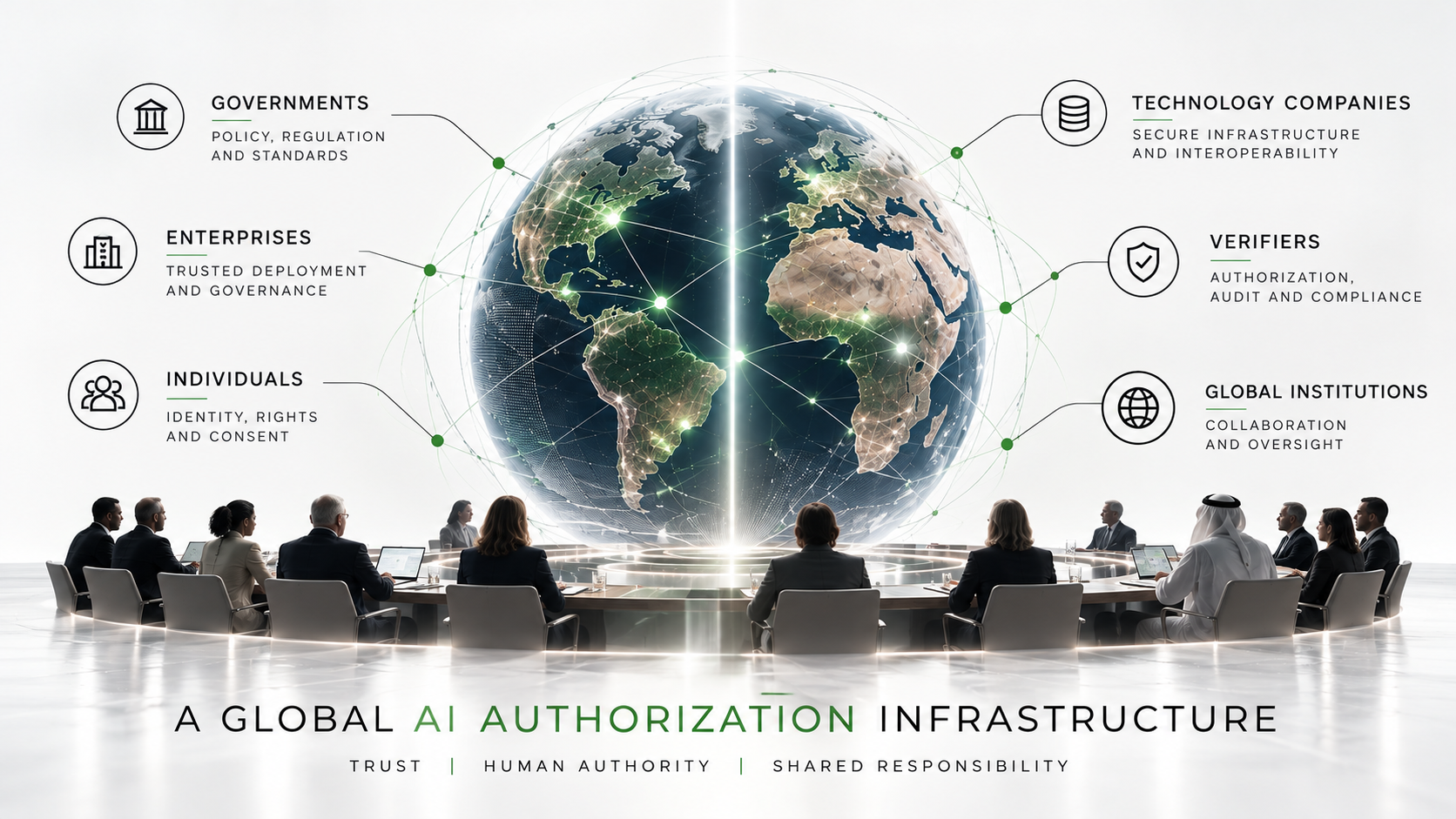
The initiative builds on arguments DeLima has advanced publicly, including in his published Leader Report article, emphasizing that AI governance must evolve beyond technical capability toward verifiable human authority. The UN submission is a proposal for international consideration, not an adopted United Nations program. Its objective is to encourage governments, standards bodies, technology companies, and private enterprises to establish common authorization mechanisms before autonomous AI becomes deeply embedded in critical economic systems. "The world cannot allow every AI platform to independently define the authority under which its agents operate," DeLima argues. "We need shared infrastructure that verifies permission before AI executes consequential actions." The governing principle is straightforward: authorization before execution.
Building the Infrastructure for the Next Era of AI
DeLima brings more than 30 years of international technology leadership to this challenge, including senior positions at EY, KPMG, Telefónica, and other global organizations. His experience spans enterprise transformation, technology strategy, and critical digital infrastructure across the Americas, Europe, and Asia Pacific. That background shapes SentientX's approach. Global infrastructure requires more than technology. It depends on common standards, institutional trust, governance, and cooperation. SentientX applies these principles to its AI-first enterprise initiatives and its broader commitment to protecting human identity and advancing accountable autonomous systems. The company reports 45 U.S. patent filings across its technology initiatives.
The Human Identity Bank and the proposed global AI authorization infrastructure address distinct problems but share a common foundation. The first protects how human identity is represented, licensed, monitored, and enforced. The second seeks to establish the authority under which autonomous AI systems act. One is an operational platform SentientX is delivering today. The other requires international cooperation beyond any single company. Together, they reflect DeLima's conviction that artificial intelligence cannot reach its full potential without mechanisms that preserve human consent, rights, and institutional accountability.
For DeLima, the defining challenge is not whether AI will become capable of performing increasingly complex tasks. That progression is already underway. The challenge is whether humanity will establish the infrastructure needed to ensure those capabilities remain subject to legitimate human authority. SentientX intends to contribute to that future by protecting human authenticity through the Human Identity Bank and advancing a global framework that verifies permission before autonomous AI acts.
The future of AI should not be defined solely by what machines are capable of doing. It must be defined by what humanity authorizes them to do.
Explore More About SentientX
Discover the Human Identity Bank™, its identity protection and forensic investigation capabilities, and SentientX's vision for a global AI authorization infrastructure.
SentientX | Protecting Human Identity. Advancing Human Authority.
Learn more at www.sentientx.com.