
Washington Turns Up the Pressure as Courts, War and Immigration Shape a Consequential Friday
The United States closed out Friday with major developments spanning foreign policy, the Supreme Court, immigration enforcement, military press freedom and trade. The Trump administration intensified its economic campaign against Iran while preparing for another confrontation with Canada, as domestic disputes over presidential authority and federal power continued to move through the courts.
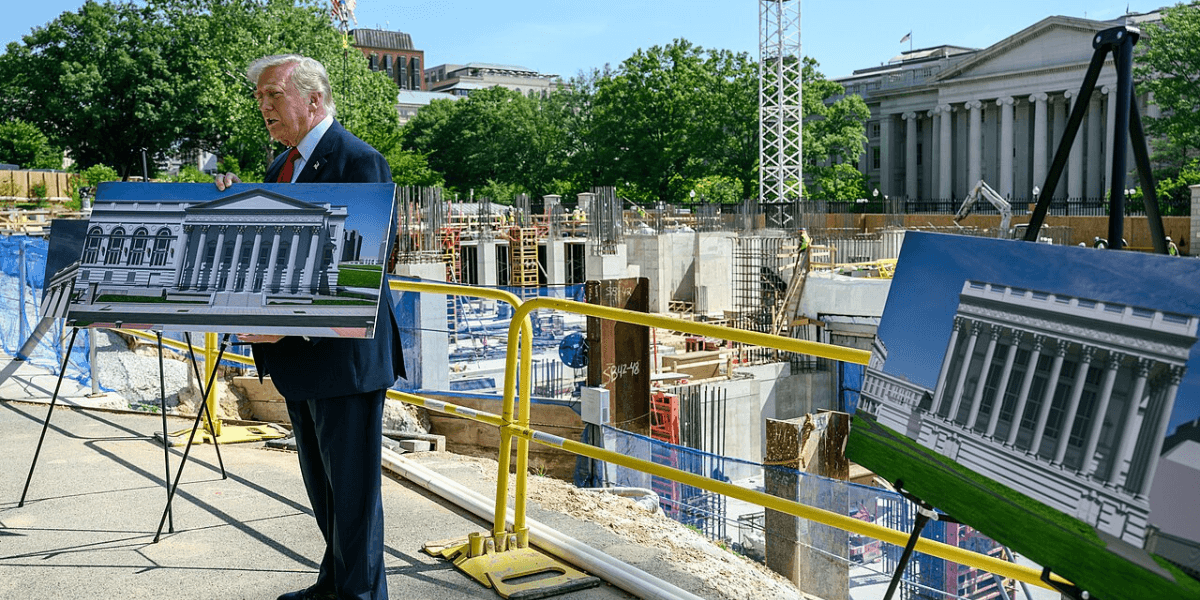
Supreme Court Lets White House Ballroom Construction Continue
Chief Justice John Roberts temporarily allowed the Trump administration to continue construction of President Donald Trump’s controversial White House ballroom project, preventing a lower-court order from halting aboveground work while the Supreme Court considers the administration’s emergency appeal.
The dispute centers on whether the administration can proceed with the massive addition to the White House complex without congressional authorization. An appeals court had concluded that the project probably required congressional approval and had set a Friday deadline that could have stopped construction. Roberts’ administrative stay does not settle that underlying legal question; instead, it preserves the status quo while the high court considers what to do next.
The case has become another test of the boundaries between presidential authority, congressional control over federal property and spending, and judicial oversight of the executive branch.
U.S. Shifts Iran Strategy Toward Sweeping Economic Pressure
The Trump administration moved toward a new phase of its conflict with Iran, emphasizing financial isolation and economic pressure after months of military confrontation. Vice President JD Vance said the conflict had entered a phase in which economic measures were becoming Washington’s most effective tool, while Treasury Secretary Scott Bessent prepared to unveil what he described as extraordinarily severe sanctions on Tehran.
The administration is also pressing other countries to cooperate, placing particular attention on China because of its economic relationship with Iran. Beijing publicly rejected the approach Friday, saying sanctions and pressure would not resolve the conflict. Iranian officials likewise vowed to resist the campaign, while oil markets remained sensitive to the confrontation and disruptions around the Strait of Hormuz.
The shift has significant implications for U.S. foreign policy and the domestic economy. Washington is attempting to increase pressure on Tehran without immediately returning to large-scale military operations, but further disruption to Persian Gulf energy flows could continue affecting oil prices and inflation.
Pentagon Moves Against Stars and Stripes Leadership
The Pentagon issued separation notices Friday to senior figures at Stars and Stripes, the military newspaper with a longstanding tradition of editorial independence. Editor-in-chief Erik Slavin, publisher Max Lederer and Middle East reporter Lara Korte received notices, with insubordination cited as the reason.
Slavin said his dismissal followed public comments in which he argued that censorship of news provided to service members would cross a red line. Korte similarly said she had emphasized that she worked for Stars and Stripes, rather than for Pentagon policymakers. The Defense Department has been pursuing a broader overhaul of the publication, prompting concerns from journalists and lawmakers about whether its legally protected editorial independence is being weakened.
The confrontation carries implications beyond the newspaper itself, raising questions about press freedom, civilian oversight of military institutions and the information available to American service members.
Deportations to Haiti Accelerate After TPS Protections End
Immigration enforcement entered another consequential phase as the administration began deporting Haitians following the termination of humanitarian protections for hundreds of thousands of Haitian nationals in the United States. A removal flight carrying roughly 170 people landed in Cap-Haïtien on Thursday, with reporting on the operation continuing into Friday.
The removals come after the administration ended Temporary Protected Status protections affecting about 350,000 Haitians. The policy has drawn particular attention because Haiti continues to face severe instability and gang violence, conditions that have also disrupted normal commercial aviation into Port-au-Prince. Community advocates reported increased immigration arrests as people who had previously been protected from removal lost their legal safeguards.
The development signals the expanding practical effects of the administration’s immigration agenda, as changes to humanitarian programs increasingly translate into detention and deportation operations.
U.S.-Canada Trade Talks Reach the Brink
Trade negotiations between Washington and Ottawa deteriorated sharply Friday as negotiators failed to secure an agreement before a new round of U.S. tariffs. The dispute put the deeply integrated North American trading relationship under renewed strain, with Canada preparing retaliation and both governments blaming the other for the breakdown.
The United States prepared 50% tariffs on roughly $20 billion of Canadian goods, scheduled to take effect just after midnight Eastern time, while Canada planned equivalent countermeasures. Although the affected trade represented only a portion of overall bilateral commerce, the confrontation raised larger questions about future negotiations over the U.S.-Mexico-Canada trade framework and cross-border supply chains.
For American businesses and consumers, the immediate concern is whether the dispute broadens into additional sectors. Canada remains one of the United States’ largest trading partners, meaning a sustained escalation could affect manufacturers, retailers and commodity markets on both sides of the border.
Looking Ahead
Attention now turns to several unresolved fronts. The Treasury Department is expected to provide details of its expanded Iran sanctions campaign on Monday, while markets will watch for effects on oil prices and relations with China. The Supreme Court must decide whether to extend or end the temporary protection allowing White House ballroom construction to continue, and the Pentagon’s actions at Stars and Stripes could face appeals or additional political scrutiny.
Meanwhile, immigration enforcement against former TPS holders is likely to remain a major domestic issue, and the breakdown in U.S.-Canada negotiations threatens to deepen one of Washington’s most consequential trade disputes. Together, Friday’s developments underscored a broader theme running through the summer of 2026: an expansion of executive power at home and economic pressure abroad, accompanied by intensifying legal and political challenges over how far those policies can go.