
Why Podcasting Needs Growth Intelligence
Why downloads alone can no longer explain podcast growth.
Podcasting has never been more competitive. Millions of shows compete for attention across Spotify, Apple Podcasts, YouTube, Google and an increasing number of AI-powered search and recommendation platforms. Yet despite having access to more analytics than ever before, many creators still cannot answer one fundamental question: Why isn’t my podcast growing?
For years, success has been measured through downloads, followers and listener demographics. Those numbers explain what happened, but they rarely explain why one podcast is discovered while another remains virtually invisible.
That question is becoming one of the defining challenges of modern podcasting. GrowMyPod believes the industry has been looking for the answer in the wrong place.
Podcast Growth Intelligence Begins with Diagnosis
For nearly two decades, podcasting has measured itself through backward-looking data. Downloads rose or fell. Followers increased or stalled. Listener geography painted a picture of where attention had already appeared. Those insights still matter, but they do not explain the deeper problem facing many creators. A strong episode can be well produced, useful, and relevant, yet still struggle because its title lacks search intent, its description is too broad, or its show has not been distributed widely enough across the places new listeners now search.
GrowMyPod was founded to address that gap. Rather than building another analytics platform, founder Matt Tones started with a different question: What is preventing a podcast from being discovered in the first place? “We realised podcasters were not short on analytics. They were short on answers. Downloads tell you what happened yesterday. They do not tell you what is stopping growth tomorrow.” That distinction gives GrowMyPod its defining point of view. It is not trying to replace hosting platforms, agencies, or traditional analytics. It addresses a different question entirely: what should a podcaster improve next?
The timing matters. Podcasting has moved into a more complex discovery environment. Listeners no longer find shows only by browsing Apple Podcasts or hearing a recommendation from a friend. Listeners now discover shows through Spotify, YouTube, Google, Reddit, LinkedIn, AI Assistants and recommendation systems that interpret the meaning of content before deciding what to surface. As a result, podcasts are no longer competing only for ears. They are competing to be understood by search engines, platforms, and machines, as well as by human audiences.
That shift resembles the moment websites entered their SEO era. In the early web, many businesses assumed that simply launching a site was enough. Then search changed the rules. Structure, keywords, clarity, authority, and user intent became essential to visibility. Podcasting is reaching a similar stage. Recording a strong interview or publishing consistently still matters, but it is no longer the full strategy. The question is whether the show communicates clearly enough for listeners and discovery systems to understand who it serves, what it covers, and why it deserves attention.
Why GrowMyPod Looks Beyond Traditional Metrics
The concept of growth intelligence represents a shift in thinking. Traditional analytics explain what has already happened. Growth intelligence focuses on understanding what may be limiting future audience growth and identifying the actions most likely to improve discoverability.
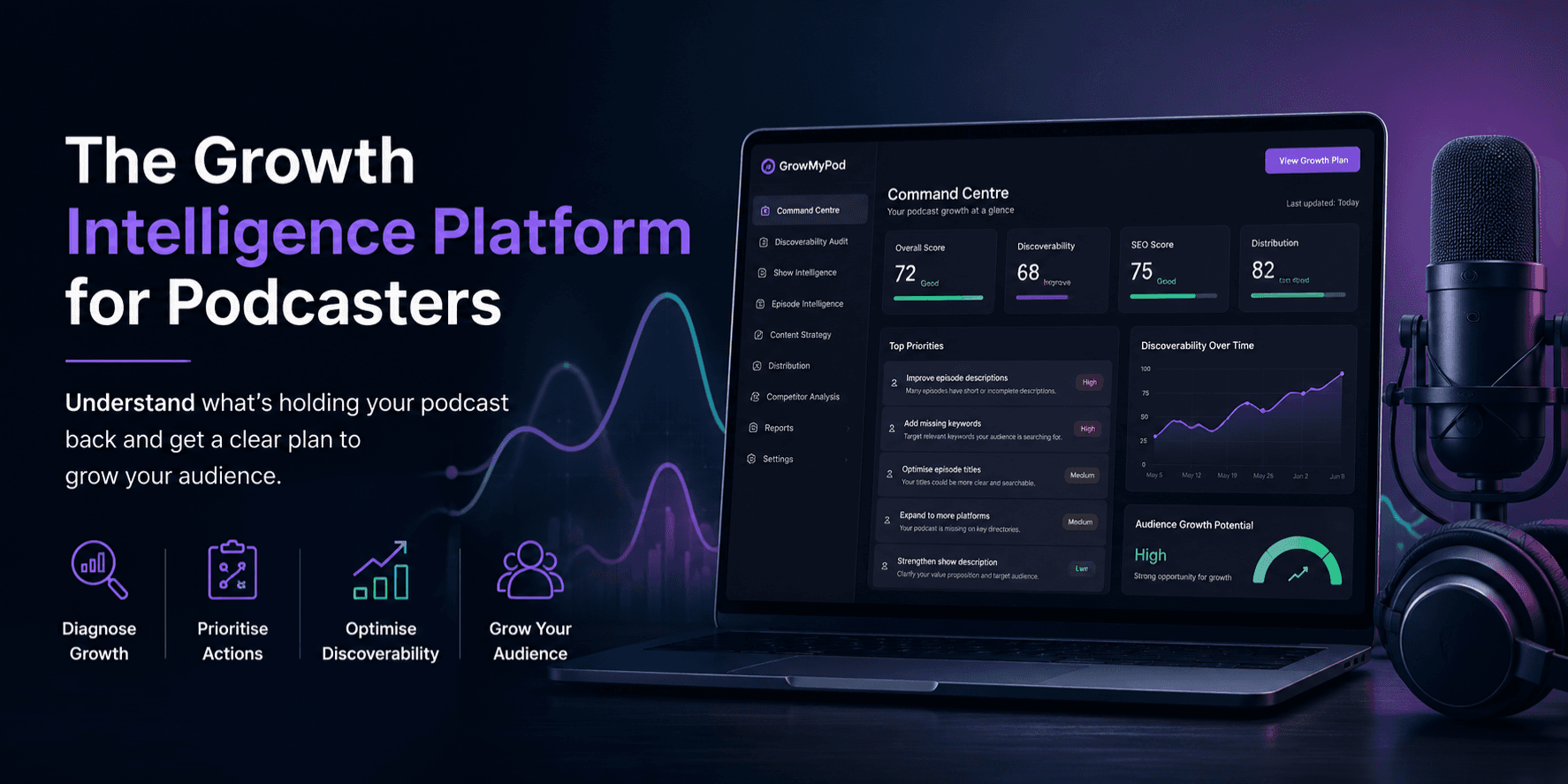
GrowMyPod analyses the signals that influence discoverability - including metadata, search intent, platform coverage, content gaps and competitor positioning - to produce a prioritised action plan.
That matters because most podcasters do not need more noise. They need clarity. A creator who sees declining downloads may assume the content is not good enough. In some cases, the content may need work. In many others, the issue may sit upstream. The show might not be visible in enough places. Episode descriptions might not match what listeners are searching for. Titles may be memorable to existing subscribers but invisible to new audiences. Topics may be valuable, yet poorly framed for discovery.
Instead of overwhelming creators with data, the platform prioritises actions. Whether the issue is metadata, distribution, content positioning or discoverability, the objective is the same: provide a clear starting point rather than another dashboard full of charts.
Most podcast platforms measure performance.
GrowMyPod studies potential.
It asks questions traditional analytics rarely answer:
Is the show easy to understand?
Are episodes aligned with listener search intent?
Are competitors owning topics this podcast hasn’t explored?
Are discoverability signals working together?
These questions shift the conversation from reporting results to improving future outcomes.
Tones summarises the philosophy simply:
“Podcasting does not have an analytics problem. It has a diagnosis problem”
The sentence lands because it speaks to a frustration many creators recognize. They do the work, publish regularly, and review the numbers, but the next move remains unclear. Podcast growth intelligence fills that space between effort and direction. It does not guarantee outcomes. Instead, it helps podcasters see what may be limiting visibility and which improvements are most likely to matter.
The Future of Podcast Discoverability
Podcast discoverability is changing rapidly. Listeners increasingly rely on search engines, recommendation systems and AI assistants to find new content. That means podcasts need to communicate clearly - not only to people, but also to the systems responsible for recommending them.
"Tomorrow's listeners will not just discover podcasts by browsing an app," says Tones. "They will ask AI assistants for recommendations. That means podcasts need to be understood by machines as well as people."
For creators, this represents a new way of thinking about growth. Discoverability is no longer just about publishing regularly. It’s about understanding the signals that influence whether a podcast is found in the first place.
As podcasting becomes more competitive, creators need more than creativity alone. They also need insight into search behavior, audience intent, and content structure. GrowMyPod brings these signals together into a single growth intelligence system, helping podcasters make smarter decisions and support sustainable audience growth.
Podcasting is entering a new phase - one where discoverability may become just as important as production quality. As creators compete across search engines, recommendation systems and AI-powered discovery platforms, understanding why a podcast is or isn’t being found will become increasingly valuable.
Whether growth intelligence becomes the next standard for podcasting remains to be seen. But as discoverability becomes increasingly complex, the need to understand - not just measure - podcast performance is only likely to grow. GrowMyPod believes the future belongs to creators who understand why their podcast is or isn’t being discovered, and who can act on those insights before opportunities are lost.
Learn more at GrowMyPod, or follow on LinkedIn, and Facebook.