
April’s Solar Surge: Why Standard Weather Models Are Missing This Month’s Catastrophic Hail Threat
As spring weather patterns intensify, an emerging threat from above the clouds could leave commercial infrastructure exposed to dangerous hailstorms.
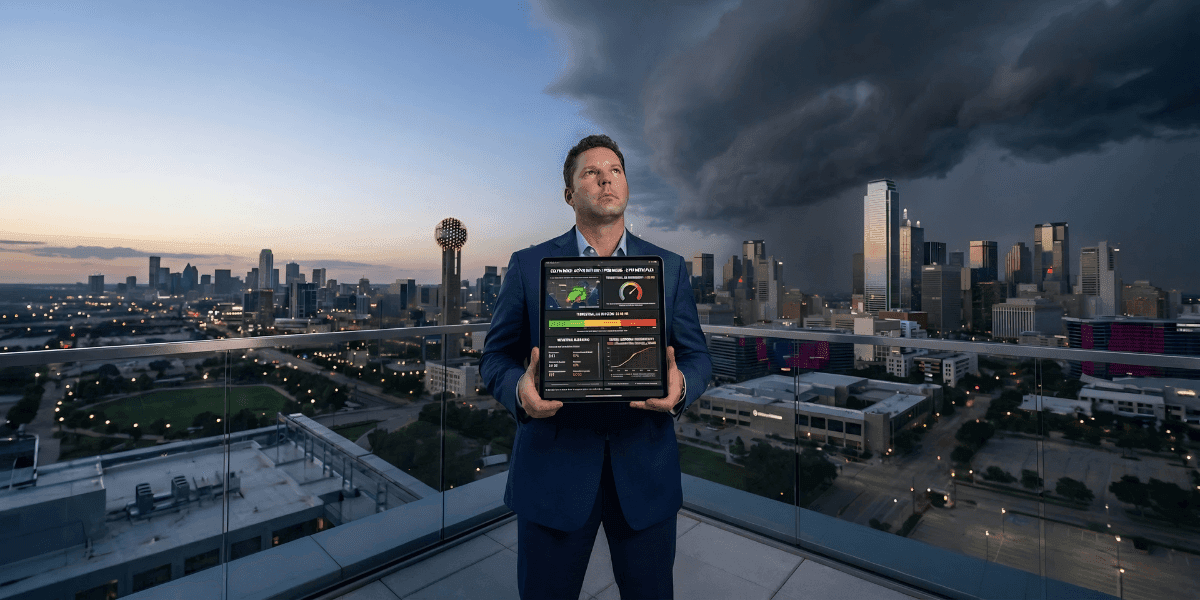
NATIONWIDE - APRIL 2026 - (USAnews.com) — As the United States enters the unpredictable spring severe weather season, a familiar set of weather patterns typically begins to emerge: spring showers, thunderstorms, and the occasional severe storm. However, this April, a new and unexpected threat is gaining attention, and it doesn’t come from the usual meteorological sources. The usual weather models, such as the GFS, NAM, and HRRR, are failing to predict a catastrophic danger originating from a place no one expects, above the clouds.
Dale Colvin, President of Blue Eagle General Contractors and Vice President of Themis Legal Group PLLC, is raising the alarm about an emerging risk to commercial developers and insurance sectors this month. According to Colvin, the real danger isn't just the traditional rain and wind; it's the unpredictable surge in space weather that has the potential to drastically change the course of severe weather.
A Critical Gap in Forecasting
For decades, meteorologists have relied on terrestrial data to predict weather patterns. Models such as the GFS, NAM, and HRRR use atmospheric temperature and humidity profiles to forecast conditions. While these tools have proven effective for tracking general rain patterns and wind, they are not sufficient for predicting extreme weather events such as large hailstorms. Often, they suffer from what Colvin refers to as “intensity blindness,” missing the signs of rapidly escalating weather conditions, including the formation of massive hailstones.
The problem, Colvin explains, is that standard weather models are focused exclusively on conditions below the Earth's surface. “They are missing the extraterrestrial catalyst,” he notes. These models don’t take into account solar activity, which can have a profound effect on atmospheric behavior.
To bridge this gap, Colvin has developed the Colvin Solar-Atmospheric Index (CSAI), a predictive model that integrates real-time heliophysical data from satellites. The CSAI uses data streams from solar flares and solar wind to help forecast when weather events will intensify rapidly.
The Solar-Weather Connection
At the heart of the CSAI is a simple but powerful insight: solar activity impacts the Earth’s atmosphere in ways that standard weather models do not account for. When a solar flare or high-speed solar wind stream hits the Earth, it rapidly destabilizes atmospheric lapse rates over landmasses. This phenomenon creates a forcing mechanism that leads to explosive convective updrafts, the key factor in forming hailstorms. According to Colvin, this is the missing link between solar activity and severe hail.
“The solar energy impacts the Earth's atmosphere in a way that causes atmospheric conditions to destabilize,” Colvin explains. “This destabilization leads to intense updrafts that allow hail to grow to dangerous sizes.”
Through historical analysis, Colvin’s research has shown that these solar-driven intensification events follow a specific time window, usually within 24 to 48 hours after the solar energy impacts Earth. This period, which Colvin refers to as the “Lag Window,” is critical for understanding when extreme weather is most likely to occur.
The Colvin Index in Action
Using the CSAI, Colvin can forecast when a solar event will interact with terrestrial atmospheric instability to create conditions ripe for explosive storms. The model generates a Severity Index Score that offers an early warning of the likelihood of severe weather. This allows for a significant shift in how commercial risk management is approached.
In the past, construction companies and insurance firms would only react to weather warnings once a storm developed. However, the CSAI offers a preemptive approach. With its 24 to 48-hour early warning system, project managers can take steps to protect high-value assets before the storm even forms. Instead of waiting for a standard thunderstorm watch to be issued, companies can preemptively secure jobsites, lock down loose materials, and take necessary compliance steps with contractors and subcontractors.
“We’ve moved from reactive damage control to Active Risk Mitigation,” Colvin says. “By leveraging this solar-based forecast, companies can reduce exposure and minimize losses from extreme weather events.”
The 2023 Solar Cycle: A Game Changer
April 2023 is shaping up to be a particularly active month in terms of solar activity. With increased solar flares and Coronal Mass Ejections (CMEs) forecasted, Colvin warns that traditional weather models will miss the true severity of the storms. These solar events have the potential to amplify thunderstorms, making them much more dangerous than initially predicted by terrestrial forecasting models.
“This year, the solar activity is expected to be higher than in previous years,” Colvin notes. “This means the potential for rapid escalation of storms is greater than ever. We're already seeing the signs that standard weather models will miss the intensity of these storms. And that’s where the Colvin Index comes in.”
For industries involved in construction, infrastructure, and commercial insurance, this is a critical point. Relying on standard weather models without considering solar activity leaves billions of dollars in high-value assets exposed. It’s no longer enough to trust forecasts that don’t take the full spectrum of environmental forces into account.
Protecting Infrastructure with Solar-Aware Risk Management
The key takeaway for businesses is clear: It’s time to rethink risk management in the age of solar activity. Commercial developers, construction firms, and insurers need to factor in the effects of space weather when assessing risks for severe storms, especially when it comes to hail. Without incorporating solar data into their forecasts, they may be leaving themselves vulnerable to sudden and catastrophic weather events.
Thanks to the CSAI, risk managers can now make informed, proactive decisions to safeguard assets against the rapidly escalating threat of severe hailstorms. As Colvin puts it, “The next major weather event won’t just come from the local radar. It will be driven by the sun.”
Stay ahead of the storm. Act now to secure your assets.