AR Labs: How Fasi Uddin Mir Is Reassessing a Graduate-School Venture Concept
Created during graduate studies, AR Labs is being revisited in 2026 as Fasi Uddin Mir reexamines its assumptions and considers what a practical path forward would require.
What happens when an idea developed in a university classroom faces the demands of the real world? For game producer Fasi Uddin Mir, that question has become central to AR Labs, an augmented-reality venture concept he originally developed during graduate school. Years after outlining its potential applications and business strategy, Mir has returned to the project with a different perspective.
Rather than announcing a startup, he is examining what it would take to develop the concept into a viable business. His reassessment focuses on establishing the venture, identifying real-world problems worth solving, exploring product possibilities, and determining what evidence will be needed to develop the business further.
How AR Labs Began at the University of Advancing Technology
AR Labs originated during Mir's master's studies at the University of Advancing Technology (UAT) in Tempe, Arizona, where he completed an MS in Game Production and Management. The concept developed through graduate projects including MS528, Final Project: Facilities, and MS559, Leadership Philosophy, both taught by Dr. Mark Smith. An AR Labs Strategic Plan dated October 7, 2021, further explored the proposed venture.
These academic projects envisioned augmented reality products and digital solutions addressing practical problems, with potential applications in education and other industries. They examined product development, marketing, customer collaboration, leadership, operations, and organizational growth. The strategic plan emphasized Lean Startup methodology, customer feedback, experimentation, and continuous improvement. However, AR Labs remained an academic venture concept rather than an established commercial company.
Why Fasi Uddin Mir Returned to AR Labs in 2026
As Mir gained professional experience, his understanding of technology development and entrepreneurship evolved. His interdisciplinary background includes game design, game production, augmented and virtual reality, marketing, and collaborative projects. His commercial game-development experience includes a level-design credit on The Skater Boy Part 2. In his July 2026 public release, Mir reported that the title had surpassed 500,000 installs during its time on Google Play. He has also contributed to projects involving augmented reality business cards, virtual environments, precision farming, AR weather applications, and web applications using Unity and PlayCanvas.
These experiences prompted Mir to reconsider the original AR Labs concept. Instead of treating his academic business plan as a finished blueprint, he began examining its underlying assumptions.
“I came back to AR Labs years later with a different question. It was no longer simply, ‘How do I build this idea?’ It became, ‘What would actually have to be true for this idea to work in the real world?’” Mir reflects.
The shift is from treating the original business plan as a blueprint to treating it as a set of assumptions to examine. The 2021 Strategic Plan and Business Model Canvas record the original proposals for value propositions, customer segments, distribution channels, costs, and revenue streams. In 2026, Mir is revisiting these elements as questions to investigate—not as evidence of an established market opportunity. The next step is to determine what should be tested and demonstrated to guide the venture's future direction.
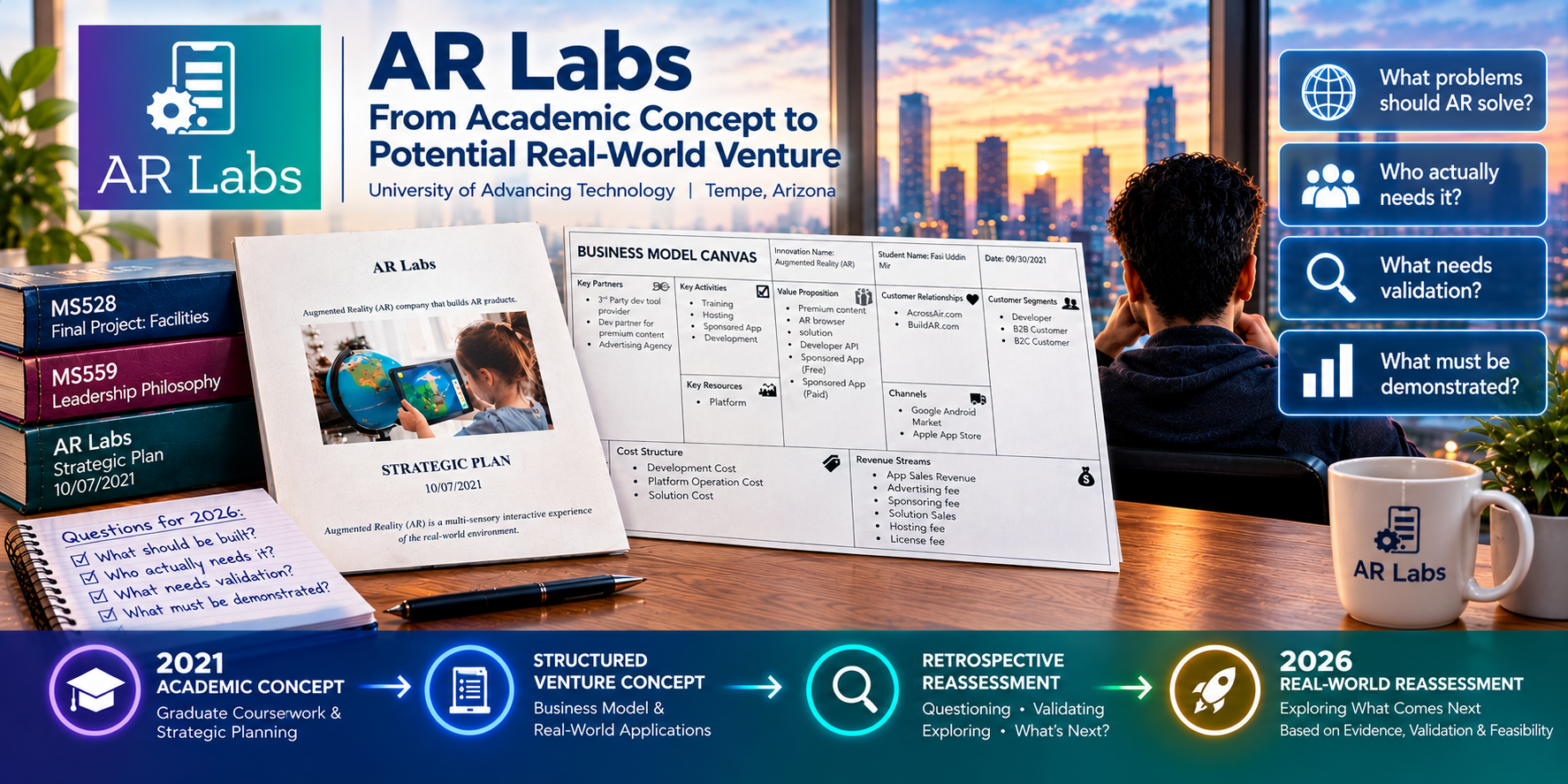
Illustration: AR Labs' journey from graduate coursework to real-world reassessment.
From Academic Planning to Practical Business Decisions
One significant example involves company formation. The original coursework envisioned AR Labs in Austin, Texas. In 2026, Mir began comparing the formation costs, ongoing requirements, and practical implications of establishing a U.S. limited liability company in different states. He intends to form an LLC as a solo founder but has not yet selected a state.
For him, formation is an initial step in a longer process, not proof that the underlying business idea has been validated. Product direction, the problems worth solving, and a potential approach to funding remain areas for further exploration.
The same scrutiny applies to product development and market validation. Mir is exploring which augmented reality problems are worth addressing, who might benefit from potential solutions, and how customer demand could be tested. He is also examining operational feasibility, remaining risks, and what would need to be demonstrated before considering external funding.
“I want to understand what should be built, who genuinely needs it, what evidence supports the opportunity, and what still needs to be proven,” Mir explains.
This approach reflects a commitment to responsible entrepreneurship. Rather than presenting academic projections as business achievements, Mir is separating what has been studied from what remains untested.
How Professional Experience Shapes the AR Labs Vision
Mir's earlier experience includes managing an online store and participating in entrepreneurship and mentorship programs. His professional profile records Top Performer recognition in the CEO for a Month Challenge, where he placed among the top 2% of participants.
More recently, he has developed an Open Knowledge Initiative featuring two nine-part, ad-free journal series: Weekly Journal: Reign and Rebellion – My Role as Producer and Weekly Journal: Fizzling's Fun House – My Role as Marketer. These publications explore game production, Agile workflows, marketing, collaboration, retrospectives, and continuous improvement. They aim to make practical knowledge more accessible to students, aspiring developers, educators, and industry professionals.
The lessons from these projects influence how Mir approaches AR Labs today. Drawing on the experimentation and collaboration central to game production, he is revisiting earlier assumptions, examining customer needs, and considering practical feasibility rather than claiming an established competitive advantage. The goal is to determine whether a meaningful problem can be identified and addressed through a sustainable approach.
What Comes Next for AR Labs?
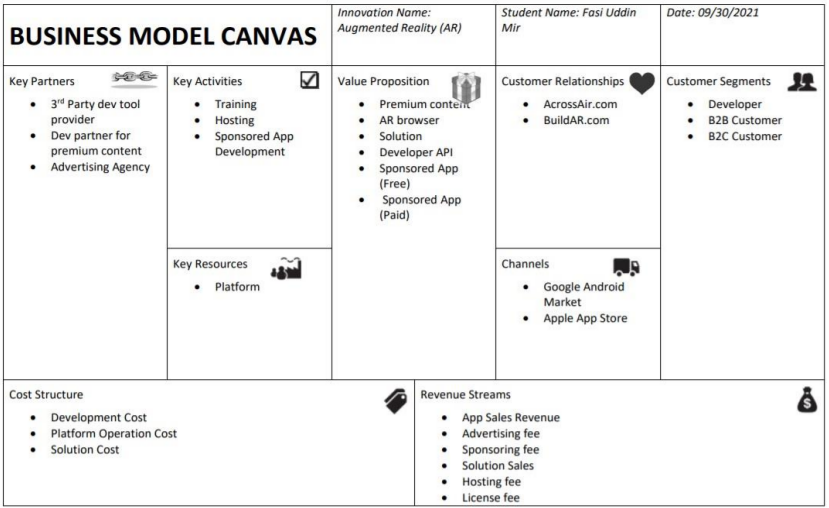
Original AR Labs Business Model Canvas, dated September 30, 2021.
In 2026, AR Labs remains a graduate-school venture concept undergoing real-world reassessment. It is not an operating company with established customers, revenue, employees, commercial products, or external funding.
Several questions remain: What product should be developed, and which real-world problems should it address? Is there evidence of customer demand? Can a proposed solution be delivered effectively? Mir is also evaluating suitable LLC formation options, the operating model, and the evidence needed to refine the business model and support future funding.
For Mir, revisiting AR Labs helps distinguish the decisions documented in his original coursework from the questions that require further investigation. Those materials provide a foundation for inquiry, but their assumptions still need to be examined against real-world conditions.
Explore Fasi Uddin Mir's Work
Readers interested in the AR Labs journey can learn more about Mir's professional background through his LinkedIn profile. His writing on game production, marketing, collaboration, and continuous improvement is available through Weekly Journal: Reign and Rebellion – My Role as Producer and Weekly Journal: Fizzling's Fun House – My Role as Marketer.
For aspiring entrepreneurs, developers, and students, the AR Labs story illustrates the difference between establishing a company and validating a business. Mir intends to form an LLC, but defining a product, identifying whom it should serve, assessing feasibility, and gathering supporting evidence remain part of the work ahead. The next stage is not a declaration of success, but a structured effort to determine whether the concept can support a viable venture.