
Are We Living Through A Pattern Of History Seen Before Or Is It All Random
Shock History explores the idea that major global events follow recurring long term cycles, offering readers a new way to understand the past.
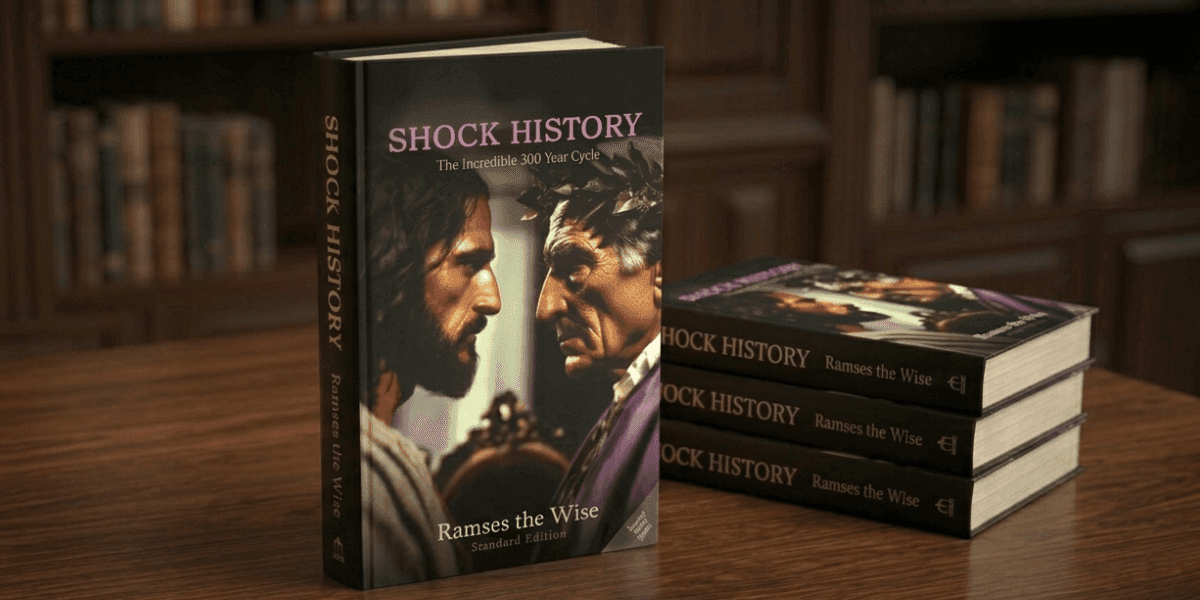
History is often taught as a sequence of dates, wars, leaders, and events. Students memorize timelines. Readers learn about revolutions, economic collapses, empires, and political transformations. Each event is typically presented as a unique chapter in humanity's story.
But what if history is not as random as it appears?
What if the same forces that shaped civilizations hundreds of years ago continue to influence the world today?
These questions sit at the heart of Shock History: The Incredible 300 Year Cycle, a work that challenges readers to look beyond individual events and consider a broader possibility: that human history may follow recurring patterns that unfold across generations.
Rather than viewing history as a straight line moving steadily forward, Shock History invites readers to consider whether major societal shifts, political transformations, economic disruptions, and periods of instability occur within larger cycles that repeat over time.
It is a perspective that has captured the attention of readers interested not only in understanding the past, but also in making sense of the present.
Looking For Patterns Instead Of Isolated Events
Human beings naturally search for patterns.
We look for connections between events, causes behind outcomes, and explanations that help make sense of an increasingly complex world. Historians have long studied recurring themes such as the rise and fall of civilizations, economic booms and busts, technological revolutions, and social movements.
Shock History takes that search one step further.
The book argues that many major events often viewed as isolated occurrences may actually be part of longer recurring cycles. By examining more than 3,500 years of recorded history, it explores similarities between different eras and asks whether the forces shaping one generation often reappear centuries later.
This approach encourages readers to shift their perspective.
Instead of focusing solely on what happened, the emphasis moves toward understanding why similar developments seem to emerge repeatedly throughout history.
The Idea Behind The 300 Year Cycle
At the center of Shock History is the concept of a recurring 300 year cycle.
The book examines historical periods separated by centuries and highlights patterns involving social upheaval, political change, economic transformation, conflict, and cultural evolution. According to the theory presented, these events may not occur randomly but as part of larger historical rhythms.
The concept is intentionally provocative.
History scholars have long debated whether human societies move through cycles or whether every era is fundamentally unique. Shock History contributes to this ongoing conversation by presenting evidence and observations that encourage readers to explore cyclical interpretations of history.
Rather than offering simple answers, the book raises important questions.
Could civilizations experience predictable phases of growth and disruption?
Do major turning points share common characteristics across centuries?
Are there lessons hidden within historical patterns that modern societies often overlook?
For readers fascinated by these questions, the book offers a framework for exploring them in greater depth.
Why Historical Cycles Continue To Fascinate
The appeal of historical cycles extends far beyond academic discussions.
Periods of uncertainty often inspire people to search for context. Economic volatility, geopolitical tensions, technological disruption, and social change can make the modern world feel unpredictable. During such moments, many people turn to history for perspective.
Patterns offer a sense of understanding.
If similar challenges have emerged before, perhaps there are lessons that can be learned from previous generations. While history never repeats itself in exactly the same way, recurring themes often provide valuable insight into how societies respond to change.
Shock History taps into this curiosity.
By connecting events across centuries, it encourages readers to think beyond daily headlines and consider longer historical timelines. The result is a perspective that feels both educational and thought provoking.
As the book suggests, understanding the past may reveal more about the present than many people realize.
A Different Approach To Understanding Global Events
Much historical analysis focuses on individual events and their immediate causes.
Shock History approaches the subject from a different angle.
Rather than concentrating solely on specific moments, it examines broader patterns that appear across generations. This methodology encourages readers to consider whether recurring social, economic, and political developments share underlying similarities despite occurring in vastly different historical contexts.
The approach appeals to readers interested in big picture thinking.
Business leaders, students, researchers, history enthusiasts, and lifelong learners often seek frameworks that help organize complex information. By exploring long term patterns, Shock History provides a lens through which readers can evaluate historical events within a larger context.
The goal is not necessarily to predict the future.
Instead, it is to encourage a deeper appreciation for the forces that have shaped human societies throughout history.
More Than A History Book
What makes Shock History distinctive is its attempt to bridge the gap between historical analysis and contemporary relevance.
Many readers approach history as a record of completed events. Shock History encourages a different perspective by suggesting that understanding historical patterns may help illuminate current developments and future possibilities.
This perspective transforms history from a subject focused exclusively on the past into one that remains actively connected to the present.
"History doesn't just repeat itself. It follows patterns we can learn to recognize."
That idea serves as one of the central themes of the book.
Whether readers ultimately agree with every conclusion or simply appreciate the questions being raised, the work succeeds in encouraging a deeper examination of history's recurring themes.
In an era defined by rapid change and information overload, stepping back to view events through a broader historical lens can offer valuable perspective.
A Conversation About The Nature Of History
Few subjects inspire debate quite like history.
Interpretations evolve. New evidence emerges. Different perspectives lead to different conclusions. This ongoing conversation is part of what makes historical study so compelling.
Shock History contributes to that discussion by presenting a theory that challenges conventional assumptions and encourages readers to think differently about the past.
The book does not ask readers to abandon traditional historical analysis. Instead, it invites them to expand it.
By exploring recurring cycles and long term patterns, readers are encouraged to consider whether history contains lessons that extend far beyond individual events and historical periods.
In doing so, Shock History transforms history from a collection of disconnected stories into a broader narrative about human behavior, societal development, and the forces that continue to shape civilizations across generations.
Learn More About Shock History
Readers interested in exploring the ideas behind Shock History: The Incredible 300 Year Cycle can learn more through the book's official Amazon listing at Shock History: The Incredible 300 Year Cycle.
For updates, historical insights, and ongoing discussions about the patterns that shape societies across generations, follow Shock History on Facebook and subscribe to Ramses The Wise on Youtube.
By examining history through the lens of recurring cycles and long term patterns, Shock History challenges readers to reconsider familiar events and explore a provocative possibility: the past may have more to say about the present than we often realize.