
The Operator Behind One of AI's Most Ambitious Bets
Ashwini Kotaru doesn't talk about changing the world. She just gets to work.

In July 2026, a woman from Hyderabad will walk into a United Nations General Assembly mandated meeting in Geneva- the Global Dialogue on Artificial Intelligence Governance and take her seat alongside member states shaping the future of AI policy worldwide.
That woman is Ashwini Kotaru. And her presence there is not the result of a title bestowed or a network leveraged. It is the result of a decade of building something the world is only now catching up to.
Kotaru serves as Chief Operating Officer and global spokesperson for Mobius by Gaian, a journey fast progressing towards an ASI-grade intelligence with operations across the United States, India, Singapore, and Dubai, anchored by the Rasa Foundation, a Liechtenstein-based structure designed to ensure the platform's intelligence remains permanently free from capture by any government, corporation, or single interest.
In an industry crowded with promises, Mobius is making a different kind of argument: that intelligence, designed correctly, should restructure how organisations coordinate at their core; not bolt onto broken systems, but replace the broken logic beneath them.
Kotaru is the person making sure that argument reaches the rooms where it matters.
An Architecture Unlike Any Other
To understand Mobius is to first understand the person who conceived it.
Chandra Kotaru - founder, scientist, and intellectual architect of the platform did not set out to build enterprise software. He set out to build something closer to a constitutional framework for intelligence itself. A system built around truth, transparency, and the principle that the most powerful AI of the next decade should be accessible to the many, not enclosed by the few.
That is not marketing language. It is structural. The Rasa Foundation exists precisely to enforce it, a governance architecture that removes Mobius from the traditional ownership models that have allowed every previous wave of technology to be captured and concentrated.
Ashwini Kotaru manages the global operations of this architecture across four countries. She owns the commercial strategy, the investor narrative, the institutional partnerships, and the public representation of a platform that its founder believes is years ahead of where the industry conversation currently sits.
She would not disagree with that assessment. She would simply add that the gap between a vision and its impact is operational and closing that gap is her job.
Research That Anticipated the Moment
Well before enterprise AI became the defining conversation in boardrooms worldwide, Kotaru published original research on what AI actually does to organisations — not at the level of tools and workflows, but at the level of institutional logic.
Her paper, The Coordination Rent Cycle, available on SSRN, advances a precise argument: as AI compresses the cost of coordination within enterprises, it does not simply accelerate existing processes. It restructures them. The layers of management, communication, and decision-making that previously required significant human coordination begin to dissolve — and in their place, new governance structures must emerge.
It is a framework that anticipates what most organisations are only now beginning to experience. And it is the intellectual foundation on which Mobius is built.
That research has drawn attention from policymakers and institutions examining the long-term implications of AI adoption — and contributed directly to Kotaru's engagement with the United Nations Information for All Programme, where she works to ensure that the restructuring AI enables reaches underserved communities, not only enterprise clients who can afford the access.
Scaling the Infrastructure, Not Just the Platform
Kotaru's operational mandate extends beyond Mobius itself.
She is personally scaling Gaian Solutions' Global Capability Center as a Service business — an offering that gives global enterprises a complete operating model for building institutional-grade teams in India. Not a staffing solution. A structural one: culture, leadership alignment, and organisational coherence built in from the start.
The connection to Mobius is deliberate. The knowledge infrastructure that enterprises build through Gaian becomes the intelligence substrate that Mobius is designed to orchestrate. Two businesses. One thesis.
It is the kind of systems thinking that defines how Kotaru approaches every domain she works in — whether that is an AI platform, a regenerative farm in the San Diego foothills at Valley Center, or a sustainable construction firm, built on the principle that environmental responsibility and design excellence are not trade-offs but the same goal.
She is also a California Licensed General Contractor. She was, before any of this, an artist.
The disciplines are different. The question she brings to each of them is identical: what is this really trying to do — and is the current form serving that?
The Personal Equation
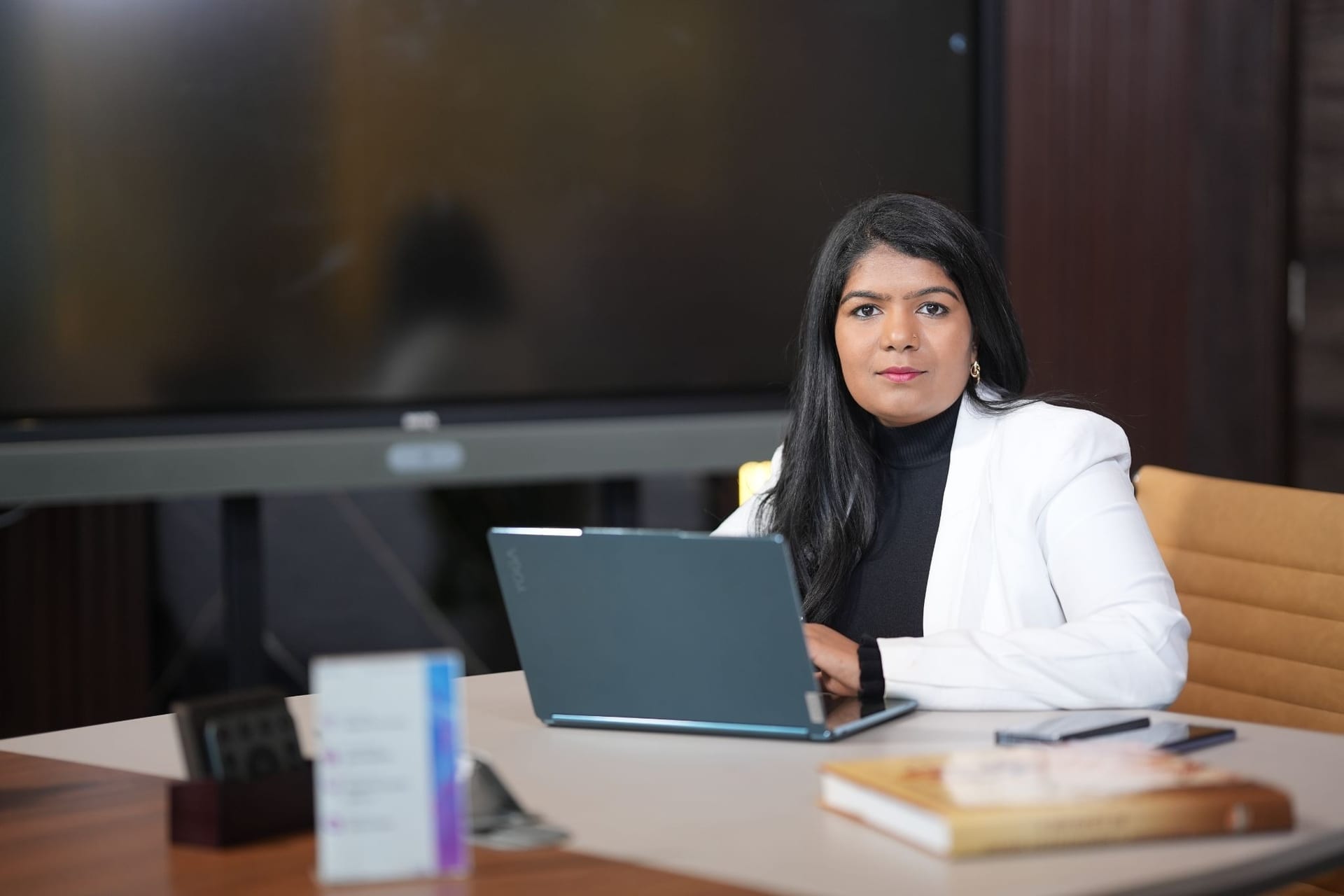
What does not appear in Kotaru's professional profile and what explains everything in it — is the story behind the story.
She did not come to Mobius through a recruitment process or a board appointment. She came to it through Chandra Kotaru, her husband, the man whose vision she has spent thirteen years helping carry into the world.
She found him. She chose him. And when the world had other ideas, she did not waver. Thirteen years later, she is still choosing him. Everything else, she will tell you, flows from that.
It is an unusual thing for a woman operating at this level to say — and she says it without apology. For Kotaru, the professional and the personal are not in tension. They are the same current running through the same life. The mission is shared. The belief is shared. The work is an expression of both.
At home, she and Chandra are raising their daughter Antara, now three. She will not claim it is easy. There are days when global operations, an evolving platform, and a young child all arrive at once and leave very little room. The weight of it is real.
But what she wants Antara to grow up knowing is not that her mother had it together. It is that her mother did not stop.
That commitment to the next generation extends beyond her own home. Kotaru serves as an appointed council member on the San Diego County Office of Education's Local Child Care and Development Planning Council — contributing to early childhood policy and the coordination of learning services across the county. It is unglamorous, local work. She shows up for it with the same seriousness she brings to Geneva.
Geneva, and What Comes After
As Kotaru prepares to represent Mobius at the UN Global Dialogue on AI Governance in Geneva this July, one of the few private sector voices in a room of member states, she carries it with the composure of someone who has been building toward this for a long time.
The platform she represents is moving toward its own landmark moment: the inaugural convening of the Rasa Foundation, expected in the summer of 2026, which will mark the formal activation of the governance structure Chandra designed and Ashwini has spent years operationalising.
She is not chasing recognition. She is not building a personal brand. She is building as she has always built — something designed to outlast the moment and serve a purpose larger than the people behind it.
In a technology landscape defined by noise, hype, and the relentless compression of attention, that is a rarer quality than it sounds.
Ashwini Kotaru has never once confused urgency with noise. And the world is beginning to notice.
To learn more about Ashwini Kotaru and Mobius by Gaian: