
The Operator Behind the Monday Morning Test
David Karpatkin built a system to turn strategy into work people can act on first thing Monday.

The strategy looked perfect on the boardroom screen. Yet by the time it reached the warehouse floor, no one knew what to do differently on Monday morning. David Karpatkin has watched that scene play out again and again. Capable leaders with clear plans, stalled not by a lack of vision but by the quiet distance between the deck and the doing.
That recurring failure became the foundation of his new book, The Monday Morning Test: How Mid-Market Companies Turn Strategy Into Work That Actually Gets Done, launching November 1, 2026.
The Gap Where Good Ideas Die
Karpatkin does not approach strategy as a theorist. He has spent more than twelve years where plans either work or fall apart: on warehouse floors, on sales teams, and in rooms full of frontline managers. He has run multi-region operations across the United States, Canada, Mexico, and the Caribbean. He once moved a 15,000-square-foot warehouse with only one day of downtime. He led teams to a 13 percent year-over-year efficiency gain, an 88 percent improvement in stock receiving, and a 34 percent jump in pick-and-pack productivity.
That experience shaped a conviction that runs through everything he does. "Most companies don't have a strategy problem," he says. "They have a translation problem. The plan is clear at the top and it disappears on the way down."
The book is built on one deceptively simple question: can the person doing the work act on your strategy first thing Monday morning? If the answer is no, the strategy is not finished. "A strategy isn't finished until someone on the front line knows what to do with it on Monday morning," Karpatkin explains.
A Practical System, Not a Theory
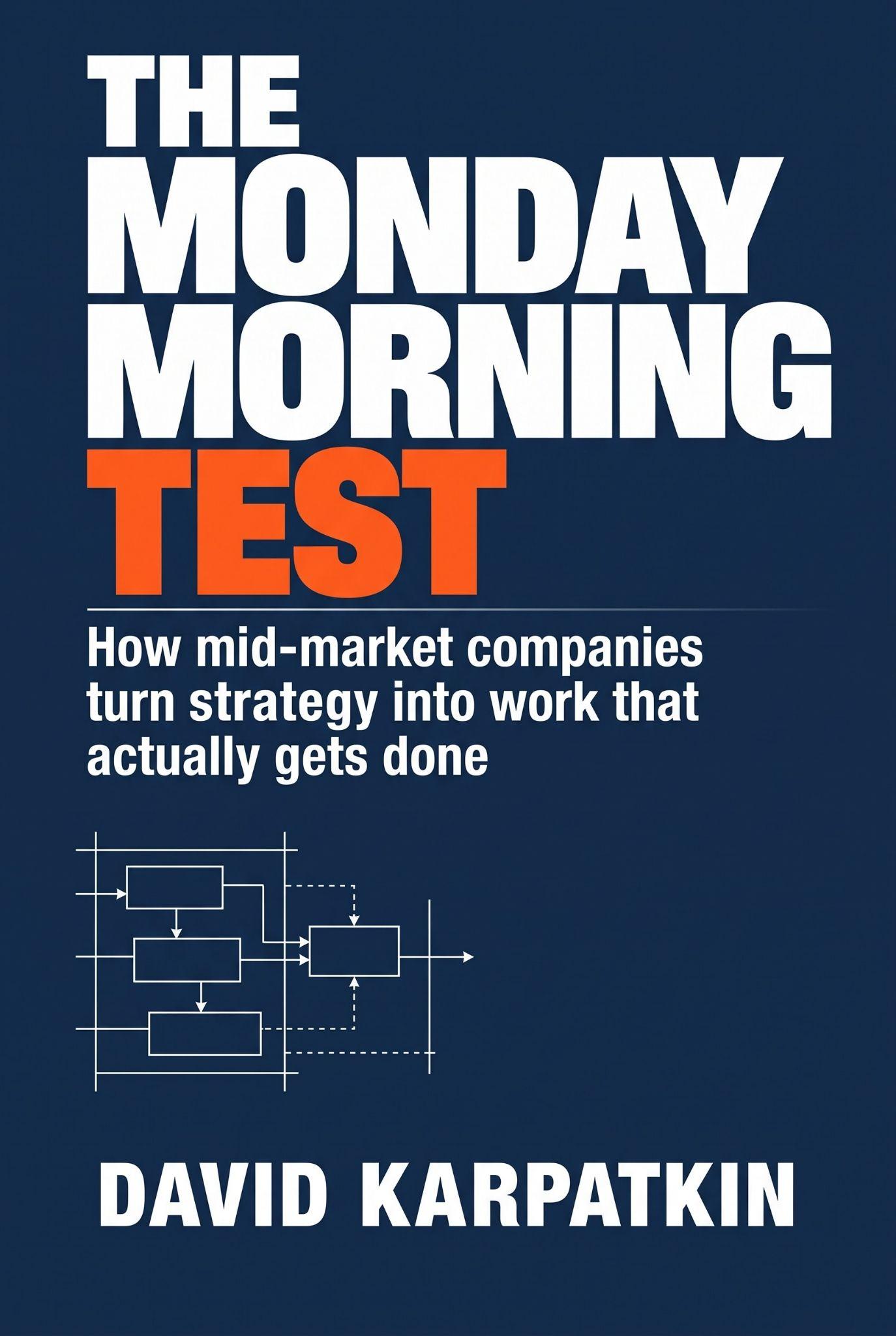
The Monday Morning Test is written for CEOs, operators, and managers who are tired of plans that sound great and then quietly stall. It trades abstraction for instruction. Readers learn to spot the seven warning signs that a strategy is not reaching the front line. They learn the five parts every clear Monday-morning instruction needs. They learn to name the "so that" behind each task, the reason the work matters to the person performing it.
The book also shows real side-by-side examples of instructions that fail the test and ones that pass. It closes with a sixty-day plan, complete with set checkpoints, so the change actually sticks rather than fading once the meeting ends.
This practical bent mirrors how Karpatkin runs TKD Consulting, the execution-focused firm he founded. TKD serves operator-CEOs of $5 to $50 million industrial, B2B services, and SaaS companies. These are leaders who usually know where the business needs to go, but whose systems, teams, and accountability structures have not kept pace with the vision.
Why He Wrote It
The story is personal. "I wrote this book for the leaders I've worked beside," Karpatkin says. "People with good plans who watched them die in the gap between the boardroom and the front line." He has felt that frustration firsthand, and he refuses to accept it as inevitable.
His philosophy rests on a belief that execution is not a lesser cousin of strategy. It is the proving ground. "Execution is where strategy earns the right to matter," he says. For Karpatkin, a great idea stays worthless until people can actually make it real.
He still manages a frontline team today, so the advice he gives is advice he uses himself every week. That distinction sets him apart from consultants who advise from a distance and leave behind a slide deck. Karpatkin works inside the business, alongside the client's own people, and gets the fix running within ninety days. Then he leaves behind systems the team owns and runs without him. His test of success is unambiguous: if a gap cannot stay closed without him, it is not really closed.
An Operator's Point of View
What makes Karpatkin stand out is that he has owned the floor, the numbers, the sales targets, and the people. His frameworks come from doing the work, not from studying it. Inside TKD, that operator's lens informs the firm's 5 Ps of Strategy, which tie five dimensions of strategy directly to execution: Plan, Ploy, Pattern, Position, and Perspective. Each one connects intent to the daily reality where results are actually made.
The results speak for themselves. TKD reports more than 150 engagements delivered, 90 percent client retention, and outcomes that include a $12 million revenue recovery for a manufacturer and a threefold gain in pipeline velocity for a technology company. One leader of an $18 million industrial services firm put it plainly: "I had the strategy nailed. What I didn't have was a company that could actually run it. TKD closed that gap. For the first time, what I pictured in my head is what's happening on the floor."
The through line is a simple personal creed. Sailing taught Karpatkin that a few degrees of course correction change where you end up. He lives by getting 1 percent better every day, at work and at home as a father. His stated purpose is to build places, at work and at home, where people feel capable of more than they thought possible. The book, he says, is that purpose written down.

The Promise Behind the Pages
Karpatkin believes every good plan deserves a company that can deliver it. "Every great plan deserves a company that can actually deliver it," he says. The Monday Morning Test exists to give mid-market leaders that company, built from their own people and their own systems.
For leaders who are tired of watching their best ideas stall between the boardroom and the front line, this book offers a different path. It does not ask you to think harder about strategy. It asks you to make strategy usable, specific, and ready for Monday.
Learn More and Get the Book
If you lead a mid-market company and your plans keep stalling on the way down, this is the resource built for you. The Monday Morning Test arrives November 1, 2026. Read it, apply the sixty-day plan, and give your strategy the frontline it deserves. To learn how David Karpatkin and TKD Consulting close the execution gap inside growing companies, reach out directly at contact@tkdconsult.com or call (877) 517-5450.
Explore More About TKD Consulting
Connect with TKD Consulting, David Karpatkin on LinkedIn, TKD Consulting on LinkedIn, and the TKD Insights blog.