
Your Brain On Sudoku: What Almost 10,000 Players Actually Experienced
Nearly 10,000 players. Three stages of survey. One unexpected finding: most people aren't playing Sudoku to get smarter. They're playing it to survive the day.
A new player survey finds that Sudoku has become less about brain training and more about surviving the attention economy. So reports Sudoku-Guru.com, which today published the Cognitive and Emotional Effects on Players: Sudoku Guru 2026 Report, drawing on responses from 9,470 players across three stages of play.
Most apps that claim to "train your brain" are selling you a story. The team behind the platform wanted to know what benefits players actually feel. Not in a lab, but on a lunch break, before bed, or instead of opening Instagram for the fourth time that day.
What came back surprised them.
The Memory Question: Answered Honestly
Start with the uncomfortable one.
When players were asked whether Sudoku improved their everyday memory, the split was almost perfect. 45% said yes. 48% said no. The report does not bury this.
It makes sense once you think about it. Sudoku does not ask you to remember things. It asks you to hold constraints, build logic chains, and test hypotheses under pressure. That is not the same skill as remembering where you put your keys.
Players, it turns out, know the difference even if the marketing does not.
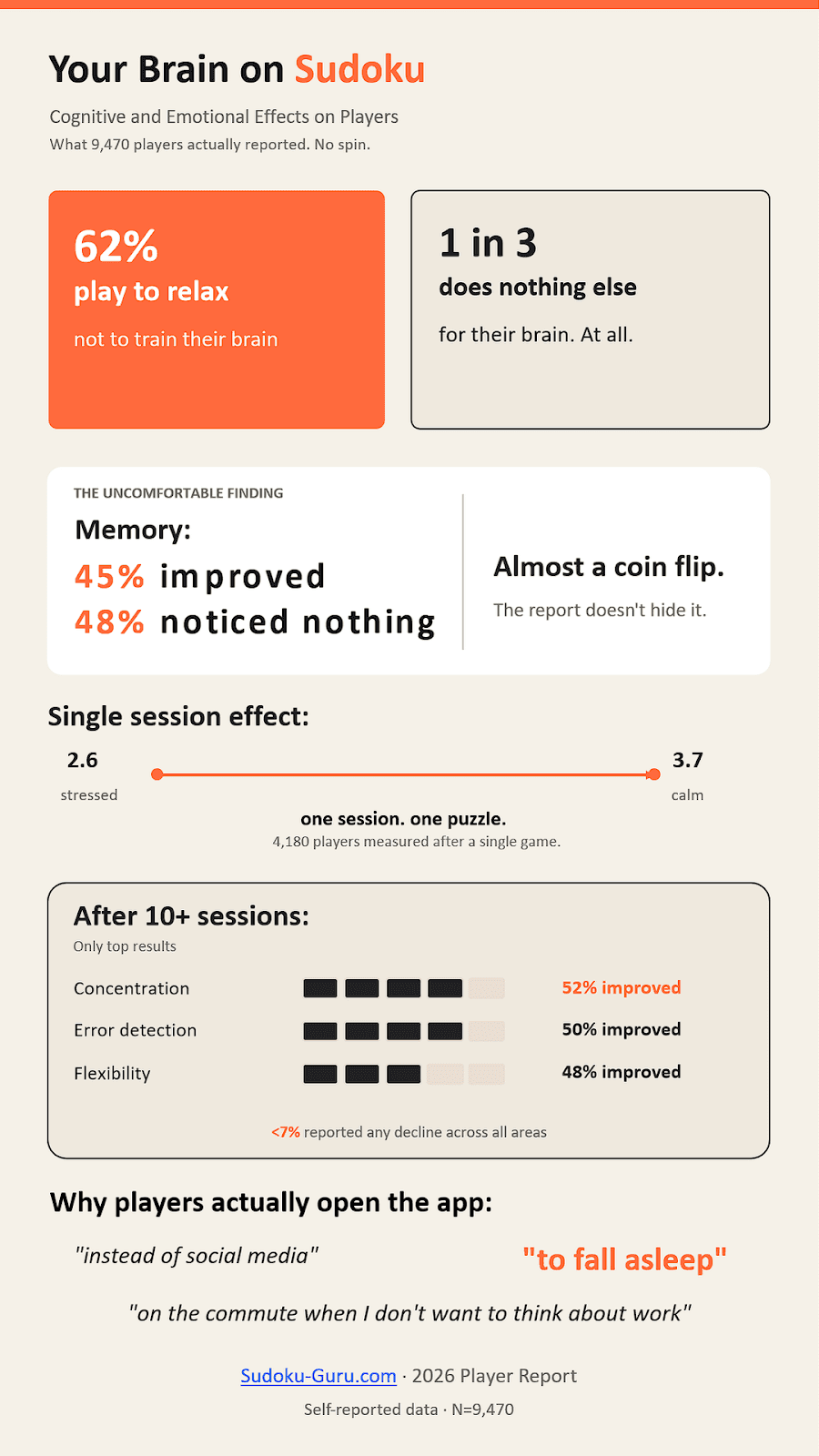
Photo Credit: BARS Agency
Sudoku And Focus: A Different Story
Among players who completed ten or more sessions, the picture of attention was clearer.
52% reported better concentration on demanding tasks, the strongest result across all six areas measured. 48% said switching between tasks felt easier. 47% noticed real changes in how they plan ahead.
None of this is a dramatic transformation. It is the kind of change you notice a few weeks in. You sit down to work and you are actually in it.
Sudoku works best as a pre-work focus ritual, a 10 to 15 minute warm up before anything that requires sustained attention. The cognitive equivalent of stretching before a run.
Why People Really Play: Stress Relief Over Brain Training
Here is the number that stopped the team.
When players were asked why they open the app, 62% said to relax. Brain training came second at 58%.
Some answers did not fit any of the preset options at all.
Instead of social media.
To fall asleep.
On the commute when I do not want to think about work.
The post session data makes the same point differently. During a puzzle, players rated their stress at 2.6 out of 5, present but manageable. After finishing, their sense of calm rose to 3.7 out of 5.
One session. One puzzle. You finish calmer than you started.
That is not nothing, especially for something that takes fifteen minutes and costs nothing.
The report does not oversell it. Sudoku is not a treatment for anxiety. But it does something specific that neither a meditation app nor a streaming show quite manages. It demands just enough attention to crowd out the noise without adding more of it.
"The stress relief findings caught us off guard. It turned out that for the majority of our players, focus and calm matter more than cognitive gains. That changes how we think about the product."
Evgeny Stakhov, Founder, Sudoku-Guru.com
The Players Who Show Up Every Day
For nearly a third of all players surveyed, Sudoku is the only intentional cognitive workout they do.
No crosswords. No chess. No brain training apps. Just this.
Nearly half the community is aged 55 or older, and for many of them the morning puzzle has replaced the morning newspaper. Something to do with your hands and your head before the day starts.
For this group, consistency is not a strategy. That is the whole point.
And the numbers suggest it is working. Fewer than 7% of players reported any cognitive decline across all six measured areas. Most noticed small gains. A few noticed nothing.
Almost nobody got worse.
How To Get The Most Benefits Out Of Daily Sudoku
Based on the habits of players who reported the strongest focus gains, the report draws four practical conclusions.
Ten to twenty minutes a day beats two hours on Sunday.
The brain responds to regular, moderate challenges rather than occasional intensity. Show up daily and the gains accumulate. Skip for a week and you are starting over.
Difficulty should stretch, not break.
Players who worked their way up from beginner to hard and Guru level puzzles reported stronger gains than those who stayed comfortable. The brain adapts fast. When a puzzle stops being slightly hard, it stops being useful.
Play before focused work, not as a reward after.
52% of players found that a puzzle session before a demanding task sharpened their concentration going in. It gets the brain into problem solving mode before the real problem arrives.
Replace one scroll session.
Not all screen time does the same thing. Twenty minutes of short form video leaves you more scattered. Twenty minutes of Sudoku tends to leave you calmer and more focused. The swap is simple. The habit takes a few weeks.
HR teams and corporate wellness programs looking for evidence based focus tools can access the report's session data alongside the full findings.
The complete Cognitive and Emotional Effects on Players: Sudoku Guru 2026 Report, including methodology, demographic breakdowns, and full data, is available at sudoku-guru.com.
About Sudoku-Guru.com
Sudoku-Guru.com is a free online Sudoku platform and mobile app serving more than 200,000 active players worldwide. Built around distraction free design and progressively challenging puzzles, from beginner to Guru level, it helps users trade passive scrolling for active thinking one puzzle at a time.