
Joe Shepard Builds Sylaris OS for Telehealth Scale
Joe Shepard launches Sylaris OS, an AI-driven telehealth operating system engineered for high-growth healthcare organizations.
There comes a moment in every growing telehealth company when the question changes. The team stops asking, "How do we launch?" and starts asking something far harder: "How do we scale?" Joe Shepard has watched that moment arrive again and again. After years spent helping emerging telehealth businesses get off the ground, he noticed a pattern. The tools that helped companies start often buckled under the weight of real growth. That realization became the foundation for Sylaris OS.
The Problem Hiding Inside Growth
Most telehealth platforms are designed for beginnings. They help organizations connect patients with providers, manage intake forms, and run basic workflows. Those capabilities matter. Yet they were never built for what comes next.
As patient volume climbs, and as providers, pharmacies, and treatment programs multiply, complexity compounds. Traditional systems lean heavily on fragmented software and manual intervention. People end up sitting in the middle of nearly every transaction. What worked at small scale becomes a bottleneck at large scale.
Sylaris OS was engineered to answer that exact challenge. It is a software-first telehealth operating system built for organizations that have already found product-market fit and now need infrastructure capable of supporting their next stage of growth.
"I've spent years building technology to help telehealth companies get off the ground, and that experience taught me something important," Shepard says. "The problems change dramatically once a company starts to scale. At that point, you don't just need more software, you need fundamentally better infrastructure."
An Engineering-First Return to Fundamentals
Sylaris OS represents a deliberate return to the core disciplines of software engineering: resilient systems, cloud architecture, automation, and machine intelligence. Rather than layering features onto an aging framework, the platform is being built from the ground up around four principles: scalability, automation, artificial intelligence, and fault-tolerant cloud infrastructure.
Scalability sits at the center of the architecture. Sylaris OS is designed for organizations managing significant volumes of both synchronous and asynchronous healthcare encounters. Instead of forcing teams to rebuild their technology stack every time they grow, the system is engineered to expand as demand rises.
Automation is approached differently here. The platform does not simply digitize manual processes. It identifies operational workloads that software and intelligent systems can carry, freeing human teams from repetitive tasks that slow growth.
"Sylaris OS is a return to what I do best," Shepard explains. "Engineering systems that can handle complexity, withstand significant load, and automate processes that traditionally require people to sit in the middle of every transaction."
AI as Infrastructure, Not a Feature
The role of artificial intelligence is where Sylaris OS separates itself most clearly from the field. Many platforms treat AI as a marketing checkbox, bolting a chatbot onto an existing system and calling it innovation. Shepard rejects that approach entirely.
Sylaris OS is being developed with AI and automation as fundamental components of the operating system itself. Large language models and intelligent workflows are woven into critical operations, including customer service, pharmacy coordination, and administrative processes. The goal is to let software take responsibility for increasingly sophisticated tasks.
"We're not interested in putting an AI chatbot on top of an existing healthcare platform and calling it innovation," Shepard says. "We want AI to become part of the operating infrastructure itself, handling real operational workloads across areas like customer service, pharmacy operations, and administrative processes."
This philosophy flows directly from Shepard's background in machine learning, distributed systems, and cloud computing. The platform is built to remain reliable under significant load, with fault tolerance and concurrency treated as first-class concerns rather than afterthoughts.
Built From Experience, Not Theory
What ultimately distinguishes Sylaris OS is its starting point. It was not designed from a theoretical whiteboard. It was engineered from years of firsthand experience watching where telehealth technology succeeds, where it breaks under pressure, and what becomes necessary when a healthcare business outgrows conventional platforms.
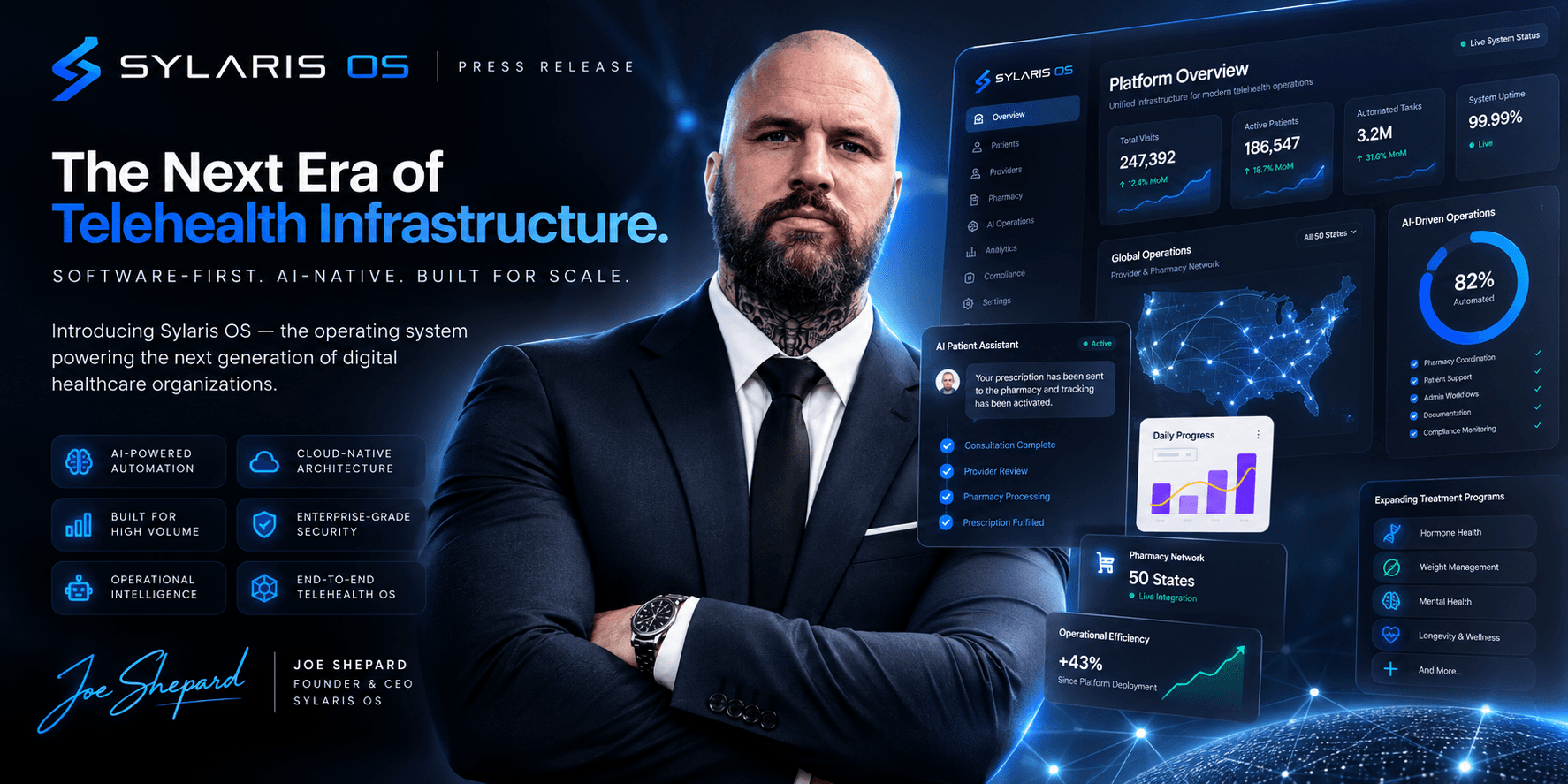
The platform unifies patient intake, provider workflows, pharmacy coordination, order tracking, subscriptions, analytics, and automation into one connected system. Modules support patient onboarding, branded web experiences, provider reviews, pharmacy fulfillment, and order tracking. An Operations Engine and Revenue Analytics layer add visibility that leaders need to make confident decisions. A scalable workflow network spans clinical review, prescription routing, and patient updates, backed by provider networks across all 50 states and Puerto Rico.
Competitors focus on helping organizations operate a telehealth business. Sylaris OS focuses on something larger: helping them build a telehealth operation that can scale. The distinction is not cosmetic. It reflects a different philosophy about the future of digital healthcare.
The Next Era of Digital Healthcare
Telehealth is moving well beyond simple video consultations and online intake forms. The next generation of digital healthcare organizations will coordinate patients, providers, pharmacies, treatment programs, and support teams at a scale that manual operations cannot sustain. Shepard believes the winners will be defined not by volume alone, but by intelligence.
"The next generation of telehealth isn't going to be defined simply by how many patients you can put through a video visit," he says. "It's going to be defined by how intelligently you can operate an entire healthcare organization at scale."
Importantly, the vision is not to replace the people who run healthcare organizations. It is to give those organizations software capable of carrying a much larger share of the operational workload, so human teams can concentrate on clinical judgment, strategic decisions, and the moments where people matter most.
The company's philosophy is refreshingly simple. As healthcare organizations become larger and more complex, their technology should become more intelligent, rather than their operational teams simply becoming larger. Throughout 2026 and into 2027, Sylaris OS intends to expand its capabilities across automation, AI, clinical and operational workflows, and cloud scalability, establishing itself as a foundational technology provider for high-growth telehealth organizations.
Ready to Scale Beyond Traditional Telehealth?
If a telehealth organization has proven demand and now feels the strain of growth, Sylaris OS offers a path forward. Instead of patching fragmented tools or hiring a way out of every bottleneck, organizations can build on infrastructure engineered for scale, automation, and intelligent operations from the very first line of code. Sylaris OS can help unify the patient experience, automate operational workloads, and grow without breaking systems. Those interested may visit the Sylaris OS website to book a demo and see what scalable, AI-driven healthcare infrastructure looks like in practice.
Explore More About Sylaris OS
Connect with Sylaris OS.