Nitin Bodade Advances Zero Trust Enterprise Security
His new book turns Zero Trust from a security slogan into an enterprise discipline.

The warning signs rarely arrive as a single dramatic breach. More often, they appear as small fractures: a cloud resource with too much access, a third-party integration no one fully owns, an identity system stretched across remote teams, legacy infrastructure, and machine-driven workflows. For cybersecurity architect and author Nitin Bodade, those fractures point to a deeper truth about modern defense. Zero Trust Enterprise Security is no longer a narrow technical model. It is a new way to govern risk, resilience, and trust across the enterprise.
Why Zero Trust Enterprise Security Matters Now
Bodade’s book, Zero Trust Enterprise Security: Architecture, Artificial Intelligence, Cloud Transformation, and Future Cyber Defense, arrives as organizations face a security landscape defined by constant change. Cloud adoption has accelerated. Software-as-a-service platforms have multiplied. Remote work has shifted access patterns. Artificial intelligence now influences how threats are detected, analyzed, and contained. At the same time, attackers have grown more patient, more automated, and more skilled at exploiting identity, supply chains, and configuration gaps.
Against that backdrop, Bodade advances a clear principle:
“Trust should never be assumed; it must be continuously verified, measured, and governed.”
That sentence gives the book its center of gravity. Rather than presenting Zero Trust as another product category, he frames it as an architectural and operational philosophy. In his view, the question is not whether a company has deployed enough tools. The stronger question is whether it can prove, through evidence, that access is appropriate, risk is visible, exceptions are governed, and security decisions improve over time.
That distinction matters because many organizations still mistake activity for maturity. They buy controls, build dashboards, and launch initiatives, yet they struggle to show whether trust decisions are consistent, measurable, and aligned to enterprise risk. Bodade challenges that pattern. His work argues that Zero Trust Enterprise Security must connect identity, access, governance, workload protection, cloud architecture, risk management, and executive accountability. The result is a broader and more disciplined conversation, one that speaks to security architects, CIOs, CISOs, researchers, graduate students, DevSecOps teams, and governance, risk, and compliance leaders.
The book’s timing also reflects a wider shift in cyber defense. Traditional network perimeters once shaped how companies thought about trust. If a user or system operated inside the boundary, it often received more confidence than it deserved. Today, that assumption has become risky. Cloud workloads move quickly. Employees connect from many locations. Machine identities often outnumber human identities. In this environment, Zero Trust Enterprise Security asks leaders to replace static confidence with continuous validation.
How Nitin Bodade Bridges Research And Practice
What sets Bodade apart is the way he connects field experience with research-based thinking. With more than two decades of experience across cybersecurity, cloud security, application security, risk management, and enterprise architecture, he writes from the perspective of someone who understands both strategy and implementation. Yet the book does not stop at practitioner advice. It also engages with contemporary scholarship around Zero Trust Architecture, adaptive security, artificial intelligence in cyber operations, and future security models.
That bridge is important. Many technical books lean too far in one direction. Some offer high-level theory that inspires discussion but leaves teams asking what to do next. Others focus narrowly on tool deployment and miss the organizational forces that determine whether a security program succeeds. Bodade’s work aims for the middle ground. It gives enterprise leaders a framework for action while giving researchers a foundation for deeper inquiry.
Recognition for Excellence in Cybersecurity Architecture
Bodade’s contributions to enterprise cybersecurity have also earned professional recognition. In 2026, Best of Best Review recognized him as Best Cybersecurity Architect in Texas, honoring his experience and work in the evolving field of enterprise security. The recognition reflects a career spanning more than two decades across cybersecurity, cloud security, application security, risk management, and enterprise architecture. It also underscores the broader impact of his work as he explores how organizations can strengthen security amid cloud transformation, artificial intelligence, distributed digital ecosystems, and increasingly complex cyber risks. His recognition adds another dimension to the work presented in Zero Trust Enterprise Security, reinforcing his position as a practitioner and author focused on connecting cybersecurity architecture with governance, measurable security outcomes, and future-ready enterprise defense.
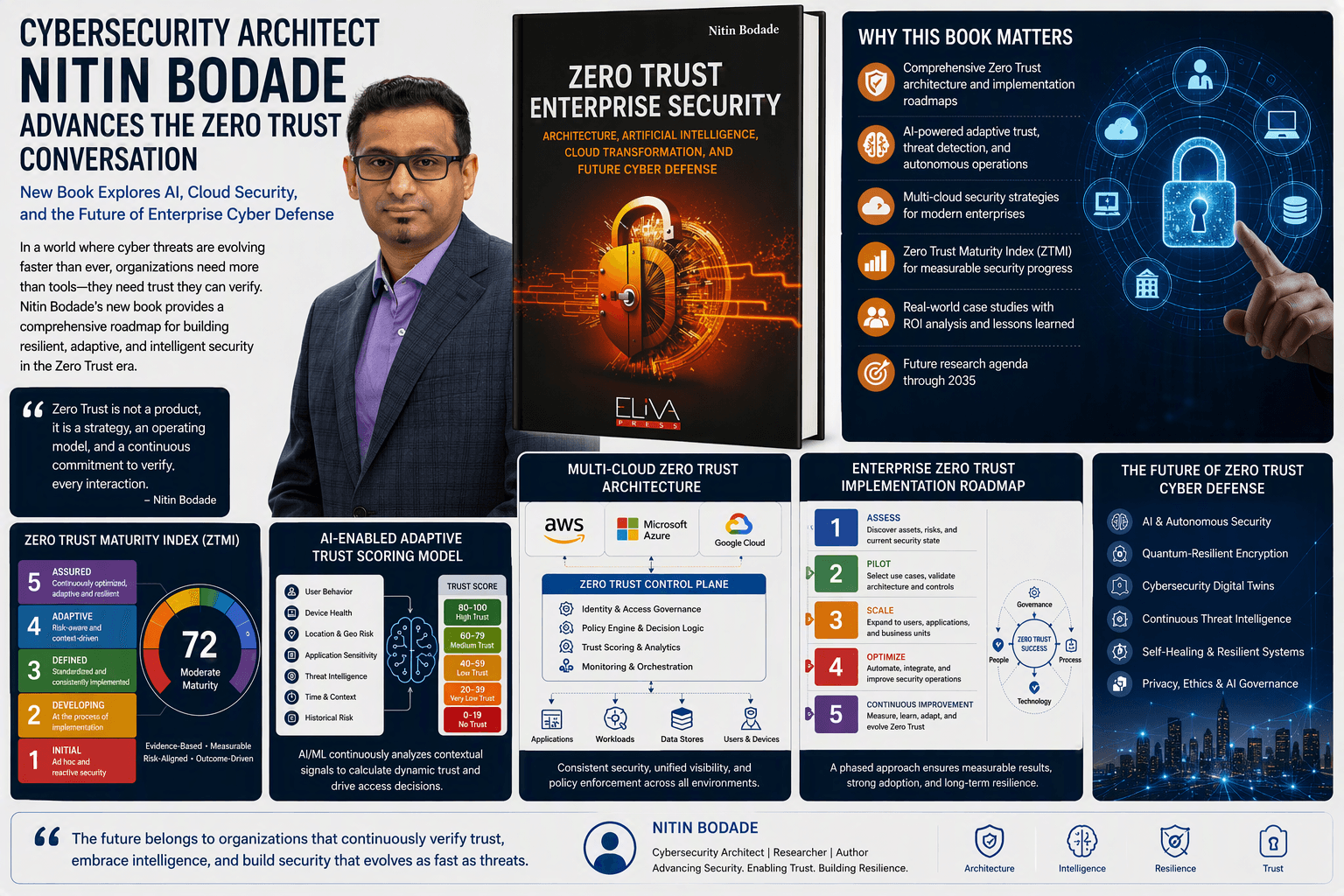
One of the book’s most notable contributions is the Zero Trust Maturity Index, or ZTMI. The framework is designed to help organizations assess maturity through measurable evidence rather than simple technology adoption. A company may have identity tools, endpoint controls, micro-segmentation, and cloud policies in place. Still, if it cannot evaluate evidence quality, exception management, governance effectiveness, operational outcomes, and continuous validation, its maturity may be weaker than its technology stack suggests.
The ZTMI reframes the measurement problem. Instead of asking, “What have we installed?” it asks, “What can we prove?” That shift can help executives see where security posture is real, where it is assumed, and where governance needs sharper ownership. It can also support more credible conversations between boards, security leaders, auditors, and operational teams. In an area often crowded with buzzwords, Bodade brings the discussion back to evidence.
His emphasis on artificial intelligence gives the book another forward-looking layer. Many Zero Trust discussions treat AI as a separate topic. Bodade brings the two together. He explores behavioral analytics, adaptive trust scoring, AI-powered threat detection, autonomous security operations, and governance of machine-driven decisions. The challenge is no longer merely technical. Leaders must decide how much autonomy to grant, how to review AI-driven judgments, how to reduce bias, and how to maintain accountability when machines shape security outcomes.
Zero Trust Enterprise Security For Cloud Transformation
Bodade also recognizes that most enterprises do not operate in clean, single-platform environments. They run hybrid infrastructures, multi-cloud systems, software-as-a-service ecosystems, legacy applications, and distributed teams. His book addresses the reality of modern architecture across platforms such as AWS, Microsoft Azure, Google Cloud Platform, and complex enterprise environments. For readers involved in cloud transformation, that practical scope offers value.
Cloud security is not just a matter of moving old controls into new environments. It requires rethinking identity, segmentation, logging, entitlement management, policy enforcement, and governance. It also requires a deeper understanding of shared responsibility. In a cloud-first or hybrid enterprise, trust decisions are spread across people, platforms, services, applications, and automated pipelines. Bodade’s treatment of Zero Trust Enterprise Security reflects that complexity without reducing it to jargon.
Perhaps the book’s most useful message is that technology is not always the largest barrier. Many organizations already have pieces of the Zero Trust puzzle. What they lack is alignment. Ownership may be fragmented. Metrics may be weak. Exceptions may grow faster than controls. Accountability may be unclear. These are governance issues, not just technical limitations, and Bodade places them near the center of the transformation effort.
For students and researchers, the book adds another dimension. Published by Eliva Press in 2026, the 168-page volume provides a roadmap for future inquiry into AI governance, autonomous security operations, machine identities, digital twins, post-quantum security, maturity measurement, and human factors in adaptive systems. For graduate and doctoral students, they may also serve as starting points for dissertations, research papers, or applied investigations.
For executives, the benefit is equally clear. Zero Trust Enterprise Security can help shift cybersecurity from a defensive cost center into a disciplined enterprise capability. When trust is measured, governed, and continuously validated, leaders gain more than protection. They gain better visibility, cleaner accountability, stronger resilience, and a clearer path for digital transformation. That is the business case beneath the technical architecture.
Bodade’s book stands out because it treats Zero Trust as a measurable enterprise discipline, not a slogan. It joins architecture, governance, cloud transformation, artificial intelligence, and maturity measurement into a single conversation. For security professionals, it offers structure. For executives, it offers perspective. For researchers, it offers questions worth pursuing. To explore how resilient enterprise defense can be designed for a cloud-driven, AI-shaped future, readers can turn to Nitin Bodade’s Zero Trust Enterprise Security. Connect with the author and find his book on Amazon.