
Kaikhan Salakhov: The Artist Redefining the Intersection of Art, Technology, and Human Consciousness
Kaikhan Salakhov is revolutionizing art by merging technology, philosophy, and futurism to explore humanity's evolution in space.
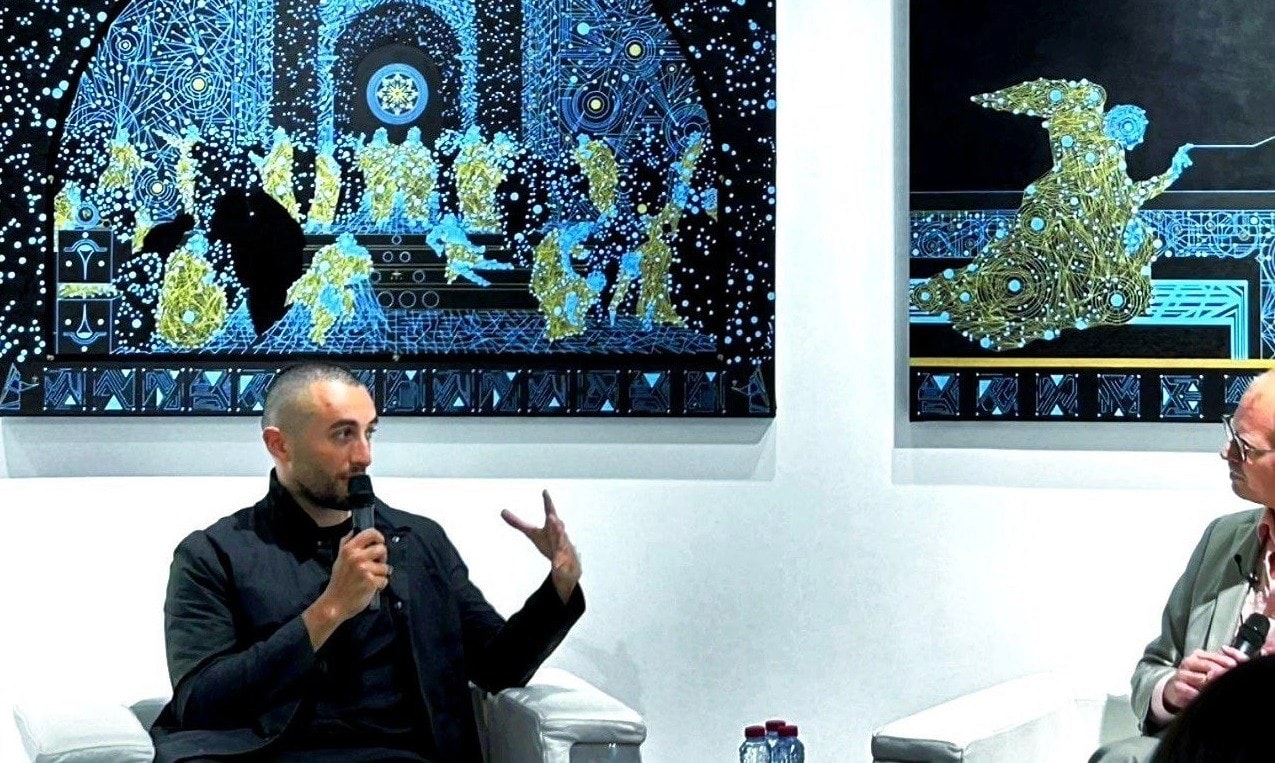
In a world where technology is progressing at an unprecedented pace, few artists are daring enough to confront its implications through creativity and thought. Salakhov, however, is shaking up the status quo by pushing the boundaries of art, science, and philosophy. With an eye on the stars and a profound reflection on humanity's place in the universe, Salakhov is creating more than art; as a futurologist, he is constructing a cognitive framework designed to identify systemic dysfunctions across technological, social, and civilizational domains, analyze their future trajectories, and critically interrogate inherited narratives and existing models of past, present, and projected futures in order to formulate the questions necessary for more robust and adaptive responses to emerging challenges.
Salakhov's approach isn't about creating pieces for beauty alone. Instead, he uses his art as a vehicle for serious inquiry, challenging us to reconsider our place in a rapidly advancing world. Drawing from multiple disciplines, his art goes beyond aesthetics to become an intellectual pursuit, tackling the monumental question: how do we evolve as a species as we expand into the stars?
The Birth of a New Artistic Movement
Salakhov, born in 1993 in New York, is more than just an artist. He is a philosopher and systems theorist whose practice crosses the boundaries between traditional art, technology, and critical inquiry into future-oriented systems. His groundbreaking body of work, Astral Space Exploration: Cosmocybernetic Art, reflects his ambition to construct a new framework for humanity’s future. His work takes the form of visual investigations: rigorously constructed paintings that integrate geometric abstraction with scientific frameworks, examining how technological systems, space exploration, and human cognitive structures may evolve over time across different environments, what outcomes can be anticipated, and which solution pathways may be identified through critical analysis.
What sets Salakhov apart is his deliberate movement beyond the conventional limits of art. Rather than responding to the world as it appears, he constructs works intended to interrogate the structural conditions under which future worlds may emerge. His approach is anchored in a central inquiry: how interacting trajectories of technological acceleration, cognitive evolution, institutional frameworks, and ethical capacity generate points of stability or dysfunction within future civilizational systems.
The answer, as he sees it, lies in a comprehensive view of space exploration, not just as a technological challenge, but as an ethical and philosophical one. Salakhov’s ASX Grid, a framework for his artistic practice, unites various fields to understand how humanity might progress as we venture beyond our planet. It’s an intellectual and creative vision for the future of civilization that extends beyond the art world and into the very fabric of society.
Art as a Cognitive Tool: A Fusion of Technology, Philosophy, and Human Experience
Where traditional art often focuses on the emotional and aesthetic aspects, Salakhov's work challenges the viewer to think deeper. Each painting, drawing, and video installation isn't merely a visual expression, but a research tool designed to investigate complex systems. He has created an entire genre of art he refers to as Cosmocybernetic Art, situated at the intersection of artistic practice and scientific inquiry. This framework is not oriented toward speculation about the future as such, but toward the critical examination of a core risk: that interstellar expansion driven primarily by technological advancement, without a corresponding evolution of human consciousness, is likely to reproduce and amplify the same systemic failures observed on Earth. Within this context, the work argues that as technological capacity expands, cognitive and ethical frameworks must widen accordingly, moving beyond tribalistic and ethnocentric constraints toward more integrative, world-centric, and cosmocentric modes of understanding.
Unlike many other contemporary artists, Salakhov is not content to merely produce what’s visually appealing. His work is a reflection of deep intellectual rigor, informed by quantum physics, cybernetics, and systems theory. It’s the work of a futurist who’s looking not just to the stars, but inward, asking what kind of consciousness we need to cultivate to match the technological progress we’re about to experience.
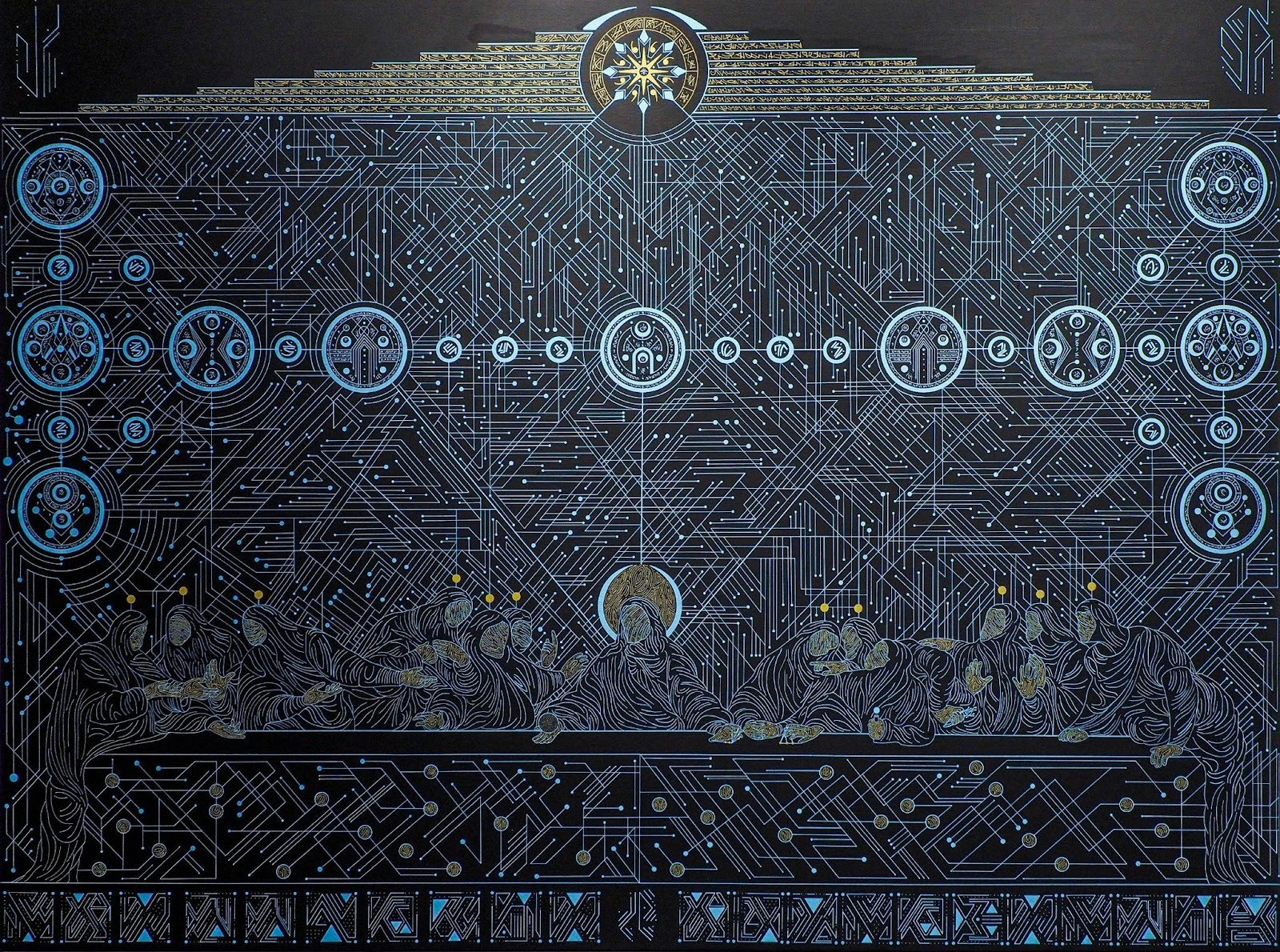
Painting “Astral Space Exploration: Renovatio”. 2019. Handwork (Not AI). Acrylics. Canvas 150x120cm.
Through the ASX Grid, Salakhov articulates an eight-stage developmental model, each stage corresponding to a distinct configuration of cognitive, ethical, and technological organization projected into humanity’s future evolution. Within this framework, space is treated not as a domain for conquest but as an externalization of internal systemic tensions, ethical constraints, and unresolved civilizational structures. The grid positions art as a methodological tool for examining the prospective evolution of human consciousness, not at the level of isolated individuals, but as a species-scale, globally integrated process.
The Cosmic Renaissance: A New Era of Space Exploration and Consciousness
In Salakhov’s work, space exploration is not a purely technological undertaking or an end in itself. It is framed as a civilizational threshold that exposes the limits of humanity’s current cognitive, ethical, and institutional configurations. The concept of the Cosmic Renaissance describes a phase where outward expansion into space must be matched by an evolution of consciousness, value systems, and collective organization.
Salakhov argues that sustained operation in cosmic environments requires recognition of systemic unity across biological, technological, social, and ecological domains. As technological capacity increases, any system misaligned with principles of interdependence and long-term equilibrium becomes unstable and prone to failure rather than sustainable growth. Unresolved terrestrial conditions, like inequality and environmental degradation, will not be left behind but are liable to be replicated and intensified across interstellar contexts.
The Cosmic Renaissance thus serves as a counter-proposal to narratives of technological dominance. It asserts that without the expansion of integrative, cosmocentric consciousness, technological progress in space remains unstable. As humanity extends its reach into the cosmos, it must develop cognitive frameworks that recognize interdependence, long-term consequences, and species-level responsibility.
Salakhov’s position is not utopian but diagnostic. His work insists that the future viability of space exploration depends on aligning technological systems with an expanded understanding of interconnectedness, unity, and collective responsibility on a planetary and cosmic scale.
A Vision Beyond Utopia
Where many visionaries envision utopias or dystopias based on technological advancements, Salakhov offers a more nuanced perspective. His art doesn’t serve as a blueprint for a perfect world but instead acts as a tool to ask the right questions. Through his Cosmocybernetic Art, Salakhov interrogates the foundational assumptions underlying humanity’s approaches to technological development, consciousness evolution, and social organization. Rather than prescribing a vision of what the future ought to be, his work compels critical reflection on the conditions, capacities, and transformations required to navigate future trajectories, both at the level of individual cognition and collective, species-scale systems.
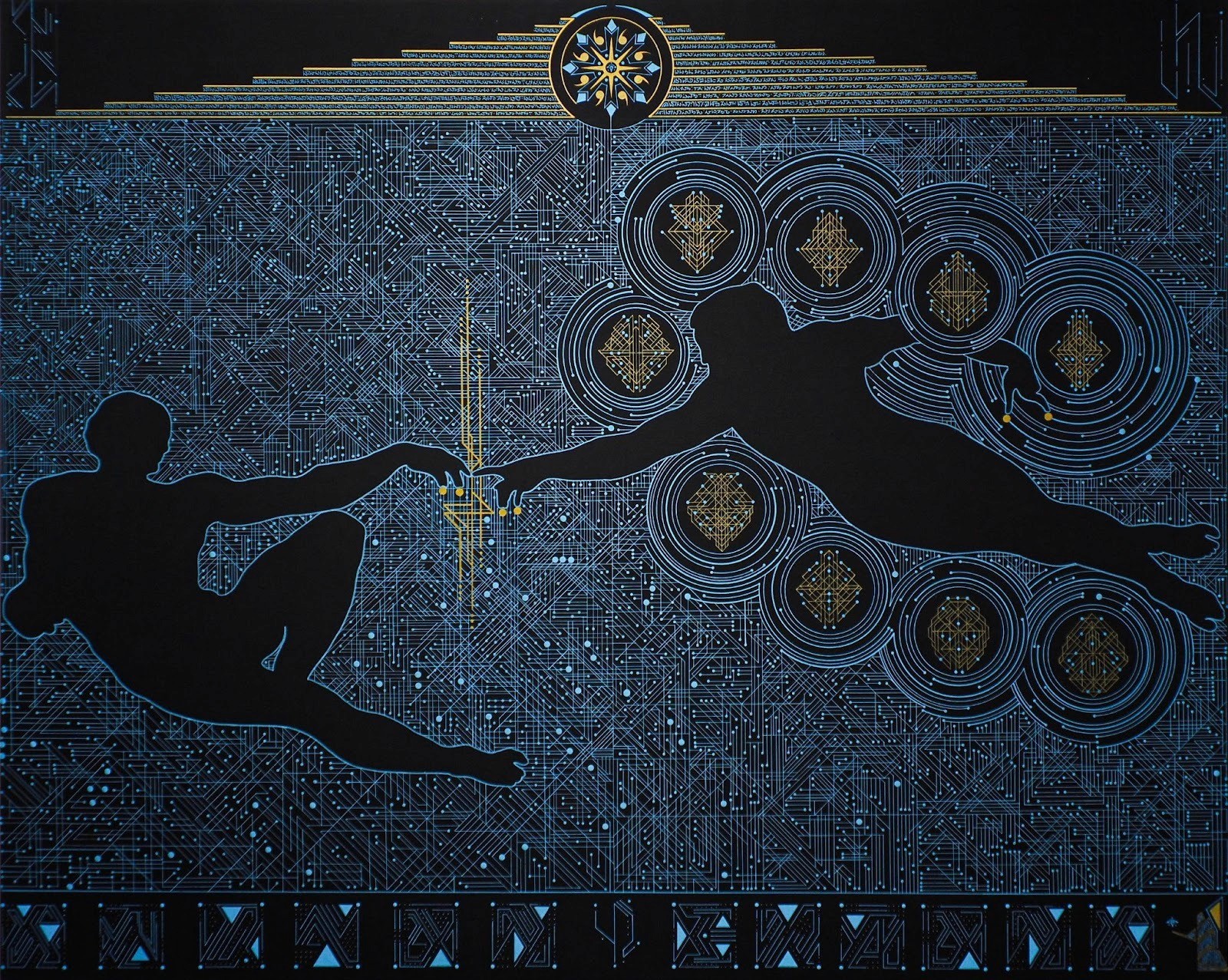
Painting “Astral Space Exploration: The Divine Matrix”. 2019. Handwork (Not AI). Acrylics. Canvas 150x120cm.
His art isn’t designed to offer easy answers. Rather, it situates viewers within a structured field of inquiry, compelling critical examination of how technology, ethical frameworks, and human consciousness are interdependent and co-evolving. By engaging with his work, viewers are not only asked to envision the future but to actively consider their role in shaping it.
A Revolution in Art and Science: The Legacy of Kaikhan Salakhov
Salakhov’s work is a revolution, not just in art but in how we think about the intersection of technology, philosophy, and human experience. By creating a new space for inquiry, he prompts us to reflect on our current trajectory and the ethical responsibilities tied to technological advancements. As the first artist to integrate philosophy, art, and futuristic thought in such a coherent way, Salakhov is shaping how we understand humanity's evolution in the cosmos.
His art isn’t about creating decorative objects but about fostering a conversation, a framework to guide future generations in navigating technological challenges. His work invites reflection on how humanity might evolve and the role art can play in examining that process. The emphasis is on cultivating the analytical conditions necessary to reassess existing assumptions about development, progress, and responsibility.
Salakhov’s practice extends beyond discrete artworks through the integration of painting and writing within a unified conceptual framework, notably in his book Astral Space Exploration: The Cosmic Renaissance: The Fundamental Principles of Cosmocybernetics. In this book, art functions as a cognitive instrument, enabling the exploration of future-oriented questions through consciousness, systems coherence, and long-term civilizational viability.
At the core of Salakhov’s practice is the construction of a distinct methodological framework. By connecting art, technology, and the evolution of human consciousness, his practice challenges prevailing frameworks and invites ongoing inquiry into how future conditions may be navigated, not through prediction, but through structural understanding and critical questioning.Visit Astral Space Exploration or follow Salakhov on Twitter at @kaikhansalakhov and Instagram @kaikhan_salakhov to learn more about his work and join the ongoing exploration of the future.