
Solar Storms and Severe Hail: How Space Weather is Changing the Forecast
As space weather surges this April, traditional weather models are missing the mark on catastrophic hail risks for commercial sectors.
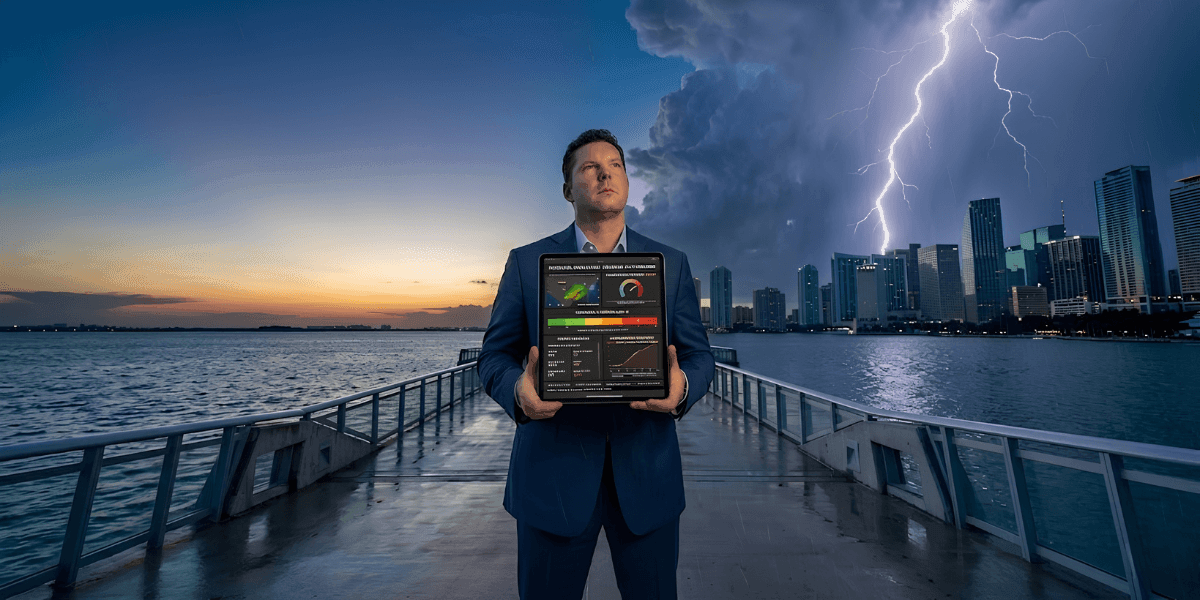
As the Midwest and Southern Plains prepare for another season of unpredictable spring storms, businesses that rely on infrastructure and insurance are facing a newly emerging threat, one that doesn’t come from the ground, but from the sky. While meteorologists traditionally forecast severe weather based on terrestrial conditions such as humidity and atmospheric pressure, a surge in solar activity this April is setting the stage for more catastrophic hailstorms. And standard forecasting models are missing it entirely.
Dale Colvin, President of Blue Eagle General Contractors and Vice President of Themis Legal Group PLLC, has raised the alarm about the hidden risk that space weather poses to commercial properties. “We are in the midst of a highly active solar cycle this month, and this surge in solar energy could transform standard spring thunderstorms into catastrophic events,” Colvin says.
Traditional Forecasting Models: Missing the Big Picture
The weather forecasting systems most commercial risk managers rely on today, like the GFS, NAM, and HRRR, are primarily driven by terrestrial data, such as atmospheric temperature, humidity, and wind patterns. While these tools are adept at predicting general weather trends like rain and wind, they fall short when it comes to forecasting extreme events, particularly those that involve rapid escalation like severe hailstorms.
Colvin calls this phenomenon “intensity blindness.” Traditional models often miss the critical tipping point where a mild storm suddenly grows into a full-blown hail catastrophe. And it’s not just about rain or wind; it’s about the solar activity influencing the very weather dynamics that forecasters typically miss.
“The current models only measure ground-level heat,” Colvin explains. “They ignore solar events happening far above us that are actually driving extreme weather patterns. They fail to account for the solar flares, the solar wind streams that have a real impact on our atmosphere.”
Introducing the Colvin Solar-Atmospheric Index (CSAI)
To address this glaring gap, Colvin developed the Colvin Solar-Atmospheric Index (CSAI), a revolutionary tool that incorporates real-time solar data into the weather forecasting equation. The CSAI tracks solar flares and high-speed solar wind, two space weather phenomena that directly affect Earth’s atmospheric conditions.
When the sun emits a flare or sends out a solar wind stream, the resulting energy destabilizes the atmosphere above landmasses. This destabilization can create explosive convective updrafts that are essential for the formation of massive hailstones. “Solar energy impacts our atmosphere in a way that standard meteorology just doesn’t account for,” Colvin notes. “This destabilization creates the perfect conditions for hailstorms that grow much larger than what traditional models predict.”
The Solar-Driven Hailstorm Cycle
What’s more, Colvin’s research has shown that these solar-induced storm intensifications occur in a distinct 24 to 48-hour window after solar events impact Earth. This “Lag Window” is a critical period when hailstorms are more likely to explode in size and severity, a connection that the standard forecasting tools fail to consider.
“We can see this in the data,” Colvin says. “Once a solar event happens, we know that within a day or two, we are more likely to see significant hail growth. When solar energy interacts with atmospheric instability, that’s when you get the perfect storm.”
Proactive Risk Management with the Colvin Index
For commercial developers, construction firms, and insurers, understanding and anticipating the solar-driven dynamics of severe weather could be the difference between financial loss and proactive risk mitigation. Traditionally, these industries have waited for weather warnings to react, securing sites only after a storm has already developed. But with the CSAI, Colvin has pioneered a new approach.
The CSAI provides a 24 to 48-hour early warning system, allowing companies to anticipate and prepare for catastrophic weather before it happens. Instead of waiting for a traditional thunderstorm watch, project managers can take action in advance, securing materials, reinforcing infrastructure, and ensuring contractors are prepared for the worst.
“The key is moving from reactive damage control to active risk mitigation,” Colvin explains. “By leveraging solar data in weather predictions, businesses can make proactive decisions that protect their assets.”
The 2023 Solar Cycle and Its Implications
April 2023 is expected to bring a particularly intense level of solar activity, including increased solar flares and Coronal Mass Ejections (CMEs). These events have the potential to significantly amplify spring thunderstorms, creating hailstorms much larger than predicted by traditional weather models.
“We’re already seeing signs that the intensity of storms this year will be higher than expected,” Colvin warns. “Traditional forecasts won’t capture the true severity of these events because they ignore the solar influence. That’s why it’s crucial for industries that depend on infrastructure to start using solar-aware forecasting like the CSAI.”
For industries across the commercial construction and insurance sectors, Colvin’s warning is clear: depending solely on traditional weather forecasting models puts high-value assets at risk. The next severe weather event may not be visible on terrestrial radar, but it will be directly influenced by solar activity.
The Future of Risk Management: Solar-Aware Forecasting
As solar-driven storms become more frequent and intense, it’s essential for risk managers to reassess how they forecast and prepare for severe weather. Commercial developers and insurers must start incorporating solar activity into their weather risk assessments to stay ahead of the curve. Failure to do so may leave them exposed to the next major hailstorm that could come from above, not just the ground.
“The next big storm won’t be coming from the radar, it’s coming from the sun,” Colvin concludes.
By utilizing the Colvin Solar-Atmospheric Index, businesses can take the guesswork out of storm predictions and shift from reactive damage control to proactive risk mitigation. For more information on how to protect your business, visit Colvin Index, Blue Eagle General Contractors, and Themis Legal Group.
Don’t wait for the storm to hit. Take action today and protect your business from the next solar-powered hailstorm.