Unlocking Sustainable Growth: Sabbir Nasir’s 7-Step Framework for Scaling Your Business
Discover Sabbir Nasir’s 7-Step Framework for scaling businesses efficiently while staying true to their core values.

By
Jan 13, 2026
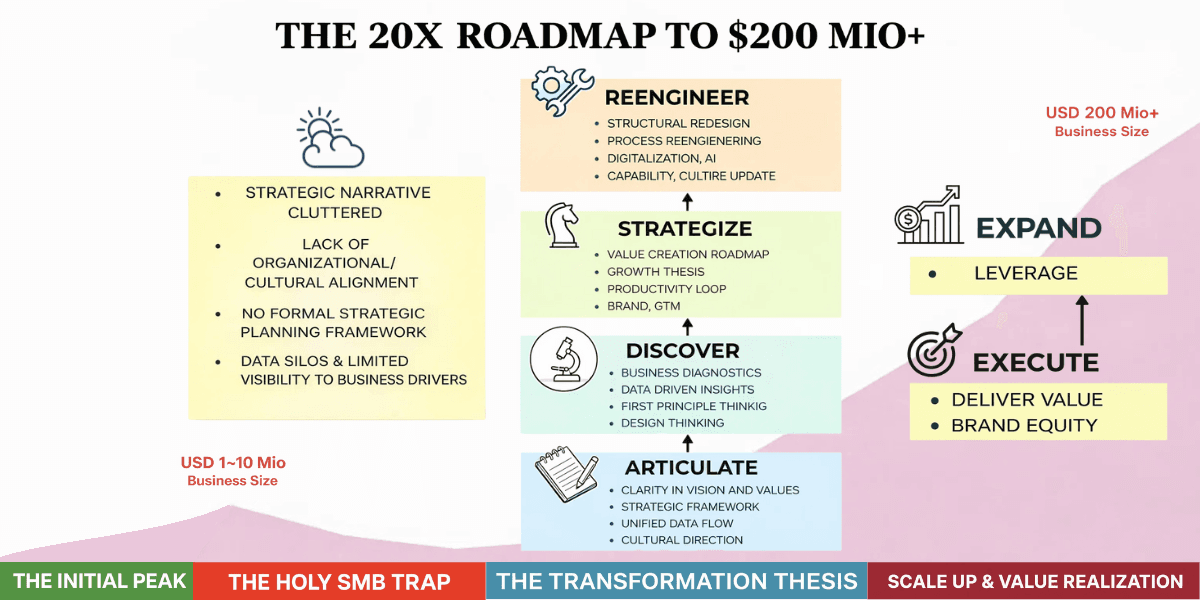
When it comes to scaling a business, most companies eventually hit a wall, especially small and mid-sized enterprises. Whether you’re an ambitious startup or a growing company, hitting a growth plateau can feel like a dead end. The “SMB[SN1] Trap,” a term often used to describe this point of stagnation, occurs when businesses are unable to scale due to insufficient systems, unclear leadership, or lack of strategic direction. This is the challenge Sabbir Nasir, founder of Novastra Global Partners, has spent over two decades helping businesses overcome.
His unique approach, based on a proven 7-step framework, has transformed mid-market companies, helping them scale without sacrificing their identity, values, or long-term sustainability. With a career spanning industries like retail, consumer products, and services, Nasir’s methodology offers a roadmap for businesses eager to scale and attract investors, all while maintaining their core culture.
The "SMB Trap": A Hidden Growth Barrier
The "SMB Trap" refers to a growth barrier many businesses face as they grow, where they become bogged down by inefficiencies, unclear strategy, and leadership issues. According to Sabbir Nasir, this phase is inevitable, but escaping it requires applying the right strategies at the right time to achieve sustainable growth. Nasir helps companies navigate this challenge and unlock their growth potential.
Sabbir Nasir: A Proven Expert in Business Transformation
Sabbir Nasir transformed Shwapno, Bangladesh’s largest retail chain, from a fragmented operation with 37 stores and $8 million in revenue to a scalable, sustainable business with over 800 stores and strong profitability. By working directly with the team, Nasir professionalized leadership, optimized supply chains, and improved financial metrics, setting Shwapno on a path for long-term growth.
The 7-Step Framework: Sabbir Nasir’s Blueprint for Growth
Step 1: Clarity of Vision, Values, and Strategy
Most SMBs do not fail because of lack of effort or intelligence, they fail because of lack of clarity.
Vision is often:
Unarticulated or locked inside the founder’s head
Contradictory across teams
Emotionally inspiring but strategically irrelevant
Disconnected from the company’s true strengths and market realities
Sabbir’s framework begins by excavating and articulating a shared vision, one that genuinely inspires the founder and aligns the organization. This is not a branding exercise. It is a strategic recalibration.
The process anchors vision in three realities:
Evolving market dynamics
The company’s core competencies and strategic assets
The founder’s long-term ambition, not just next year’s survival
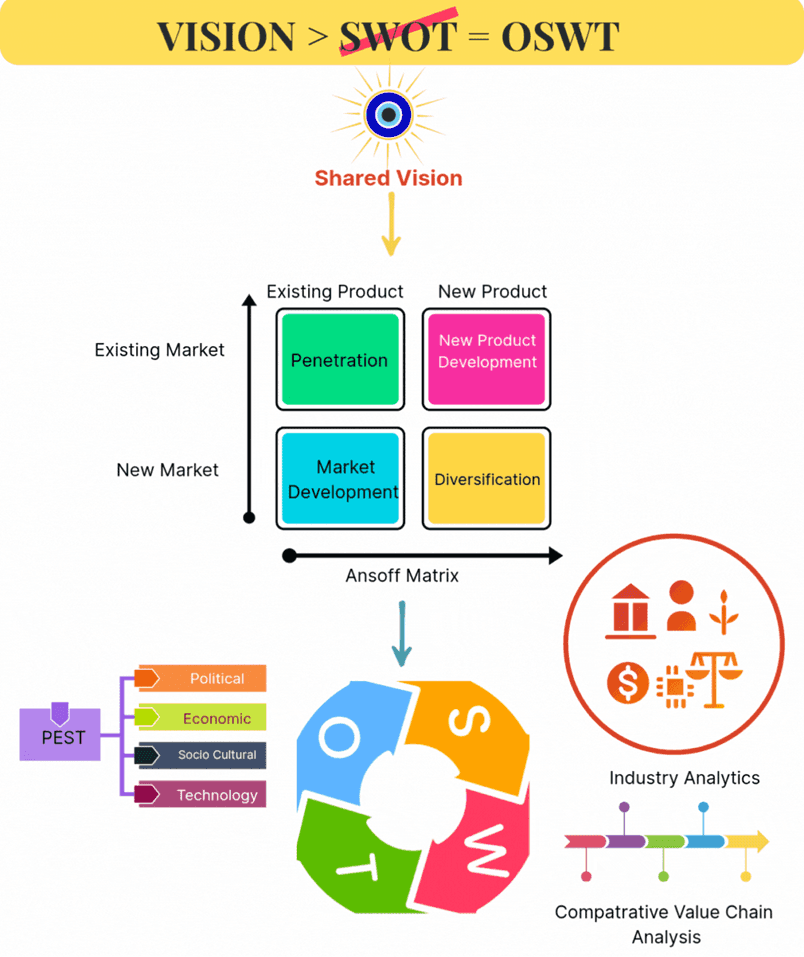
To operationalize this, Sabbir replaces the traditional SWOT with a sharper construct he calls OSWT:
O – Opportunity: What large, structural opportunity is emerging in the market?
S – Strengths: What unique capabilities, assets, or unfair advantages does the company truly possess?
W – Weaknesses: What internal constraints must be acknowledged, not ignored?
T – Threats: What external forces could derail the vision if left unaddressed?
Unlike generic SWOT analyses, OSWT is vision-led. Strategy flows from aspiration, not backward from limitations. The outcome of Step 1 is a clear strategic north star, one that teams can rally around and decisions can be tested against.
Without this clarity, execution becomes noise.
With it, scale becomes inevitable.
Business culture plays a decisive role in whether growth strengthens or destroys a company.
Sabbir Nasir understands that scaling is not merely a numerical exercise, it is a human and behavioral transformation. Many companies grow revenue only to lose their soul, agility, or founder-led edge in the process. His framework directly addresses this risk.
This step focuses on cultural reengineering, not cultural replacement. The objective is to evolve behaviors, decision-making norms, and accountability structures in line with the strategic vision, while preserving the company’s core DNA.
As markets shift and organizations grow more complex, culture must adapt without becoming bureaucratic or diluted. This step ensures that growth happens without eroding what made the company successful in the first place
Step 2: Data Integration and Strategic Relevance
Most businesses are data-rich but insight-poor.
They collect financials, operational metrics, customer feedback, and market signals, but fail to integrate them into a coherent decision system. Nasir’s framework begins by consolidating all available data, financial and non-financial, quantitative and qualitative, into a single, decision-relevant view.
This includes:
Financial performance
Operational productivity
Customer behavior and feedback
Market and competitive dynamics
Organizational signals and execution gaps
The emphasis is not on dashboards for appearance, but on actionable insight. This integrated data layer becomes the foundation upon which every strategic, operational, and investment decision is built in later steps.
Step 3: Resolving Today’s Bottlenecks Through Agile Innovation
Transformation cannot wait for perfect conditions.
Businesses must address their most critical current issues while simultaneously innovating for the future. Nasir’s framework is deliberately practical, it is not an abstract PowerPoint exercise.
This step engages leadership and frontline teams to:
Identify the most pressing constraints holding the business back now
Apply Design Thinking, First-Principles Thinking, and rapid experimentation
Optimize operations while improving customer relevance
The goal is to solve real problems in real time, creating momentum, confidence, and organizational learning as transformation unfolds.
Step 4: The Growth Thesis
A growth thesis is the intellectual backbone of scaling.
In this step, Nasir works with companies to clearly articulate where growth will come from, why it is defensible, and how it can be repeated. This includes defining both short-term priorities and long-term strategic bets.
Rather than chasing every opportunity, the focus is on:
Opportunities aligned with core strengths
Scalable business and operating models
Creating a repeatable productivity loop, not one-off wins
The growth thesis becomes a disciplined filter for decisions, investments, and resource allocation.
Step 5: Structural and Process Reengineering
Structure and process are silent growth killers when misaligned.
As companies scale, informal systems that once worked begin to break. Nasir’s framework addresses this through deliberate structural and process reengineering, ensuring alignment between strategy, organization design, and execution flow.
This step emphasizes:
Business Process Reengineering (BPR)
Role clarity and decision rights
Digitalization and automation where it creates leverage
The objective is to unlock hidden value, remove friction, and enable teams to perform at scale without heroics.
Step 6: Execution Cadence
Execution is where strategies live or die.
This final step institutionalizes discipline through:
Clear, organization-wide KPIs
Dashboards that measure what truly matters
A defined execution cadence, from leadership reviews to frontline action
Continuous innovation in execution, whether through digital tools, automation, or process refinement, ensures that strategy translates into results.
Step 7: Investor Confidence
Sabbir Nasir’s framework creates investor confidence by building operational credibility, execution discipline, and scalability before seeking capital. It emphasizes systems, governance, and data-driven decisions to ensure growth is repeatable and independent of the founder. This approach safeguards the founder's vision while making the business investable, attracting long-term capital by proving it can scale with confidence and control.
A Hands-On Approach: Action Over Advice
What sets Sabbir Nasir apart is his hands-on approach. Unlike traditional consultants who only offer advice, Nasir actively co-leads the transformation, implementing strategies within the business. He focuses on sustainable growth while preserving the company’s core identity, aiming to amplify what made the business successful rather than change it.
Results That Speak for Themselves
Through Novastra Global Partners, Sabbir Nasir has helped businesses in diverse industries, from retail to services and value-driven sectors, scale effectively. His 7-Step Framework has proven successful time and again, with businesses experiencing significant growth and attracting investment. The businesses he works with don’t just grow; they evolve into institutions ready to compete on a global scale.
Nasir’s work isn’t just about scaling for the sake of growth; it’s about building businesses that are sustainable, scalable, and prepared for the future. His method doesn’t sacrifice the company’s values or vision, it enhances them.
Scale Without Compromise: A Roadmap for Business Owners and Investors
For business owners, Sabbir Nasir’s 7-Step Business Transformation Framework offers a clear, actionable roadmap for scaling. It provides the tools needed to escape the SMB Trap and build a company that is ready for the next phase of growth. For investors, the framework offers insight into what makes a business truly scalable and sustainable, helping them identify companies that are primed for long-term success.
Scaling your business doesn’t have to come at the expense of its core values. With Sabbir Nasir’s proven framework, you can grow your business without compromise, ensuring that the future is both bright and sustainable.
For more information about Sabbir Nasir and his work, visit the following links:
● Sabbir Nasir on LinkedIn
● Novastra Global Partners
With his 7-Step Framework, Sabbir Nasir offers a transformative approach to business growth, one that helps companies scale without losing sight of what made them great. Whether you’re a business owner looking to take your company to the next level or an investor seeking confidence in a business’s scalability, Nasir’s approach offers a proven path to success.