What Comes After Identity Verification? GuyID Explores the Trust Gap in Online Dating
GuyID examines what identity verification can prove in online dating, what it cannot prove, and how people might add context before meeting.

For someone preparing to meet an online match in person, seeing that an identity has been verified can resolve one important question: Is this person connected to the identity they claim? But another question remains. What, if anything, can reasonably be known about the person beyond that verification? It is in this space between identity verification and trust that GuyID is exploring a different approach to online dating.
Identity verification can establish selected facts about identity, depending on the method used. It does not establish someone's character, honesty, intentions, or safety. That distinction matters because a verified identity can sometimes be interpreted more broadly than the evidence supports. Verification may reduce uncertainty about who someone is, but trust is a separate judgment that develops from context, experience, and human relationships.
Looking Beyond Identity Verification
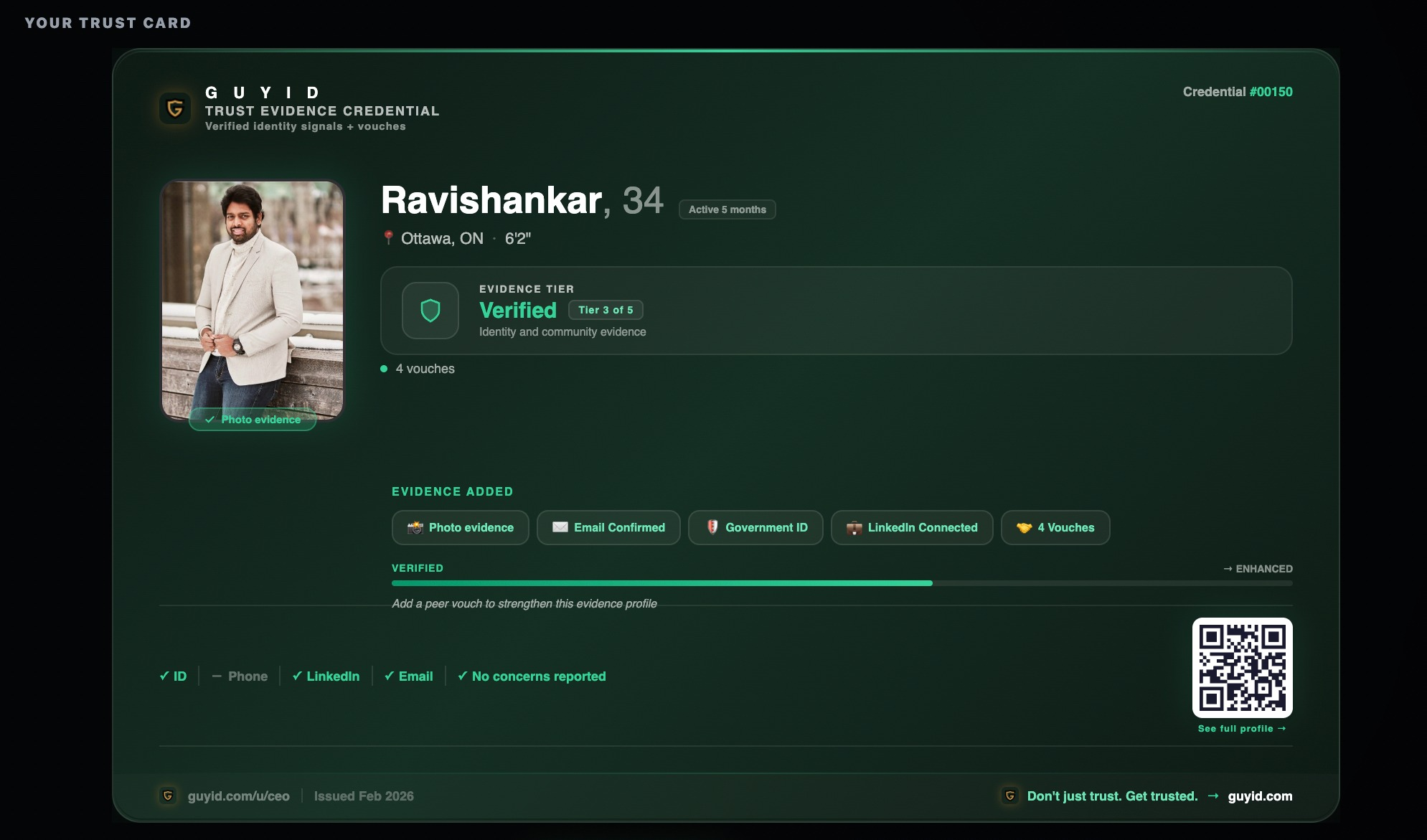
GuyID approaches that distinction by positioning itself as a consent based, portable trust layer and profile. Rather than attempting to determine whether a person is trustworthy, the platform is designed to let individuals voluntarily present different pieces of trust related evidence in one place. According to the GuyID website, those signals can include identity verification and vouches from people who know the profile owner. The person viewing the profile is left to interpret that information rather than being told what conclusion to reach.
The distinction is particularly important when discussing a GuyID Trust Profile. A Trust Profile is not a universal trust score or safety score. It is intended to organize information that a person chooses to share so another person can consider individual signals for themselves. GuyID also states that identity verification is not a background check and does not guarantee safety, character, or intent.
Vouches require similar context. A vouch is an endorsement from another person who says they know the individual. It is not a guarantee of someone's behavior or character. Personal endorsements can add human context that an identity document cannot provide, but they remain statements from individuals and should be understood within those limits.
That separation between evidence and judgment is central to the broader question GuyID is raising. Identity verification can answer a factual question about identity. Trust, however, is more complex. It can involve personal history, social context, consistency, judgment, and experiences that cannot be reduced to a single verification event.
A Data Problem With Human Consequences
GuyID founder Ravi Shankar Jayasankar brings more than 13 years of experience working with marketplace data and two sided platform behavior. His interest in the problem grew from examining how digital marketplaces depend on the quality and context of the information available to participants.
For online dating, that problem becomes unusually personal. People often move from a digital profile to an in person meeting while working with limited information. They may search social profiles, compare details, ask mutual contacts, or conduct their own informal research. These actions reflect a basic tension in online interaction: people want enough information to make informed decisions without turning dating into an invasive investigation.
Jayasankar describes the distinction this way:
“Identity verification answers the question of whether someone is real. It doesn't necessarily answer what you can reasonably know about them before meeting. We built GuyID to explore what comes next, giving people a consent based way to share the trust evidence that already exists around them.”
That concept also changes who controls the disclosure. Instead of information being assembled about someone without their involvement, the GuyID model emphasizes voluntary sharing. A profile owner decides to present identity information and other context, while the recipient decides what weight, if any, to give each piece of evidence.
AI Makes Precision More Important, Not Certainty Easier
Developments in artificial intelligence have added another dimension to discussions about digital identity. AI tools can create increasingly convincing images, text, audio, and other synthetic content. At the same time, the existence of these technologies does not mean every suspicious profile is AI generated, nor does it mean identity verification can eliminate every form of deception.
The more useful question is what a particular verification method actually establishes. A photo check, identity document check, social connection, and personal vouch each provide different kinds of information. None should automatically be treated as proof of character or future behavior.
This is why the language surrounding identity verification matters. As digital content becomes easier to create and modify, platforms face pressure to distinguish between confirming an identity and making broader claims about a person. GuyID's approach is to keep those categories separate while allowing users to share additional context voluntarily.
Independent Attention To The Trust Question
The concept has also received independent media attention. In August 2026, Biometric Update reported on GuyID's combination of identity verification, personal vouches, and user controlled information sharing for online dating. The publication described the platform's approach to presenting individual signals rather than reducing them to a single aggregate judgment. The coverage represents independent reporting on GuyID and its model, not an endorsement of the company or its claims.
That distinction mirrors the larger principle behind the product. Evidence can inform a decision without making the decision for someone. A verified identity is one signal. A vouch is another. Neither can promise what another person will do, and neither removes the need for individual judgment.
The Question After The Checkmark
The broader debate around online dating may therefore be moving beyond whether identity verification should exist. The more difficult question is what should happen after identity has been verified.
Should people be able to carry identity and trust related context across platforms? How much information should they choose to disclose? How should a recipient interpret personal endorsements? And how can services provide useful context without converting complex human judgment into a universal score?
GuyID is exploring those questions through a consent based, portable trust profile that separates identity verification from conclusions about trustworthiness. Its model does not resolve the uncertainty inherent in meeting another person, nor can any profile guarantee character, honesty, or safety.
Perhaps that is the more consequential point. In online dating, identity verification can answer who someone is. What comes next requires a different kind of information, and ultimately, human judgment.
Those interested in the company's approach can connect with GuyID, LinkedIn, X, and founder Ravi Shankar to learn more about its Trust Profile and the broader idea of portable, consent based trust.