Art As A Cognitive System: Kaikhan Salakhov
How one artist is reframing space exploration as a civilizational question through geometric painting, scientific modeling, and the philosophy of consciousness.
There is a painting completed in 1961 that almost disappeared from history. Tahir Salakhov, a distinguished Azerbaijani painter, created "To You, Humanity," a monumental work addressing humanity's expansion into space at the height of Soviet optimism. Ideological pressure eventually pulled it from public view, where it remained inaccessible for decades. Years later, it was rediscovered and restored. For Kaikhan Salakhov, his grandfather's painting did not simply return. It demonstrated something essential: that forward-looking ideas can outlast the political systems that suppress them, and that art, when grounded in genuine inquiry, carries a durability that trends and spectacle cannot replicate. That conviction sits at the foundation of everything Salakhov builds today.
A Practice Built on Questions, Not Answers
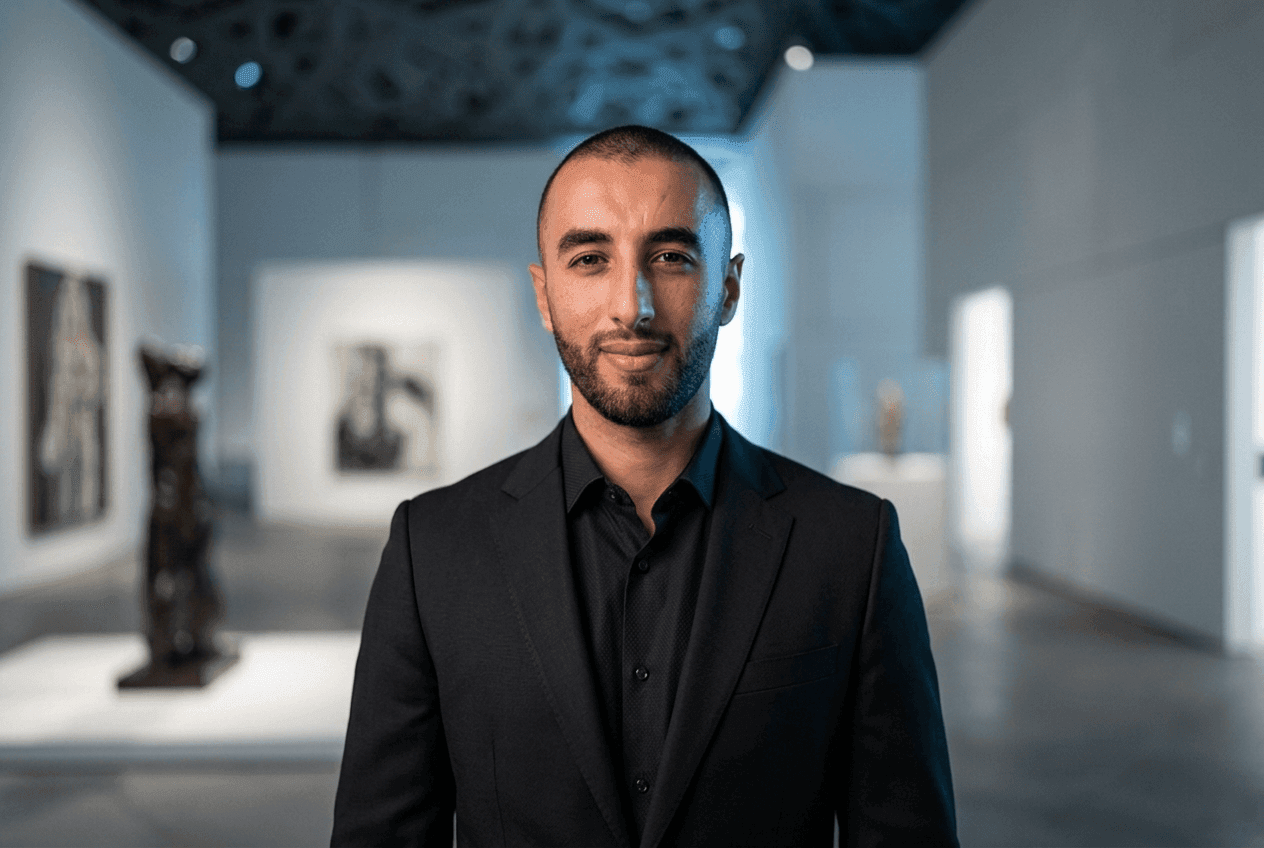
Kaikhan Salakhov, born in New York in 1993, is a multidisciplinary artist, futurologist, philosopher, writer, and architect. His practice, developed under the name Astral Space Exploration: Cosmocybernetic Art, is not oriented toward aesthetic production in the conventional sense. It is a long-term research project. His paintings, theoretical models, and books function as components of a unified conceptual architecture, each one a node within a larger analytical system designed to examine the conditions under which human civilization might responsibly expand beyond Earth.
The distinction matters. Where many artists reference science or futurism as visual inspiration, Salakhov constructs his work as structured investigation. During his studies in sculpture and painting at the Carrara Academy of Fine Arts, he developed a self-directed methodology grounded in geometric abstraction and analytical painting, integrating principles derived from scientific modeling and conceptual analogies drawn from artificial intelligence and neural network architectures. His sculptural works received second-degree diplomas in consecutive UNESCO competitions in Carrara, Italy, reflecting both technical mastery and conceptual seriousness.
The ASX Grid and the Architecture of Consciousness
Central to Salakhov's practice is the Astral Space Exploration Model of Consciousness, known as the ASX Grid. This framework maps the co-evolution of technology and awareness through eight stages of development, treating technological progress and the evolution of consciousness not as parallel tracks but as inseparable processes. The premise is direct: acceleration in one domain without corresponding development in the other produces systemic instability, both on Earth and beyond it.
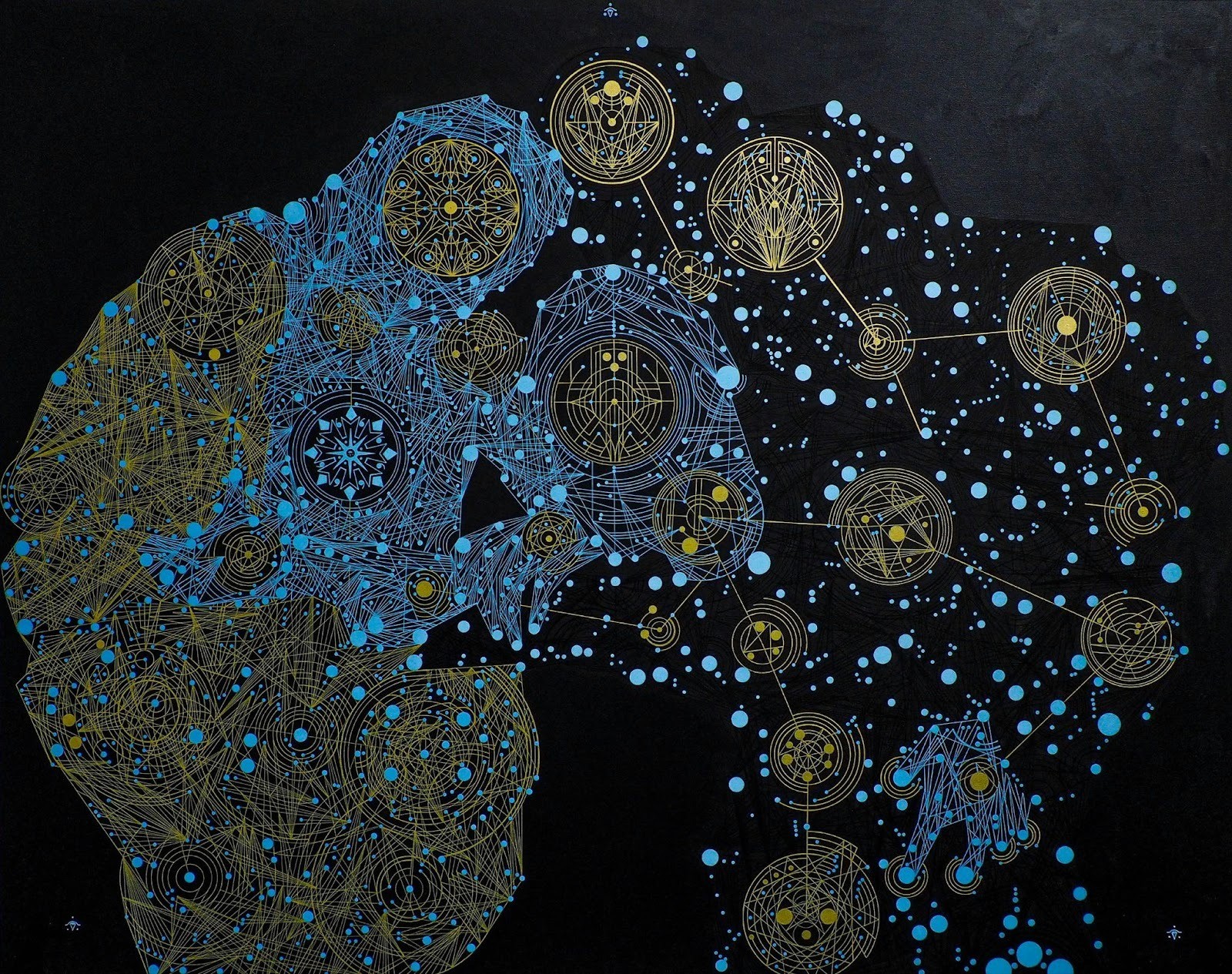
His paintings function as cognitive models within this system. Each work represents a node in a distributed network of intelligence, where geometry serves as a universal code linking matter, energy, and consciousness. Titles such as "The Divine Matrix," "The Cosmic Engineer," and "The Connection to the Cosmic Library" are not metaphors in the literary sense. They are visual schematics, structural diagrams rendered in acrylics and oils, designed to make complex systemic relationships perceptible.
Salakhov grounds this methodology in the integral logic articulated by Leonardo da Vinci: study the science of art and study the art of science. Over more than a decade, he has conducted systematic research across quantum physics, cybernetics, and systems theory, treating science fiction not as genre entertainment but as a methodological instrument for examining systemic dysfunctions and modeling adaptive strategies for civilization.
Space as a Civilizational Mirror
Salakhov's most significant written contribution to date is "Astral Space Exploration: The Fundamental Principles of Cosmocybernetics." The book addresses a question that accelerating technological capability is increasingly urgent: whether humanity, as a species, is adequately prepared for interstellar expansion. His answer is carefully constructed and deliberately uncomfortable.
Technical capability, he argues, is insufficient on its own. Persistent structural conditions such as conflict, ecological mismanagement, institutional imbalance, and fragmented ethical frameworks are not resolved through spatial expansion. When combined with increasing technological power, they are likely to scale in complexity and impact. Within this perspective, space is not treated as a domain of escape but as an environment in which existing cognitive, social, and technological systems are extended and tested under new conditions. The outcomes of such expansion depend on the degree to which these systems are internally coherent, adaptable, and aligned with long-term, integrative modes of organization.
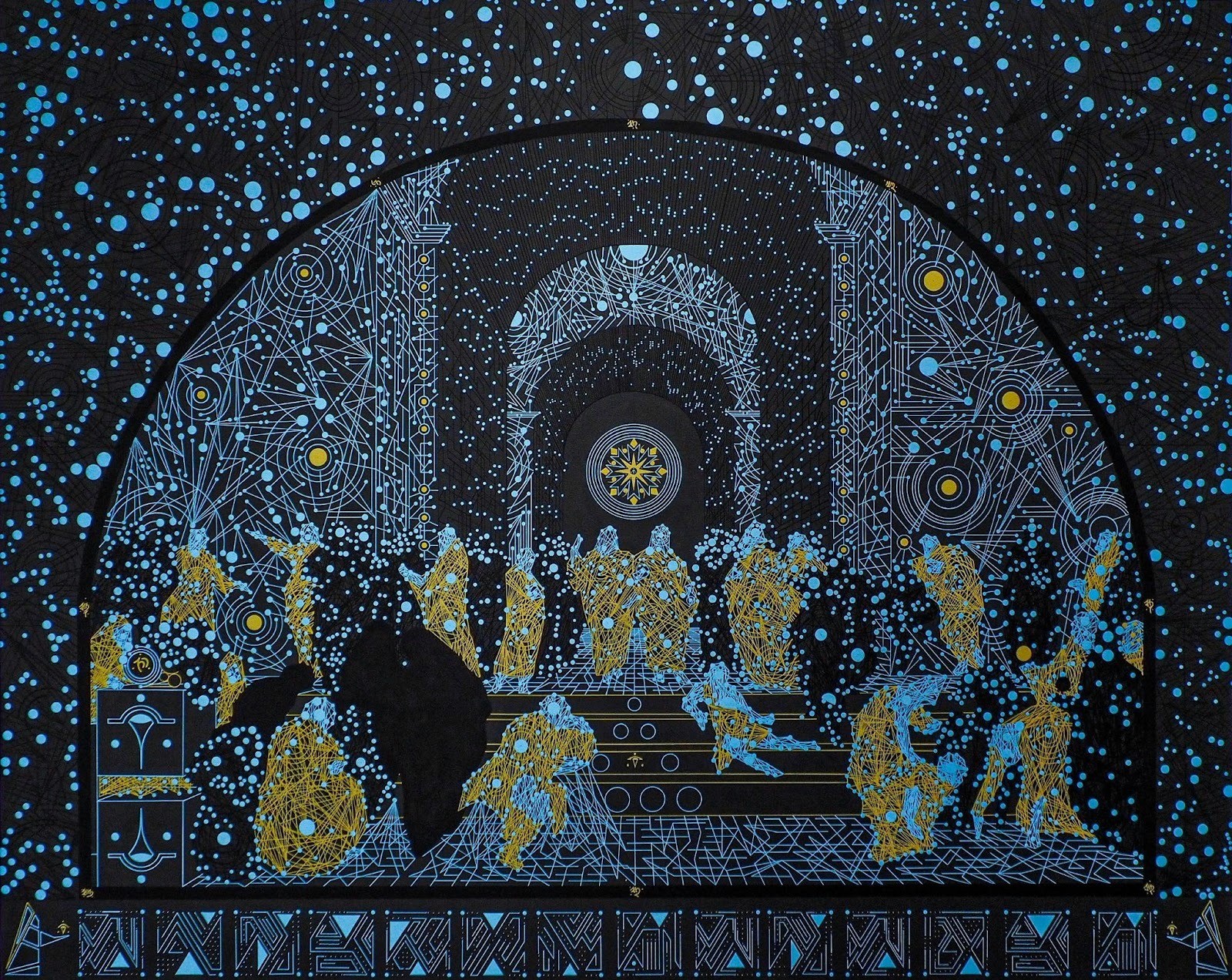
This argument is developed further through his visual series, particularly "The Cosmic Renaissance" and "The Astral Space Exploration: T.A.H.I.R.A - 108." These works do not propose utopian outcomes or dystopian warnings. They construct conditional future scenarios, emphasizing that the direction of human development remains contingent upon the alignment between accelerating technological power and the evolution of cognitive, ethical, and societal frameworks. The artist's role, as Salakhov defines it, is to formulate precise and necessary questions, not to offer reassurance.
International Recognition and Institutional Context
Salakhov's international exhibition history reflects the conceptual reach of his practice. He has presented solo exhibitions including "The Cosmic Revelations" in Parma and "The Cosmic Renaissance" in Dubai, and has participated in major global platforms such as Tokyo Gendai with Mizuma Art Gallery and Contemporary Istanbul. His work has been presented in contexts supported by the United Nations Office at Geneva, the Heydar Aliyev Foundation, and UNESCO, situating his research within conversations about technology, civilization, and long-term human development that extend well beyond the contemporary art market.
These institutional contexts are not incidental. They reflect the degree to which Salakhov's practice addresses concerns that transcend disciplinary boundaries. His exhibitions are not isolated events but nodes within a continuous conceptual architecture, each one advancing the same core inquiry through different visual and theoretical registers.
Why This Work Demands Attention Now
For collectors, institutions, researchers, and readers engaging with the intersection of art, science, and civilizational futures, Salakhov's practice offers something rare: intellectual coherence sustained across multiple disciplines over a long period. His refusal to separate art from responsibility, or aesthetic rigor from analytical purpose, positions his work as a contribution to long-term discourse rather than short-term cultural consumption.
The questions his paintings and books raise are not abstract. As artificial intelligence reshapes cognitive systems and space exploration transitions from aspiration to operational planning, the civilizational frameworks that will govern these developments remain largely unexamined. Salakhov's work exists precisely to examine them.
Explore More About Astral Space Exploration
Discover the full scope of Kaikhan Salakhov's research and visual practice at Astral Space Exploration, follow his ongoing work on X, and explore his visual archive on Instagram.