
Bruce Lee The Shaolin Mystic Explores Mysticism And Mastery
Bruce Lee The Shaolin Mystic explores mysticism, transcendence, and the unseen dimensions of human potential through Prof. Robert Stewart’s philosophical interpretation of Bruce Lee.
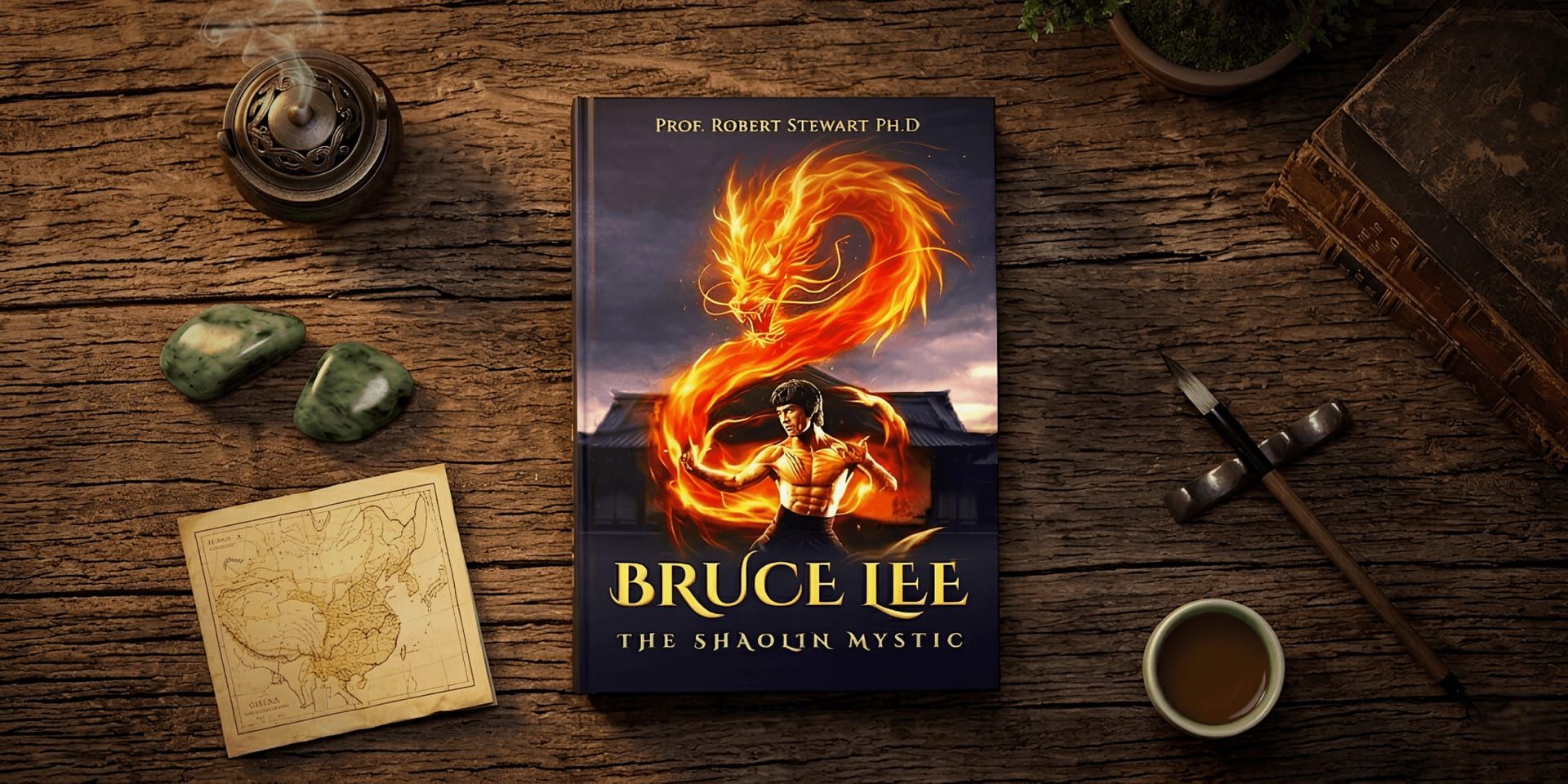
There is a version of Bruce Lee that history has made familiar: the martial artist, the film icon, and the voice behind widely quoted philosophies on discipline and self expression. Yet for Prof. Robert Stewart, Ph.D., that version only represents the surface of a far deeper inquiry.
In Bruce Lee The Shaolin Mystic, Bruce Lee is revisited not only as a master of physical discipline, but as a figure whose life invites exploration into mysticism, transcendence, and what the author describes as the “realm unseen.” Within this framework, Bruce Lee becomes less a fixed historical figure and more a catalyst for examining consciousness, identity, and human potential.
The work is presented not as a conventional biography, but as a hybrid narrative blending semi memoir, philosophical reflection, and martial arts history.
Mysticism, Discipline, And The Realm Unseen
At the center of the book is the idea that mastery extends beyond physical technique. Prof. Stewart explores Bruce Lee’s intellectual and philosophical evolution as part of a broader inquiry into awareness and transformation.
Bruce Lee’s documented study of Taoism, Shaolin influenced teachings, and philosophical texts is presented as evidence of a sustained intellectual pursuit that went far beyond martial training. His personal library, reportedly consisting of thousands of books across multiple disciplines, is referenced within the narrative as part of this deeper intellectual landscape.
Within the book, mysticism is not treated as abstraction. Instead, it is explored as a dimension of lived experience, where discipline becomes a pathway toward heightened awareness. Prof. Stewart frames this as a space where physical training, consciousness, and what he describes as the “realm unseen” begin to intersect.
In broader martial arts discourse, selected archival footage and widely circulated training clips are often referenced alongside Bruce Lee’s philosophy as part of ongoing discussions about perception, focus, and interpretive concepts such as chi and psychological influence.
At times, the book explores interpretations that position certain individuals at the outer edge of human potential, where physical ability, cognitive awareness, and philosophical depth appear to converge in uncommon ways. These ideas are presented as reflective inquiry rather than fixed conclusions.
From Structure To Fluidity: The Jeet Kune Do Philosophy
A key focus of Bruce Lee The Shaolin Mystic is the evolution of Bruce Lee’s martial philosophy from structured training in Wing Chun to the development of Jeet Kune Do.
Within the narrative, this shift is framed as more than technical innovation. It is presented as a philosophical transition from fixed systems toward adaptability, awareness, and personal expression.
Prof. Stewart interprets this development as part of a larger question central to the book: what happens when discipline becomes fluid rather than rigid, and when mastery is defined not by imitation, but by direct experience?
This perspective situates Bruce Lee’s philosophy as an evolving framework for identity formation, where structure serves as a foundation rather than a limitation.
Semi Memoir And Interdisciplinary Perspective
A distinctive element of the work is its semi memoir structure. Prof. Stewart integrates reflections from his own experiences in science, martial arts training, world religions, and music.
Holding a Doctor of Science in Astronomy and an honorary doctorate in World Religions, his academic and philosophical background informs the interpretive lens of the book. This allows the narrative to move between historical analysis and personal reflection, creating a layered examination of discipline and transformation.
Rather than presenting fixed interpretations, the text positions itself as an ongoing inquiry into how lived experience shapes understanding of mastery and consciousness.
Music, Improvisation, And Structural Rhythm
In addition to academic and martial arts influences, the book reflects the author’s background in music composition and performance. Prof. Stewart has worked as a multi-instrumentalist and producer, contributing to recordings under major label distribution and collaborating with recognized figures in the jazz music community such as Quincy Jones and Wynton Marsalis.
He draws parallels between musical improvisation and martial arts practice, highlighting how both require presence, responsiveness, and the ability to move beyond fixed patterns.
This approach reinforces one of the central ideas of the book: mastery is not static, but continuously responsive to context and experience.
Reframing Mastery In A Contemporary Context
In a modern environment often defined by external validation and measurable performance, Bruce Lee The Shaolin Mystic offers a different perspective.
It emphasizes internal clarity, adaptability, and reflective awareness as essential components of mastery. Rather than focusing solely on achievement, the book explores how discipline can become a method of inquiry into consciousness itself.
This framing places Bruce Lee’s philosophy within a broader interdisciplinary conversation about human potential, identity, and transformation.
Editorial Positioning And Intended Readership
The work positions itself within a niche intersection of martial arts history, philosophical exploration, and personal narrative. It is designed for readers interested in examining how structured disciplines evolve into individualized systems of thought and practice.
Rather than offering prescriptive conclusions, the book encourages reflection on how meaning is constructed through experience, discipline, and awareness.
Reader Access And Ongoing Work
Bruce Lee The Shaolin Mystic presents an exploration of how mastery is understood across physical, intellectual, and philosophical dimensions.
Additional information about Prof. Robert Stewart’s work and related interdisciplinary projects is available through his official website.
The publication is also listed on Amazon for reference.
Further publicly accessible materials and updates are also available on Instagram, X (formerly Twitter), YouTube, and Facebook.