
NeuroGuard+ Reframes The Athlete Mouthguard
One dentist’s jaw-alignment discovery is changing how athletes think about protection and performance.

The NeuroGuard+ Mouthguard Origin Story
Josh Bell was building another productive season for the Minnesota Twins when a quieter part of his routine began drawing attention beyond the clubhouse. It was not a new bat, swing drill, or recovery device. It was the NeuroGuard+ mouthguard, a lower-teeth athletic guard created from an unexpected dental insight in Michigan. For athletes, parents, and coaches worried about head impact, the story lands with force: what if a mouthguard could be designed not only to protect teeth, but also to support physiologic jaw alignment during competition?
The NeuroGuard+ mouthguard began in the dental office of Dr. Michael Hutchison, a Michigan family dentist who treated patients with TMJ disorders. During that work, he noticed a pattern that did not fit the usual dental script. Patients who had their jaw alignment corrected often returned with reports that reached beyond pain relief. They said they felt stronger, stood steadier, tired less quickly, and performed better under physical stress.
“I had patients coming back telling me they could lift more weight, run longer, recover faster,” Dr. Hutchison recalls. “At first, I thought it was coincidental. But it kept happening.”
That repeated observation became the seed of NeuroGuard+. Dr. Hutchison began studying the relationship between jaw position, body mechanics, and impact forces. His belief was simple, but ambitious: the jaw is not an isolated structure. It is connected to posture, breathing, neuromuscular response, and the way the body absorbs stress. If an athlete could maintain a more physiologic jaw position during play, the body might respond differently during contact and exertion.
The first real-world signal came from a 65-year-old powerlifter who used an early version of the device and broke a world bench press record that had stood for 10 years. That did not prove the entire theory, but it did enough to push the idea forward. Later, according to the company, independent biomedical engineers at Wayne State University measured an average 16.8 percent strength increase among participants using Dr. Hutchison’s device. For a dentist working from clinical observation, it was a turning point.
“All mouth guards help keep you from breaking your teeth,” Dr. Hutchison says. “But the NeuroGuard+ can lower the G-Force impact to your brain.”
Today, the NeuroGuard+ mouthguard is described as a patented, do-it-yourself home device that customizes around an athlete’s bite. Unlike traditional mouthguards, it fits on the lower teeth. The company says that lower arch placement is intended to help athletes breathe, speak, and compete while maintaining physiologic jaw alignment. The goal is not to replace good coaching, proper technique, or medical evaluation. It is to give athletes another layer of equipment designed around how the body functions under pressure.
Why Athlete Safety Needed A New Question
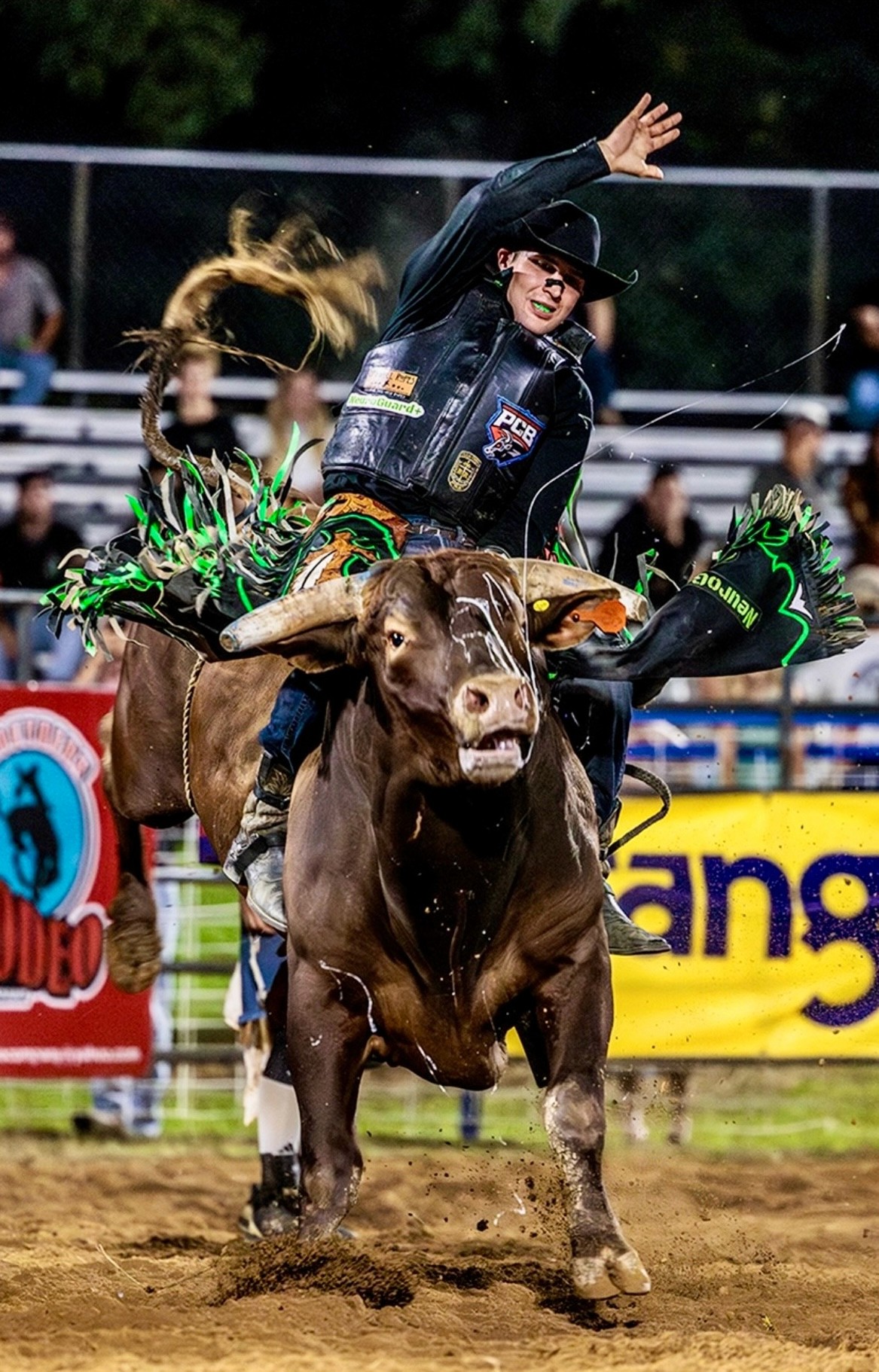
Alex Goins, professional bull rider, wearing the NeuroGuard+ device.
For decades, mouthguards were treated as basic protective gear. Their purpose was clear: protect teeth, gums, and oral structures from direct trauma. That role still matters. Yet the rise in public awareness around concussions has changed the conversation. Parents want answers. Coaches want tools that fit within rules. Athletes want protection that does not interfere with performance. The NeuroGuard+ mouthguard entered that environment with a different question: what happens when jaw alignment becomes part of the safety equation?
Dr. Hutchison’s team points to more than 20 years of work with thousands of athletes across youth, high school, collegiate, and professional sports. The company reports that its tracked data shows a substantial reduction in concussion incidence among NeuroGuard+ users. Because concussion risk is complex and depends on many variables, the most responsible way to state the claim is this: NeuroGuard+ is designed to help reduce the transfer of impact forces by supporting physiologic jaw position, and company data, white papers, and testimonials support further study of that approach.
A new white paper by Dr. Alan Pearce of Australia examines the science behind jaw alignment and impact force distribution. The idea centers on how impact forces may travel through the jaw, skull, and cervical structures. By encouraging a more stable jaw position, the NeuroGuard+ mouthguard is designed to reduce and dissipate certain forces during collision. That design is especially relevant in sports where contact is sudden, repetitive and unpredictable.
The device has also entered the conversation at the high school level. In a recent press release, the National Federation of State High School Associations said, “The NFHS has determined that the NeuroGuard+ football mouthguard is permissible for use under the 2026 NFHS Football Rules, opening the door for millions of high school football players to wear the innovative lower-jaw mouthguard.” The statement also noted that the lower-teeth design may allow athletes to breathe and communicate with fewer limitations than traditional upper-jaw mouthguards.
This matters because adoption in sports depends on more than a clever product. The equipment must work in real conditions. It must fit rules. It must be simple enough for teams to use. It must make sense to parents who are choosing gear for young athletes. NeuroGuard+ has built its value around those needs, positioning the mouthguard as a safety-minded and performance-conscious option for athletes who compete in football, hockey, baseball, cheerleading, bull riding, softball, and strength sports.
The NeuroGuard+ Mouthguard Performance Edge

Dr. Michael Hutchison, inventor of the NeuroGuard + device.
The NeuroGuard+ mouthguard has drawn attention because its story is not limited to safety. Athletes also describe performance benefits tied to balance, strength, agility, oxygen intake, and the ability to communicate while wearing the device. Those claims are best understood as reported outcomes and areas of ongoing research, not universal promises. Still, the pattern has been strong enough to attract users from several demanding sports.
Josh Bell of the Minnesota Twins is one of the most visible names connected to NeuroGuard+. The intake materials note that Bell is leading his team in runs batted in this season, and his use of the device adds a major-league spotlight to a product that began in a Michigan dental practice. For baseball players, where balance, rotation, strength, timing, and recovery all matter, even a small edge can become meaningful over a long season.
Other featured athletes point to the range of use cases. Alex Goins, a professional bull rider, competes in a sport that is among the most dangerous in the world and where success is defined by impact and split-second reaction. Oliver Chau, an NCAA Division I national champion hockey player, faces speed and contact on the ice. Travis Shouse, a national collegiate super heavyweight powerlifting champion, represents the strength side of the story. McKenna Roush, a national cheerleading grand champion, brings attention to high-impact stunting, landing, and balance.
Those examples give NeuroGuard+ a broader identity than a single-sport product. It is not merely a football mouthguard, although football may be one of its most urgent markets. It is a jaw-alignment device built for athletes who need protection without losing breath, speech, or confidence. In that sense, its lower-teeth design becomes more than a feature. It becomes part of the benefit.
Sports professionals have also taken notice. Dr. David Todd, a Certified Chiropractic Sports Physician, and Kelly Ahrens, an NCAA Division I softball coach and founder of Test and Train Sports, are among the experts connected to the product’s use in athlete training and safety settings. Their involvement reflects a larger shift in sports performance: the best solutions often sit at the intersection of disciplines. Dentistry, biomechanics, chiropractic sports care, coaching, and athlete feedback all have a role.
NeuroGuard+ is different because it began with a clinical mystery rather than a marketing trend. Dr. Hutchison did not start with a slogan. He started with patients who kept saying something had changed for the better. Over time, that observation became a device, then a patent, then a growing body of athlete stories and research materials. The result is a product that speaks to a deep desire in modern sports: compete harder, but protect smarter.
The company’s message remains direct. Every athlete has a unique anatomy. Every sport carries different risk. No device can remove all danger from competition. But the NeuroGuard+ mouthguard offers parents, athletes, trainers, and coaches a practical way to explore physiologic jaw alignment as part of a broader safety and performance plan.
For athletes who want equipment built around both protection and performance, NeuroGuard+ is worth a serious look. Those interested may explore the research, compare the design, review the athlete stories, and see how a lower-teeth mouthguard may fit their sport, team, or training routine. Connect with NeuroGuard+, LinkedIn, Facebook, YouTube, and Instagram.