
Shadan Kapri: The Story Behind The Red Movement
An attorney and author builds her life’s work around justice, purpose, and the human cost to silence.
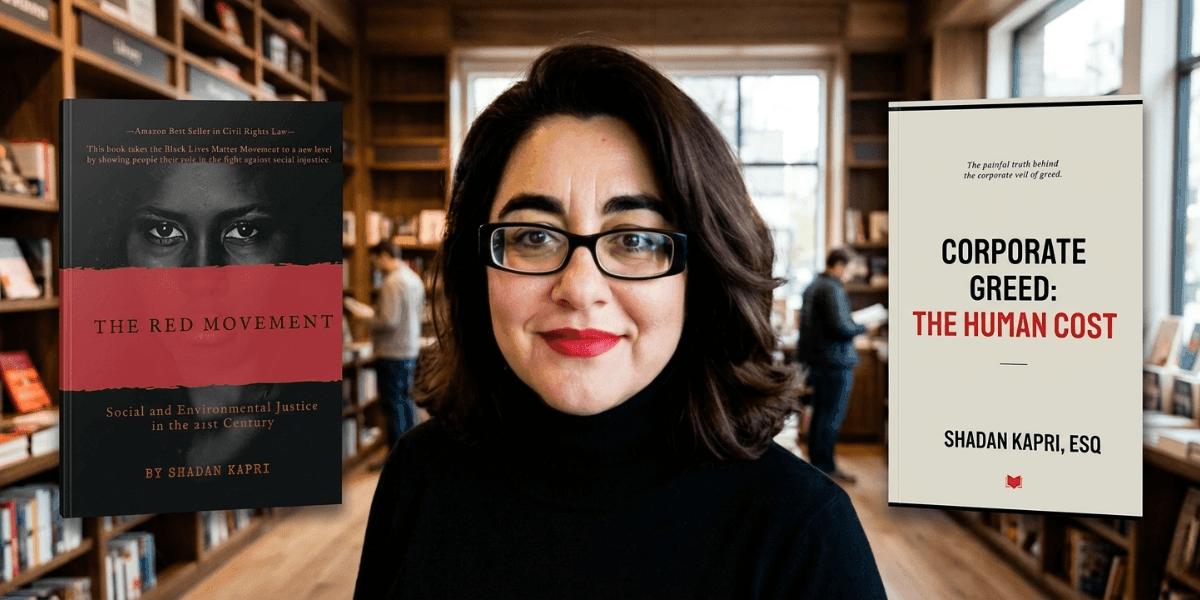
Shadan Kapri (pronounced Shah-don Capri) has built her career on a simple but unsettling truth: silence has a cost, and someone always pays the price.
As an attorney, author, and human rights advocate, Shadan moves between the courtroom, the literary world, and the global stage with a clarity of purpose that feels increasingly rare. Her work is rooted not in theory, but in lived experience — a childhood shaped by displacement, a family shaped by revolution, and a worldview shaped by the consequences of unchecked power.
Shadan was three when her parents fled the 1979 Iranian Revolution, resettling in Washington State, where her oldest brother was in college at the time. The family never intended to stay. “My parents, especially my mother, always wanted to go back,” she says. “Living in the U.S., far from her family, was never the goal for my mom or for millions who were forced to leave and scatter throughout the world.”
One of Shadan’s earliest memories was watching her mother receive letters from home. “They came in those special international envelopes with the red and blue striped borders back then. I still remember my mom’s happiness whenever one arrived. The pure joy on her face is still etched in my memory.”
That early rupture between homeland and exile, belonging and loss became the quiet foundation for her life’s work. “Being a child of immigrants and understanding why my parents left their beloved homeland has fueled my work,” she says. “What has been done to Iranian women, children, and men over the past 47 years is indescribable. Being born there made me acutely aware of human rights issues.”
But Shadan’s mission is not confined to Iran. “The fight for women’s rights and human rights is global,” she says. “Women everywhere face exploitation and abuse. It’s my calling to bring these issues to light.”
That calling now spans multiple platforms. Through Kapri Law & Consulting, she works with clients navigating complex legal circumstances. Through her global initiative, The Red Movement, she pushes audiences to confront the systems — political, environmental, economic — that shape their lives. And through her writing, she offers a framework for understanding how individual choices intersect with global forces.
Her first book, The Red Movement, released in 2020 became an international bestseller, introducing readers to her central thesis: social and environmental justice are inseparable, and accountability begins when ordinary people refuse to look away.
Her second book, Corporate Greed: The Human Cost, released in 2025 takes aim at the consequences of profit without ethics. It is a blunt examination of what happens when corporations prioritize growth over humanity and the human rights violations that can follow.
Her forthcoming book, If They Only Knew: A Story of Loss, Love, and Revolution, will be her most personal. Blending memoir and historical narrative, it traces her journey from a childhood uprooted by violence to a lifelong search for meaning and purpose in a world full of contradictions.
What makes Shadan’s work distinct is the way she bridges roles that rarely intersect. Attorneys fight for outcomes. Authors shape narratives. Advocates mobilize public attention. Shadan does all three and treats justice not as a profession, but as a lived responsibility.
Her approach is both practical and philosophical. Her legal practice offers tangible support. Her writing provides context. Her public platform connects the two, creating a rare continuity between advocacy, education, and action.
At a moment when public discourse often rewards outrage over understanding, Shadan insists on depth. Her work asks uncomfortable questions: What does fairness require? What does courage look like? What happens when people stop paying attention?
That same commitment carries into The Red Movement, the platform she created to spotlight social and environmental justice in the twenty-first century. The Red Movement is not abstract theory. It is a practical invitation to think about accountability, systems, and everyday decisions. It stands for a consistent message: justice begins when people refuse to look away. And that is the message she continues to share worldwide including at the Women Changing the World Summit in Paris recently.
“This is my life’s purpose,” she says. A truth forged in exile, sharpened by history, and handed down through generations who refused to be silenced. “Without a shadow of a doubt.”
To learn more about her work in international human rights, visit The Red Movement, Kapri Law, LinkedIn, or Instagram.